Q&A
20 years later, Moishe House’s founder has aged out of its demographic — but not out of the job
Mem Global’s David Cygielman discusses diversifying donors, setting lines on Zionism and working with Ukrainian Jews
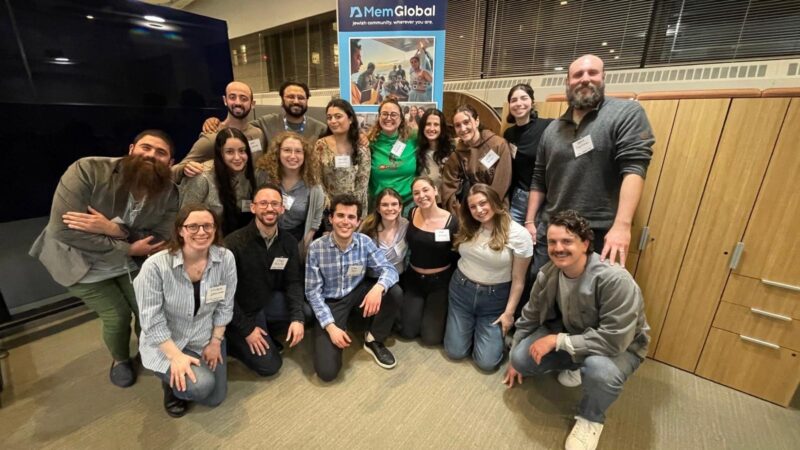
Courtesy/Mem Global
David Cygielman (top right) with New York City-based Mem Global participants, in an undated photograph.


 Add EJP on Google
David Cygielman was 26 when he and a group of friends held the Shabbat dinner in Oakland, Calif., that would serve as the inspiration for Moishe House, an initiative christened by The New York Times as the “‘Real World’ — the MTV series — with challah.”
Twenty years later, there are over 150 Moishe Houses — offering rent subsidies to young Jews living together who, in turn, organize Jewish communal programming and events for other young Jews living nearby — and pods in more than 25 countries engaging over 42,000 people last year. Last year, the organization rebranded itself as Mem Global and it now includes multiple spin-offs, including Moishe House Without Walls, Embark, Camp Nai Nai Nai, Base, Learning Retreats and the Jewish Learning Collaborative. Every offshoot serves post-college-aged Jews, a demographic that Cygielman, a husband and father who serves as Mem Global’s CEO, no longer fits into.
“There was a black hole, a void in Jewish life for this post-college, pre-settled-down [age group],” Cygielman told eJewishPhilanthropy. “We were the consumers. We were the users of it.”
Today, Moishe House makes up one-third of Mem Global’s $20 million budget, with the other initiatives dividing the rest. The majority of Mem Global’s programs are launched by alumni or alumni-adjacent Jews, such as friends or siblings of Moishe House alums.
“We want to make sure that our focus is our mission, not only our programs,” Cygielman said, echoing advice Barry Finestone, the Jim Joseph Foundation’s president and CEO, told eJP in October. When someone is in love with a mission and not a program, he said, they can pivot and innovate, not get stuck on something that is stalling out.
Mem Global is celebrating 20 years the same way it began, with Shabbat dinner — this time, over 300 of them around the world throughout November. “We’re not a suit-and-tie gala organization,” Cygielman, who loves a good brisket and matzah ball soup, said. “It’s just not who we are. We like to bring people together in the homes.”
Cygielman spoke with eJP about the lessons he’s learned over two decades, including the importance of research, expanding beyond one funder, the impact of the war in Ukraine on Mem Global programs in the region and setting boundaries around Zionism.
The interview has been lightly edited for length and clarity.
Jay Deitcher: What did you learn in the early years?
David Cygielman: In the early years, our first grant from the Jim Joseph Foundation was funding to do an evaluation, and I thought to myself, ‘We need funding to keep the lights on.’ [I had] never done an evaluation. It turned out to be such a great gift. We learned that the majority of people coming to and living in Moishe houses didn’t grow up doing the things they’re now leading. So we had a huge opportunity to create immersive experiences that would give young adults the confidence and skills to create and lead Jewish life, the calendar, holidays, rituals out of their homes for their peers.
We learned that there were a lot of people who want to do Moishe House-style programs and have Moishe House-style leadership, but don’t have the sort of time or ability to live in a Moishe House, so then we created things like Moishe House Without Walls
We also learned that we’re filling a Jewish need and a human need for young adults, and that human need and Jewish need was universal around the world. So, [we worked to ] say, ‘How are we going to be able to serve young Jewish adults throughout the world? The majority of our work, two-thirds, is in the U.S., but we’re in 30 countries now.
We were uniquely unqualified to do any of this stuff, so we had to really learn along the way, and one of the things that we learned was we have to surround ourselves with really smart, great people, and the funders have been amazing. The board has been terrific in helping us do this work and do it better and do more of it.
JD: You started out with one funder, psychologist and hospital administrator Morris Bear Squire, hence Moishe House, and then you had to diversify. I want to hear about that.
DC: Morris had two rules: no board of directors and no outside funders. I thought they were great rules until we found out [that] there’s a reason why having diverse funding and a board of directors helps you as an organization.
When Morris had committed to giving all of the interest away on his corpus, and he had about $20 million, and to me a million dollars a year was a bigger budget than I could have ever imagined anyone having. We were just out of college, and so when 2008 happened, and there was a financial collapse, and there was no more interest on the money, and we were operating fully out of his foundation, it was really tough, but we were young enough and had so little experience in the world that we didn’t know any better. That was a huge advantage for us because we didn’t have mortgages; we didn’t have our kids to feed and get to camp and do all these things. We were at a phase in life where it all felt like it was part of the adventure of building something special.
JD: So you’re no longer the man who started this organization. You aged out of Moishe House, which serves young adults up to 32 years old. In 2010, you told The New York Times that you were determined to avoid a top-down organization of many Jewish charities. Now you have all these funders giving you advice, and you’re dealing with a lot of voices that are not part of Moishe House’s demographics. How do you weigh all that?
DC: The biggest thing is having the leadership of the teams represent the programs that they’re running. Houses and pods, they are run by young adults. A big percentage of the community managers are former residents. They finished being a resident and then they moved in.
The young adult volunteer leaders are going to be reflective of the staff, and the participants are going to be reflective of the young adult volunteer leaders. A lot of my work is now connecting the dots and finding ways to say yes to as many talented young adults as possible.
I never lived in a Moishe House. I’ve never actually been the one to do any of the work. My job along the way has always been to find ways to say yes to really talented young adults who want to build and create things for their peers.
JD: How did you choose where to branch out, both in where to put Moishe Houses, but also what programs to branch out to over the years?
DC: One thing we always want to be doing is following demand, not creating supply. So we want to spend as little time and money on recruitment as possible, and as much time and money on making great programs as possible. We’ve been able to pilot things in really fast, inexpensive ways that we can then decide what’s the feedback loop on this? How is it being received? Do people want more of it?
The other thing [about] my saying yes to people is that it’s not enough for a good idea to exist in the world, someone has to execute that good idea and so we also try to only do things where we feel like there’s someone who is so motivated to make it great because we’re investing in the idea and the person.
JD: In an eJP editorial a decade ago, a former Moishe House leader said that your aim at the beginning was to serve underserved Jewish communities and not go into oversaturated hubs like L.A. and New York. You were quoted by him as saying they were low-hanging fruit. And today Moishe Houses are often in the hubs, not the smaller communities. What led to that pivot?
DC: We should be where young Jewish adults are. There are more young Jewish adults in New York than anywhere else, so we should have our biggest presence there. We’re also able to have a Moishe pod in Tulsa, [Okla.] [and] Moishe House Without Walls hosts in Salt Lake City, so it should be proportional to the populations that we serve. We have now multiple models, based on the size of the cities and communities.
JD: How do you support people when something like the war in Ukraine happens?
DC: We had seven Moishe Houses in Russia and a house in Belarus. There are no Moishe Houses in Russia or Belarus anymore. It got to the point where the residents had to say, “We have too high of a risk. We’re not allowed to receive funds. We could go to jail for it.”
We’ve worked very hard to support [folks] in Ukraine. We haven’t shrunk there at all. We have four houses and pods. We have gotten all of the houses generators. One of the things that we found is that [houses were] using too much electricity to be able to have things during the day and then host at night. What we didn’t realize is that those generators [have] become hubs. When we look at [an] evaluation [that] we just did, 25% of the respondents chose Russian as their language to do [the evaluation] in and Ukraine was the highest country outside of the U.S. for evaluation responses. People are going there to charge their phones and their computers, and the residents asked them to fill out the evaluation while they were juicing up their phones.
We’ve also expanded our Russian-Speaking-Jewish work in Israel. There’s more and more folks from Ukraine and Russia and Belarus who have moved there. Before the war, the Baltics was not a big place for Mem Global, but now there are three houses and pods in the Baltics because of people moving there from Russia, Belarus, and Ukraine. There continue to be young Jewish adults who need our investment and support there.
JD: Mem Global has been accused of being too progressive by some, but then it fired an employee for her connection to the anti-Zionist organization Jewish Voice for Peace. How do you set lines, especially dealing with young adults straight out of college, when one of your catchphrases is that there’s no one way to be Jewish.
DC: What we’ve learned is that we have to have policies. There are guardrails. They’re critical to maximize the number of young Jewish adults we serve. Our goal is not to demonize the folks who might not fall within our policies and goals, but we want to stick to them.
We’re not partnering with [organizations] that support racism, homophobia, not supporting Israel as a Jewish democratic state or proselytizing Jews away from Judaism or supporting BDS.
In addition to policies, we have goals. Talking about Israel, we have a goal that we want to build positive and lasting relationships [between] young Jewish adults [and] Israel and Israelis. So we have to ask ourselves: if something comes to us, is that going to help achieve our goal of doing that? Prior to Oct. 7 in North America, we had nine Israeli residents. There are over 50 now.
There’s also a difference between the programs that we’re leading and the people that we’re partnering with, and the people who we allow or welcome at our Shabbat tables or our program tables, and those are different things. We have to be very clear about the programs and partnerships, and be a welcoming place to a wide swath of backgrounds and experiences.
JD: How do you ensure you aren’t in a situation like Emory Hillel in Atlanta was in last month, where they had a rabbi uproot her life for a job but then fired her, with her saying she was fired due to her fiancé’s activism against Israeli settlements in the West Bank and violent attacks by Israeli extremists against Palestinians and their supporters.
DC: We can only control what we can control, and our work, strategy and goals is always to be transparent up front. So, for example, the policies that I shared, those are the same policies for the staff, for the residents, for the Moishe House Without Walls host. We all read it. We all sign it. And we’re all working towards it.
Also part of it is trying to be in relationship with all the folks that we’re serving. If there is a direction that some people don’t agree with, because that’s always going to happen, we’re at least wanting them to understand where we’re coming from and why and that we would apply that across the board.
JD: It’s interesting to see you inspire other organizations like Abrahamic House in Washington, a multifaith iteration of Moishe House, that you helped get off the ground. What lesson was learned from an experience like that?
DC: It was awesome that when [Abrahamic House founder] Mohammed [Al Samawi] came to the U.S., he was sleeping on the couch in Moishe House DC, and that’s where that idea came from. We were like, ‘Here’s everything that we have. Here’s all the handbooks, and I’ve served on the board, and we introduce him to our funding partners. The more the better.
Our mission is to maximize the number of young Jewish adults [who] are having great experiences, so it’s a good thing when something like Abrahamic House exists, and there’s a whole population of young Jews amongst others who find their place and find community and are engaging in those ways. Our goal isn’t the biggest Mem Global possible. Our goal is the most-young Jewish adults possible engaged.
JD: When you were 26, did you imagine you would be where you are now?
DC: I think the key to happiness is having low expectations. I never wanted to have a budget more than $2 million because I felt like that was just going to be impossible. I thought having staff is such a responsibility. I didn’t want to go past five [countries]. I thought if we could be in five countries, that would really make us global. So every day I’m in shock and awe of all the things happening. There are like 15,000 programs a year, almost 100,000 participants. I’m totally blown away by it.
Related News

MAGICAL EXPERIENCE
Shefa launches psychedelics retreat for Jewish professionals suffering burnout
EXIT INTERVIEW
Elizabeth Sokolsky, longtime EVP of Birthright Israel, to retire next year
ADVANCING A VISION
N.Y. federation donates $1M toward building shared-society center named for peace activist killed on 10/7
CLOSING WORDS
In AZM address, Cosgrove links communal ‘orthodoxy’ on Israel to rising anti-Zionism among young Jews
HIGHER EDUCATION
As Jewish donors reconsider academia, Jan Koum doubles down, endowing Israel studies at Stanford