ON THE SCENE
Weitzman Museum honors Wilfs for ‘Only in America’ rags-to-riches story, deep communal ties
The Philadelphia institution raised $3 million as it aims to raise $100 million for a major overhaul of its core exhibits
Don Pollard
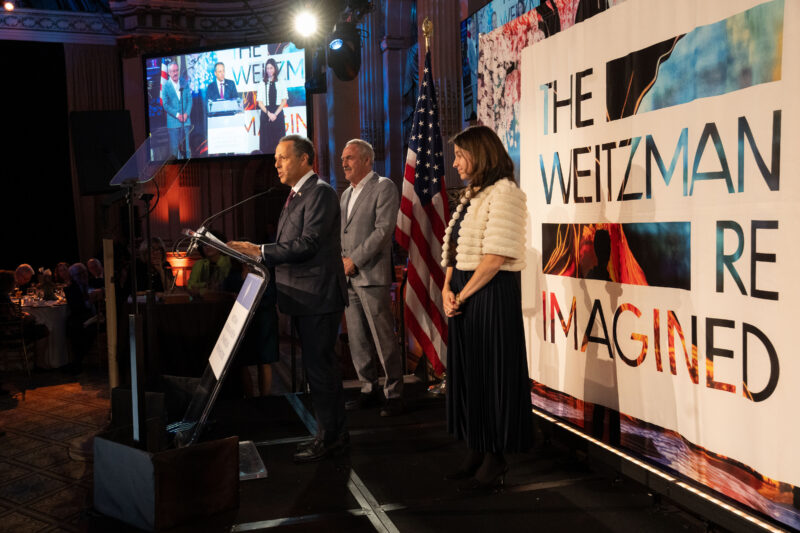
Mark Wilf speaks on stage at the Weitzman Museum gala dinner at The Plaza hotel in New York City on Nov. 16, 2026.


 Add EJP on Google
It was a family affair at The Plaza in midtown Manhattan on Monday night as the Weitzman National Museum of American Jewish History honored four generations of the Wilf family — descendants of Holocaust survivor-turned-real estate moguls Harry and Joseph Wilf.
For decades, the Wilf family, which also owns the Minnesota Vikings NFL team, has been helping build and support Jewish communal institutions, from Yad Vashem and the Jewish Federations of North America to Yeshiva University and the Weitzman Museum.
At its gala, the museum presented representatives of three of the four generations with its “Only in America” award (matriarch Elizabeth Wilf, 94, was not able to attend). Other recipients include Emma Lazarus, Leonard Bernstein, Louis Brandeis, Albert Einstein, Golda Meir and Menachem Mendel Schneerson. This marked the first time that an entire family received the distinction.
“Across four generations now, one principle remains constant: When there is a need, a Wilf responds, ‘Hineni — here I am,’” Mimi Schneirov, a Weitzman board member, who introduced the prize, told the several hundred museum supporters in attendance.
The gala comes as the museum, which opened in its current form in 2010, is looking to overhaul its main exhibitions and expand its offerings outside the building. To do so, the museum is more than halfway through a $100 million capital campaign, dubbed “The Weitzman Reimagined.” Monday’s event raised more than $3 million for the museum, for the campaign and general operating expenses, Jacqueline Glodstein, the Weitzman’s chief development officer, told eJewishPhilanthropy on the sidelines of the event. “The evening exceeded expectations,” she said, noting that they had set a goal of raising $2.5 million. “We’re very pleased and feel very fortunate and honored.”
In addition to the funds raised, Glodstein, one of the main organizers of the event, said that she was thrilled to have offered the attendees a chance to experience what the museum has to offer by featuring a dance performance based on one of its new offerings, “Colors of Creation” — an exhibit aimed at families. “It’s not exactly the ‘Colors of Creation’ exhibition, but it certainly was indicative of that immersive, interactive experience,” she said.
As attendees noshed on herb-crusted beef fillets on tables adorned with floral arrangements in the shape of the Liberty Bell, Phil Darivoff, Weitzman’s chair emeritus, updated them about the museum’s efforts to become a full part of the Smithsonian Institution. (It is currently an affiliate.)
Last month, a commission was created — with Darivoff as chair and author Dara Horn as co-chair — to examine the matter and present recommendations to the president and Congress, which must approve the measure.
“With the commission underway, we have cleared a huge hurdle. Yet there are three major tasks ahead of us,” Darivoff said. “First, we need to submit our report and secure another act of Congress. … Second, whether we’re part of the Smithsonian or not, we must be uniquely outstanding. This museum, which was designed about 20 years ago, is not the museum we need today. We must reimagine our museum… And the third and final element, given the financial pressures in Washington — and our own desire to control how our story is told — we cannot be reliant on government officials or taxpayers for the Smithsonian for our future. We cannot become a burden when it is our goal to bring a blessing to our nation.”
Accepting the museum’s “Only in America” award on behalf of the family, Mark Wilf, the immediate past board chair of the Jewish Agency and a former board chair of the Jewish Federations of North America, stressed the distinctly American trajectory of his family. His father and uncle arrived in the United States after the Holocaust with little, and by seeing the opportunity in the GI Bill, which helped many American families get a mortgage to purchase a home, they were able to build a massive real estate empire, Garden Homes.
“They raised us to understand that the life they built was not inevitable. It was an opportunity. And opportunity carries the responsibility to give back and to make sure others have the same chance this country provided them,” Wilf said.
Acknowledging Schneirov’s description of the family credo, Mark Wilf said that this was a lesson that he and his brother and their first cousin, Leonard, learned from their parents. “We are committed to living it and passing it along to the generations that come after us,” he said.
To honor the Wilfs’ history, the museum had the Polish Mi Polin Judaica Center visit the family’s former homes in Poland and make mezuzot out of the impressions left in the doorways from the mezuzot that had originally been hung there.
Wilf stressed the need for the museum in light of rising antisemitism. “The generation that lived through the Holocaust is leaving us, and antisemitism is rising again in places we never imagined we would see it,” he said. “A museum like this keeps memory alive, and memory is how we protect and build a better future.”
In his remarks, Weitzman President and CEO Dan Tadmor similarly argued that the museum served a critical function in combating antisemitism — something that the institution was not initially built to do.
“There are fewer and fewer places where we can all agree on what is real and what isn’t. Facts are challenged. Memory is contested,” he said. “A museum must be different. Because here, claims must stand beside evidence. Objects carry memory. Testimony has weight. Scholarship matters, and complexity is not something to edit out; it is the point.”
Both Tadmor and Wilf also highlighted that the museum not only tells the story of American Jews but of the way in which they are a critical part of the country.
“The Weitzman preserves our story and the stories of so many Jewish families who came to America seeking safety, dignity and opportunity. It teaches the next generation — Jewish and non-Jewish — that Jewish people are part of the fabric of America, preserving and sharing that history is essential to telling the full American story,” Wilf said.
One of three new exhibits opened at the museum in the past year is one dedicated to contemporary antisemitism, featuring testimonies of survivors. Glodstein said that this new permanent exhibition was not something that was even considered when the museum first opened.
“We need to be responsive to the times. We need to be relevant,” she said. “We are redoing the core [exhibitions]. It’s 15 years old, and lots has changed. We created the new exhibition on contemporary antisemitism. There wasn’t a full gallery [on the subject] in the old core because it wasn’t really on the radar.”
Speaking to eJP on the sidelines, Arthur Sandman, the museum’s COO, noted that the museum has faced antisemitism both directly and indirectly in recent years. In August 2025, the outside of the museum was vandalized, and it was again in August 2026. Sandman said that the museum has also, at times, seen marked drops in attendance following antisemitic attacks elsewhere, such as the deadly shooting attack outside the Capital Jewish Museum last May.
Glodstein stressed that combating antisemitism is not a core part of the museum’s mission. Instead, she said, through education, “it is a natural product in what we do.”
While some Jewish museums have struggled to raise funds in the wake of the Oct. 7 terror attacks — as Jewish communal interests were pulled elsewhere — Glodstein told eJP that the museum has “been able to make a case for ourselves.”
Glodstein said that the museum’s goal of joining the Smithsonian is not a financial one, with no clear indication that joining the institution would be accompanied by a windfall. Instead, she said, it was a matter of validation, and not only for the museum.
“It has to do with the fact that the Smithsonian is an endorsement, not just of the museum, but of the Jewish People’s place here, in these United States of America, and what we have contributed and what we have received in terms of opportunity, freedom of speech, freedom, of economics, freedom of opportunities.”
Related News
ADVANCING A VISION
N.Y. federation donates $1M toward building shared-society center named for peace activist killed on 10/7
HIGHER EDUCATION
As Jewish donors reconsider academia, Jan Koum doubles down, endowing Israel studies at Stanford

EXCLUSIVE
Detroit-based philanthropists Nancy, James Grosfeld donate $8M to renovate JDC’s Israel campus

MAJOR GIFTS
Center for Jewish History celebrates 25 years with a $25M matching grant

MAGICAL EXPERIENCE
Shefa launches psychedelics retreat for Jewish professionals suffering burnout