WHAT YOU SHOULD KNOW
Emory Hillel’s rabbi firing should have been avoided by vetting candidates, experts say
Wikimedia
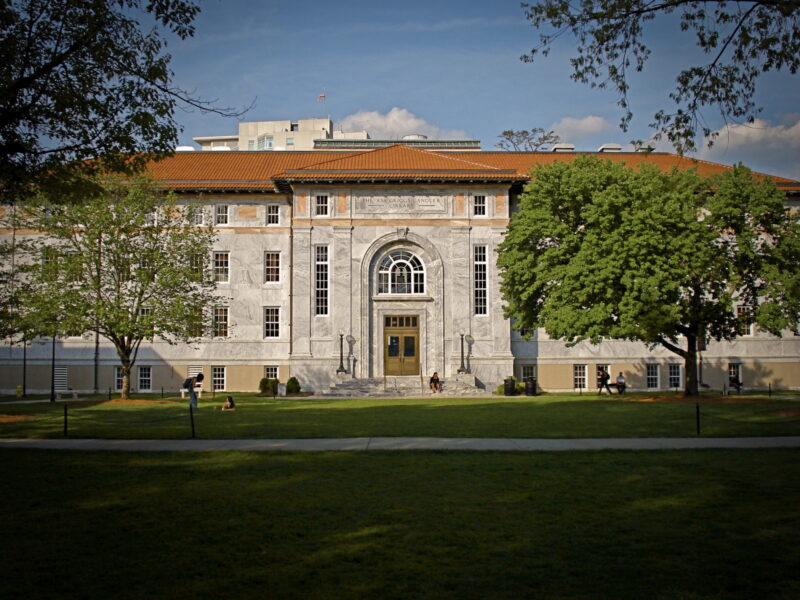
Emory University's Candler Library.


 Add EJP on Google
Since Thursday, Jewish social media has been buzzing over Rabbi Nikki Golomb’s firing from Emory Hillel, with fervent discussions and debates about Zionism, misogyny, pluralism, donors’ influence over nonprofits, Israel’s military control over the West Bank and workers’ rights. However, at the heart of the matter, senior Jewish figures say, is a failure in the hiring process, an apparent lack of transparency all around and a lesson for other Jewish organizations going forward.
After graduating from Hebrew College’s nondenominational rabbinical school outside Boston, Golomb, 31, began work at the Emory Hillel in Atlanta on July 1. She was fired one month later, and for the past two months has been involved in a negotiation with the Hillel over severance.
Speaking to the far-left publication Jewish Currents, which first reported on her termination, Golomb said that she was fired due to her fiancé’s activism against Israeli settlements in the West Bank and violent attacks by Israeli extremists against Palestinians and their supporters. Hillels of Georgia has disputed this claim.
Hillels of Georgia, which did not return requests for interviews, has released a statement saying that it reviews candidates’ social media accounts and that Golomb’s didn’t raise any red flags before she was hired, nor did her remarks during the application process. But once she started the job, the organizion said that her conduct changed, though it would not specify how. “Shortly into her tenure with Emory Hillel, this changed dramatically in ways that demonstrated she had not been truthful or transparent during the interview process,” the statement said.
The focus on her fiancé’s anti-settlement activism in the original reports belies his opposition not only to Israel’s military control over the West Bank — a position that many Zionist Jews hold in Israel and the Diaspora — but to Zionism itself, to Israel’s continued existence as a Jewish state. It also ignores Golomb’s own involvement with organizations and initiatives with deep ties to the anti-Zionist movement.
Legally, Hillels of Georgia is within its rights to terminate Golomb. She was an at-will employee, meaning she could be fired with or without cause, provided there was no illicit discrimination, which is not being alleged here. Practically, however, going through the process of hiring someone, having them move to a new city and then firing them weeks into the new position is, if nothing else, wildly inefficient for all parties.
This whole situation could have been avoided if Golomb had been properly vetted before her hiring, experts told eJewishPhilanthropy. It’s essential that both potential employees and the nonprofits hiring them are transparent about their values to ensure they align. Similarly, conversations between donors and nonprofits about values need to take place before a crisis, not during.
“A lot of times when these kinds of incidents happen, with people getting terminated around things that could have been discerned earlier in the process, [it] is probably a process issue,” Yehuda Kurtzer, president of the Shalom Hartman Institute, told eJP. “We’re in a very delicate place around political commitments in Jewish life. Organizations have to be clear with themselves and transparent with candidates about their political expectations, even if that’s costly for them.”
Being transparent may mean the pool of potential employees grows smaller. “We kind of owe it to each other to have a community of that kind of transparency,” Kurtzer said. “Then you just have to do your homework. If a person’s affiliations and associations really matter to you, and if there’s [a] social media trail and that matters to you, then you have to know what you’re going into in advance.”
Sarah Fried, chief external affairs officer at Hillel International, the umbrella organization that supports over 800 Hillel chapters, agrees that transparency about values is essential in the hiring process. “We’re a mission-driven organization,” she said, “and our mission is very important, and our talent is equally important because they carry out and bring our mission to life. So when we are hiring, we’re making sure that the candidate is the right fit for the role they’re applying for. Each role is different, so you can imagine hiring for an IT role is different than hiring for an educator position. And at Hillel International, we look for candidates who align with our mission, vision and values, and that is guidance that we provide for our local affiliates as well.”
Golomb’s Facebook page shows a person who has a deep relationship with Israel — during the 2010s she lived for stretches in both Tel Aviv and Jerusalem. Her LinkedIn shows she was a 2015/2016 Hasbara Fellow, advocating for Israel at the University of Delaware. From 2017 to 2018, she blogged for the Jerusalem Institute of Justice writing about how criticism of Israel can turn antisemitic and bristling at Pink Floyd’s Roger Waters and the term “apartheid” being used in relation to Israel. In 2018, Golomb stated on her Facebook feed that “It is possible to support Israel’s right to exist without supporting every political decision (just like literally every other country).”
Yet it is also apparent that, at a certain point, Golomb’s politics regarding Israel changed. She is, for instance, one of the first rabbis listed as a member of Rabbis for Ceasefire, an organization founded in the immediate aftermath of the Oct. 7 terror attacks by avowed anti-Zionist Rabbi Alissa Wise, whose mission statement says it is committed to dismantling “Jewish supremacy” and to “Palestinian liberation.”
Golomb has been a member of the group since at least February, when she was still a rabbinical student, according to an archived version of the group’s website. Hillels of Georgia did not respond when asked if it was aware of her involvement with the group at the time of her hiring.
Speaking with eJP yesterday, Golomb said that she does not identify as a Zionist — or as anti-Zionist — because everyone defines them differently. During the interview for the position, she said, the interviewer shared that Hillel identified as a Zionist organization and many of the students who attend Hillel identified as Zionist.
“I have a lot of relationships with people who are very strongly Zionist, so this didn’t feel like it was outside of my comfort zone,” Golomb said. “It didn’t feel like it was asking me to make any compromises. This is something that I was excited to do… to work with students across the political spectrum.”
If she had been asked about her views regarding Zionism, Golomb indicated that she would not have given a concrete answer about Jewish self-determination in the land of Israel. Instead, Golomb said, she would have responded: “I believe that all people should be able to feel safe in their home, and of course, I believe that Jews around the world, including Jews in Israel, have the right to feel safe.”
Golomb said she doesn’t remember asking the interviewer how Emory Hillel defined Zionism. She does remember that they never asked her for her then-boyfriend’s views on Israel. “It would not have felt appropriate for them to ask me about my boyfriend’s social media or my boyfriend’s views on Zionism and anti-Zionism, especially as a young woman in a male-dominated field,” she said. “I did not want to bring my male partner’s political views into my work.”
Her fiancé, Sam Stein, a professional activist with nearly 60,000 followers on Instagram, identifies as an anti- or non-Zionist, opposing Israel’s existence as a Jewish state. He has called Israel’s Law of Return — the legislation granting Israel citizenship to nearly anyone with at least one Jewish grandparent — “inherently colonial and supremacist” (despite using it to gain Israeli citizenship); has shared posts referring to Israel as a “Zionist terrorist state;” has blogged about Israel being an apartheid state and about Israel’s war in Gaza being a “genocide.”
“It is definitely complicated when it comes to questions of a spouse’s identity and a hire,” Kurtzer said. “We all would like to say that we’re all independent and we have nothing to do with our spouses, and ideally, that is a goal to aspire to. On the other hand, in real life, these associations can matter. And any rabbi will tell you that they have had to navigate these questions sometimes in what felt like appropriate ways and sometimes completely inappropriate ways.”
Employers need to be honest with a candidate if their spouse’s activism or opinions are an issue for them, before hiring an employee, Kurtzer said. “It is just a reality of life that people sometimes get associated with their spouses. When employers care about that question, they have to be transparent about that.”
Donors, too, need transparency about their values and what they want from an organization they fund, Andrés Spokoiny, president and CEO of the Jewish Funders Network, told eJP in a WhatsApp conversation, speaking in general and not about Emory Hillel. “Nobody should be forced to fund something that goes against their principles, but the key part is that fairness demands that those principles should be communicated. In general, there’s a balance. Funders should defend their ideas without directly dictating [nonprofits on] what to do on specific cases.”
Conversations between donors and nonprofits “need to take place BEFORE a crisis,” Spokoiny wrote, and discussions “should be ongoing” with both sides seeing themselves as partners who are not trying to throw surprises at each other.
“It’s a key part of what we call trust-based philanthropy,” he said. “Which doesn’t mean ‘We trust you so you can do what you want.’ It means ‘we invest in a relationship so that we can talk openly about our priorities.’”
Jay Kaiman, president of the Marcus Foundation, told eJP’s sister site Jewish Insider yesterday that the organization had no role in Golomb’s hiring or dismissal.
Speaking with eJP yesterday, Golomb said that she “absolutely” believes her values align with Hillel International’s. “I’m really passionate about the work that Hillel does. I feel very strongly about providing experiences for Jewish college students,” she said, highlighting Hillel’s pluralistic outlook on religion and culture. “It’s becoming evident that at least in some Hillels, Israel-Palestine politics are where that pluralism ends,” Golomb said.
While Hillel International does identify itself as an “inclusive, pluralistic community” as it relates to Israel, the organization also explicitly refers to itself as a Zionist institution. It also has a standing policy to refuse to partner with organizations that “deny the right of Israel to exist as a Jewish and democratic state with secure and recognized borders; delegitimize, demonize or apply a double standard to Israel; support boycott of, divestment from, or sanctions against the State of Israel; or exhibit a pattern of disruptive behavior toward campus events or guest speakers, or foster an atmosphere of incivility.”
This should have been well known to Golomb, who has a long personal history with Hillel. According to her LinkedIn, she was president of Hillel Student Life at the University of Delaware, where she studied from 2013 to 2017. At the University of Delaware, she was also a Hillel intern who blogged and researched Israel opportunities for students. In 2016, she was awarded the University of Delaware Hillel’s Golda Meir Award for Leadership and in 2018, she became an Ezra Fellow at the UC San Diego Hillel.