Come Together
East Bay Jewish Campus gathers 20-plus Jewish organizations to create local hub
The campus creates built-in audience for organizations with over 100 Jewish professionals working on-site
courtesy
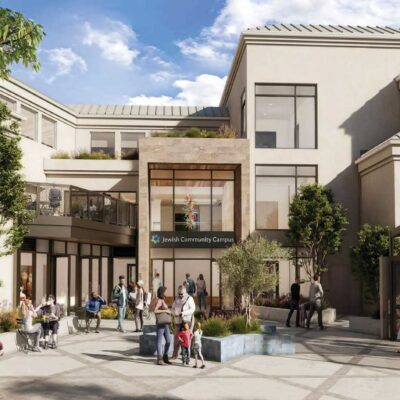
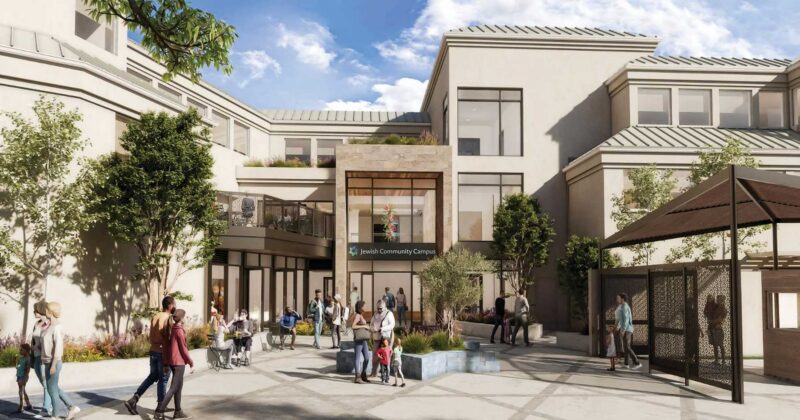
A digital rendering of the East Bay Jewish Campus.


 Add EJP on Google
More than 30 years ago, real estate developer and philanthropist Moses Libitzky had a dream. It started humbly: a permanent home for the Jewish Federation of the Greater East Bay, which had been operating out of a leased and crumbling headquarters.
“It was a long search with few results,” Libitzky told eJewishPhilanthropy. But as other organizations’ facilities aged over the decades, including the East Bay JCC, his dream expanded — he envisioned a campus uniting every Jewish nonprofit in the East Bay and bustling with Jewish life.
As if by miracle, the perfect property hit the market in 2018: the Dreyer’s Grand Ice Cream headquarters in Oakland, Calif., then owned by Nestlé. The property was three acres with 83,000 square feet spread across seven buildings. It had private parking, was walking distance from a Bay Area Rapid Transit station and was near the University of California, Berkeley, which hosts a strong Hillel.
“Boy, that would be perfect, but we’ll never get it,” Libitzky thought to himself. “It’s too good.”
But Libitzky and his brother-in-law, Nathan Petrowsky, placed a bid — and they won, closing for $41 million through the commercial real estate company, Libitzky Property Companies. Originally, Dreyer’s planned to lease back the property’s main 55,000-square-foot building for up to 10 years, but the COVID-19 pandemic sped up the timeline, and Nestlé wanted out early, leaving the site in 2024, making way for what would become the East Bay Jewish Community Campus.
After years of remodeling, including the creation of a state-of-the-art 200-seat performance venue, the East Bay Jewish Community Campus will be completed by the new year. In August, the JCC East Bay, the campus’ anchor partner, moved on-site, and by January, the campus will be home to over 100 Jewish professionals and 20 partner organizations, including the Jewish Federation Bay Area, Foundation for Jewish Camp, Repair the World, Jewish LearningWorks, UpStart, Jews of Color Initiative, BASE Bay and Moishe House. In all, the project cost $125 million, including property costs, $46 million for construction and $20 million for an endowment.
“We call it the Jewish Community Campus, and I call it the Jewish Community’s — I add an apostrophe ‘s’ — so the Community’s Campus, because I want every partner here to feel like it’s their home,” Robert Wise, the campus’ executive director, told eJP.
According to 2019 Rosov research, the East Bay is home to the largest number of Jews in all of California’s Bay Area, which itself includes over 350,000 Jews. East Bay Jewish families are young and diverse, with 1 in 4 households including a non-white member. Twenty percent of East Bay Jews were born outside the United States, and 55% of East Bay Jews are in interfaith relationships.
“East Bay is a very wide, diverse geographic area, and we have little organizations peppered all over the place,” Libitzky said. “The idea is to bring everybody together and introduce a unique concept in the Jewish community called cooperation instead of competition, with the idea that you bring Jewish organizations together and synergies can happen and they can avoid duplicating efforts. That’s the experiment, and so far so good.”
The initiative was inspired by other Jewish shared workspace communities such as The Hive in San Diego, SketchPad in Chicago and The Dupree in Atlanta as well as JCCs and federations across the country. “I did a lot of research on what does a Jewish hub mean, because it’s one of those terms,” Wise said. “It’s great because everybody knows what that means, and it’s terrible because it means everything to everybody.”
The JCC’s move to the campus was urgent. Founded in 1978 as the Berkeley-Richmond JCC, the JCC East Bay serves more than 9,000 people a year with adult programming, a preschool, summer camp and after-school programs, but its main branch was housed in a 107-year-old landmarked building in North Berkeley that was too small to serve the expanding community.
The East Bay Jewish Community Campus allowed the JCC to double the size of its preschool from 60 children to 120 and expand its teen and young adult programming as well as its camp. The JCC will take up nearly 70% of the campus.
Prior to the move, the East Bay center had difficulty reaching young adults and teens, but with Moishe House and other young-adult organizations on the new campus, it’s a built-in audience, Susie Cohen Crumpler, CEO of JCC East Bay, told eJP. “It’s really incredible just to be walking down the hall and welcoming these new staff and organizations onto this campus that everyone can call home.”
Already, 15 events have been held on the campus, with many more rolling out in coming months. The construction on the performance venue is set to wrap next month, and the JCC is planning a massive Hanukkah celebration bringing all the institutions together. A bat mitzvah is scheduled to take place in the event center in January, and the JCC’s arts, ideas and culture programming begins in February, featuring artists and thinkers, including some from UC Berkeley. And in April, the JCC will hold a Passover shuk, or market, where all the campus organizations will come together to present their offerings in the campus’ grass meadow — “the heart of the campus,” Cohen Crumpler said.
The campus will also feature a kosher café “and the woman who’s going to run the cafe makes these incredible salted-chocolate babkas,” Cohen Crumpler said. “I’m gonna try and stay away from the place because it’s dangerous for me.”
When looking for new partners, Wise hopes to check every box for age groups and demographics so everyone is served on the campus.
“The Bay Area has always been where bold Jewish ideas get started,” Aaron Katler, CEO of UpStart, told eJP. UpStart is launching the UpStart Jewish Social Innovation Lab in early 2027 on the campus, allowing visitors to explore the innovative programs the organization funds. “The organizations born here have shaped Jewish life across the country. For years, they’ve been scattered, working without a shared home or physical connection to each other.” Olamim: Latin Jewish Belonging for Families was one of the first organizations to set up shop on the campus, renting space for over a year. The East Bay-born organization began as a six-family playgroup in 2021, rapidly growing to the point where it has over 45 in-person programs yearly, including playgroups, workshops and music programs — titled “¡Cantamos!,” “We sing!”— and over a dozen local and national partnerships. The East Bay campus is the first office space the organization has rented.
“Our work is aimed to support Latin Jewish families within, between and beyond institutions, and so becoming part of an East Bay hub of national organizations that are partnering creatively to support Jewish community and Jewish peoplehood is key,” Ariela Ronay-Jinich, Olamim’s founder and executive director, told eJP.
The Bay Area mirrors many Jewish metropolitan areas where “demographics are shifting and evolving,” Ronay-Jinich said. “It’s time to be creative and on the leading edge of how we serve community.”
Ronay-Jinich is a childhood educator who has dedicated decades to working with Jewish nonprofits including Urban Adamah, Edah and Gan Shalom Preschool, and she hopes that the campus becomes a “home away from home” for Jewish families, with activities for children including a library and makerspace, which are planned, but also a kid’s corner where families can find resources and see the many different ways people can be Jewish.
“It’s beautiful for a family or for young professionals to be able to walk in and see a whole mosaic of Jewish life that they can be a part of at different stages in their life,” Ronay-Jinich said. She also hopes that people who frequent the campus feel that they have ownership over it. “That would be my challenge to the project,” she said. “That we have ways for people to not just consume Jewish life, but jump into creating it together and producing it together.”
The establishment of the campus should feel “like a provocation to the field,” Ronay-Jinich said, to work in partnership that expands beyond affiliation, membership or denomination. The campus “gives smaller organizations like us, that have a big vision and that are meeting emerging and evolving and growing needs, [the opportunity] to be [treated] as equals in a place and build community together.”
Prior to moving back to the Bay Area, Wise had been retired, living in Palm Springs, FL after a career serving Bay Area philanthropists and nonprofits. But then Libitzky called, asking him to take the helm of the project, and Wise jumped at the opportunity.
Wise looked at a picture of his great-grandfather who had immigrated from Kyiv to Portland, Ore., in 1907, starting a men’s clothing store and helping launch the Reform synagogue Congregation Beth Israel in 1927, which still stands today.
Helping establish the campus “brings me full circle,” Wise said. “I think about the institutions our predecessors built, the communities they nurtured and the generations that have benefited from their vision and commitment. I envision this campus serving the East Bay and broader Bay Area Jewish community in new, creative and meaningful ways for the next 100 years.”
Related News
ADVANCING A VISION
N.Y. federation donates $1M toward building shared-society center named for peace activist killed on 10/7
EXCLUSIVE
Detroit-based philanthropists Nancy, James Grosfeld donate $8M to renovate JDC’s Israel campus
CLOSING WORDS
In AZM address, Cosgrove links communal ‘orthodoxy’ on Israel to rising anti-Zionism among young Jews

MAJOR GIFTS
Center for Jewish History celebrates 25 years with a $25M matching grant

MAGICAL EXPERIENCE
Shefa launches psychedelics retreat for Jewish professionals suffering burnout