TRACTATE TUTOR
Talmud Daily offers free guide to the text, offering newcomers an on-ramp for serious study
Initiative timed to end so participants can join next cycle of daily Daf Yomi study program
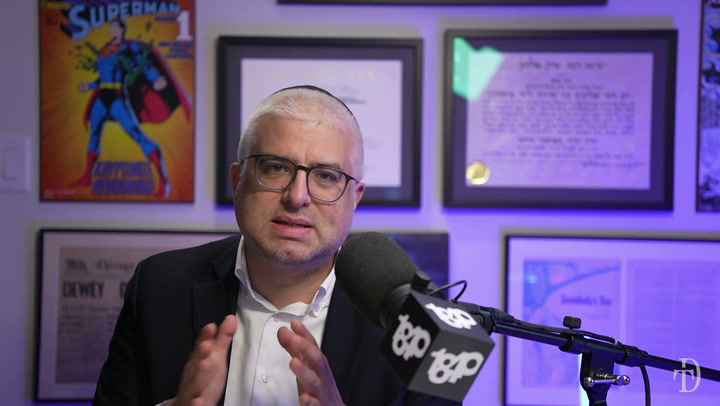
Courtesy/18Forty
Rabbi David Bashevkin presenting an episode of Talmud Daily


 Add EJP on Google
Cracking open the standard Talmud — coming in at 2,711 double-sided pages — presents a daunting challenge for many Jews. To offer an easy introduction to the central text of Rabbinic law, Rabbi David Bashevkin, the founder of the religious engagement website 18Forty, recently launched Talmud Daily, a free 40-week, daily video breakdown of the Talmud, which he says he’s treating like a tour through a theme park.
“A lot of times there’s a tram or a train that takes you around the park to point out where everything is,” Bashevkin told eJewishPhilanthropy. “This is where the bears are; this is where the giraffes are and then after you do the train ride, you can go to each exhibit or decide [to] leave the zoo.”
Bashevkin began the expedition in late August with a journey through the history and terminology of the Talmud followed by discussion of key themes, including prayer, holidays, family law, business, theology and ritual purity. Episodes are taped in Bashevkin’s Teaneck, N.J., home, with the rabbi flanked by posters of Batman and Superman.
Each Monday through Thursday study session runs roughly 10 minutes, and Friday’s episodes are long-form interviews with experts chosen not only based on the guest’s knowledge, but their digital accessibility: each needs to have classes and content readily available online. As of Monday, 7,500 users have signed up for the program.
The program takes inspiration from the simple and accessible way Britain’s former chief rabbi, the late Rabbi Lord Jonathan Sacks, broke down the Five Books of Moses, Bashevkin said. Talmud Daily is dedicated to the former head of the Orthodox Union, Rabbi Moshe Hauer, who died of a heart attack last October and was a figure known for his empathy and ability to connect with Jews across the religious spectrum.
Hauer’s “spirit hovers over the entirety of” Talmud Daily, Bashevkin said, and the rabbi was “constantly pushing” Bashevkin to “think about how [he] can take [his] platform and use it as a vehicle to show [people] the doorway for how they can find their place in Torah life and Torah study.”
Talmud Daily is “an innovative, user-friendly way to explain what the Talmud is along with the key concepts of the tractates,” Raanan Agus, one of the founding sponsors, along with his wife, Nicole, told eJP. “The project unlocks this fundamental book for a much larger number of people than those who study it today. Additional founding sponsors include Micah Philanthropies, Janet and Lior Hod and family, George and Pamela Rohr, and Reuven Moskowitz and family.
The initiative is set to end in June alongside the conclusion of Daf Yomi, the 7 1/2-year cycle where participants study the Talmud one page per day. In recent years, Daf Yomi study has surged due to growing accessibility of texts through Sefaria and of podcasts including Tablet’s “Take One Daf Yomi.”
People see the excitement of Daf Yomi and “feel left out of these celebrations” because they don’t have the background to be able to jump right into Talmud, Rabbi Gil Student, a rabbinic advisor to Talmud Daily, told eJP.
“Talmud Daily is a way for [people] to participate in their own way, to expand their horizons, learn more without going to a place that they don’t feel comfortable because of the lack of background,” Student said. It offers an “on-ramp” to the next cycle” of Daf Yomi, which begins immediately after the current one ends.
“Daily learning is a brilliant, though sometimes difficult and often maddening approach,” Liel Leibovitz, the host of “Take One Daf Yomi,” the podcast he launched with Bashevkin’s help in 2020, told eJP. Leibovitz was also the first Talmud Daily guest.
The Daf Yomi method of breaking study down to short sessions works because instead of opening the Talmud and “turn[ing] the page and get[ting] immediately overwhelmed by this ocean of knowledge and references and complications, the Daf Yomi method says, ‘You know what, here’s what you have to do. It’s very simple. It’s just one page a day.’” Leibovitz said.
The same way people around the world are studying identical pages of Talmud every day for Daf Yomi, Talmud Daily will offer a feeling of community, Student said. “Even though the Talmud Daily people are not meeting each other, the very act of listening to the same podcast and partaking the same themes every day creates a community of conversation.”
The Talmud is often “misunderstood,” Student said. “The Talmud is not actually a book… It’s really a record of conversations over hundreds of years.” Because “that kind of text is so unfamiliar” to many Jews, studying the Talmud “requires a switch in your thinking, going away from reading page by page, line by line, like you read any novel, to thinking non-linearly, and that requires certain amounts of training and certain amounts of background.”
Just like someone can’t join “ an elite unit [of the army] without training for at least a year,” serious Talmudic learning takes training, Leibovitz said, and getting in the habit of engaging with the Talmud on a daily basis “changes your heart and your mind.”
Each episode is short, to adapt to a modern lifestyle, Bashevkin said. “Ten minutes is just relating to the average attention span. Getting your day started, you can do it while sipping a cup of coffee.”
The course duration has deep meaning, too, he said. “Moses got the Torah in 40 days and 40 nights on Sinai. I figured, I don’t know if I could do this [initiative] in 40 days and 40 nights, but if you give me 40 weeks.”
After the terrorist attacks of Oct. 7, 2023, Jews are looking for “a reset for the Jewish people to relearn our common language of thought and practice,” Bashevkin said. Recently, antisemites have started disseminating age-old propaganda about Jews using Talmudic secrets to dominate the world.
“The purpose of Judaism is not to fight antisemitism,” he said. “We fight antisemitism so we can focus on the purpose of Judaism, and to me, [that is] what Talmud Daily is all about. This is what we’re fighting for.”
Related News

MAJOR GIFTS
Center for Jewish History celebrates 25 years with a $25M matching grant

MAGICAL EXPERIENCE
Shefa launches psychedelics retreat for Jewish professionals suffering burnout
CLOSING WORDS
In AZM address, Cosgrove links communal ‘orthodoxy’ on Israel to rising anti-Zionism among young Jews
PRESIDENTIAL REBUKE
Israel’s Herzog: Mamdani ‘makes no effort’ to hide disdain for Israel, Jews must fight back
EXCLUSIVE
Detroit-based philanthropists Nancy, James Grosfeld donate $8M to renovate JDC’s Israel campus