Q&A
For Jewish funders, a sense of ‘political homelessness’ heading into consequential midterm elections
The U.S. midterms and Israel’s deadlock add uncertainty, but could also push funders to become less shy about entering the political arena, JFN’s Spokoiny says
Allison Joyce/Getty Images
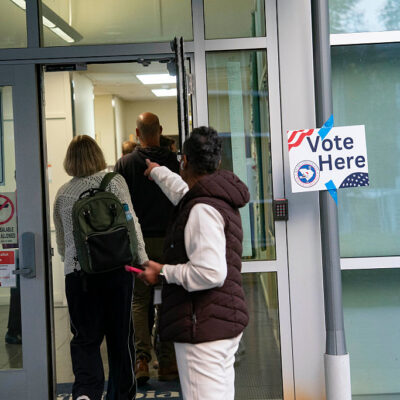
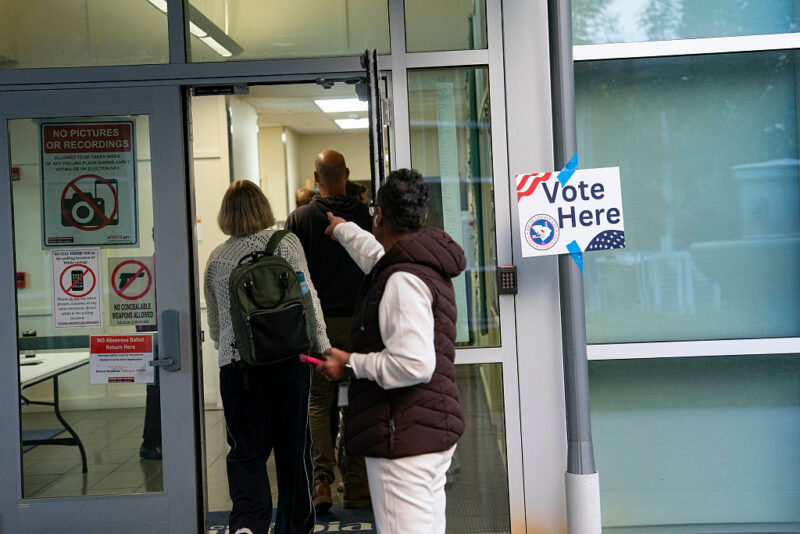
People enter a voting location as polls open in Columbia, S.C., on Nov. 3, 2026.


 Add EJP on Google
As American Jews head to the polls today in the country’s midterm election, many in the traditionally liberal-leaning community will be feeling a sense of “political homelessness.” Historically liberal Jews are increasingly finding themselves at odds with the Democratic Party on the issues of Israel and antisemitism. At the same time, they oppose the conservative nationalism of the Republicans, who have their own issues with rising anti-Israel positions and antisemitic figures.
“This campaign season has been deeply painful for the American Jewish community,” American Jewish Committee CEO Ted Deutch, a former Democratic congressman, wrote ahead of today’s election. “When we’ve spoken out against candidates trafficking in antisemitism, we’ve been brushed aside. … The fixation on Israel — and, inevitably, on Jews — has been relentless. This goes far beyond disagreements on foreign policy. No community should become a political scapegoat or be subjected to ideological litmus tests. Yet throughout this election, Jews have found ourselves targeted from both the far left and the far right.”
But while for many this may be the most significant element of this election cycle, it is far from the only one. These elections have the potential to significantly shift the partisan makeup of Congress two years into President Donald Trump’s second term — a term that has already significantly impacted philanthropy through federal funding cuts, a wave of congressional investigations into nonprofits and new challenges to organizations’ tax-exempt status.
This election also comes in the days after an Israeli parliamentary election, which resulted in the current coalition losing its majority, while the main opposition bloc would need to partner with Arab parties in order to gain control of the Knesset — something that several of them have indicated they will not do, in light of the Arab parties’ historic opposition to Zionism and broader questions about the long-term stability of such a government.
On the eve of the U.S. midterm elections, eJewishPhilanthropy spoke with Andrés Spokoiny, president and CEO of the Jewish Funders Network, about the sense of “political homelessness” felt among Jewish funders, philanthropy’s role in politics and the impacts of political uncertainty in both Israel and the United States.
Nira Dayanim: I’m speaking to you between two elections, last week in Israel and today in the U.S. In your view, what’s at stake for philanthropy in today’s midterms, whether control of Congress changes hands or stays put?
Andrés Spokoiny: Philanthropists have a number of concerns. And by the way, philanthropists traverse the entire political spectrum, right? So you can’t say all philanthropists are worried by a Republican loss or all philanthropists are ecstatic about a Democratic win. It just doesn’t work like that. I think that for many mainstream centrist, Jewish funders, this election is very indicative of a feeling of political homelessness. They have a problem finding a home in either party for different reasons. And this election is very indicative of that.
A lot of people that I speak to are crossing party lines in both directions, and nobody is 100% satisfied. So it is very much a sign of the times in which we live as a Jewish community: that feeling of political homelessness. That’s one thing.
The second thing is there are threats from both the left and the right to philanthropic freedom in this country. And that has a lot of funders very concerned.
ND: Can you elaborate on that?
AS: For example, the political left… has an ideological problem with philanthropy in many cases. Let’s put it this way: They think that people should just pay more taxes and not do philanthropy. I’m caricaturizing it, but it’s where the opposition comes from.
In the case of Jewish philanthropy, the left presents a threat to some Jewish philanthropic activities, [namely] Jewish-slash-Zionist philanthropic activity.
From the perspective of the right, there is paradoxically a similar threat, but from the other ideological spectrum; the right believes that the philanthropic sector is not transparent enough and does political things that are not philanthropic, and therefore proposes restrictions to philanthropic freedom. Some of those restrictions make sense, but there is a fear that when the government starts messing with philanthropy, it’s a slippery slope.
The dynamism of the philanthropic field in the United States was due to the fact that there was a lot of freedom for funders to innovate and create new stuff. The question really becomes: Can you regulate it better, but without politicizing it first, and second, without making something that weakens philanthropic freedom, and therefore weakens the capacity of the philanthropic sector to operate and to create change?
There is another aspect in the United States in particular, which is that Jewish funders have realized the importance of being involved in the political space. They realize that you know you can invest hundreds of millions of dollars in fighting antisemitism, but then [New York City Mayor Zohran] Mamdani gets elected, and all of that goes down the drain. The neat separation between philanthropy and politics is becoming very limiting for funders.
Funders, for example, are looking to establish 501(c)(4) vehicles and PACs, not as part of their foundations — that would be illegal — but as part of their broad view of how to make change in society. That is coming into play in these elections. Funders are less shy to try to intervene in the political game. I personally think that’s a good thing.
The literature on these things 30 years ago believed that sectors had to be siloed; the business sector, the philanthropic sector and the government sector didn’t have to touch each other. They were supposed to operate on very distinct lanes. That’s not the case anymore. All the sectors realize that they can amplify their impact when they work on all sectors at the same time. They’re less strict about boundaries between sectors.
ND: With Israel’s government still forming and Americans voting today, how do these two moments of change affect the U.S.-Israel relationship, especially the dynamics in the philanthropic sector?
AS: I have my opinions, but I’m not an expert in how the relation between Israel and America can change. It’s a very interesting question because, besides the things I have already told you, it’s very hard to predict, right? Because we don’t know what government Israel will have. We don’t know what of governance America will establish, and we live in times of great uncertainty, and these two elections add to the uncertainty, because even if there is a “blue wave,” the level of change is going to be limited, and we don’t really know what that’s going to mean for actual policies in the United States.
In general, both domestically and in Israel, others felt that they could safely ignore what was happening in the political arena. Now you can’t anymore. We thought we could isolate philanthropy from politics, and it’s proving very, very hard.
The one thing that I think is important to say is that the philanthropic, the Diaspora philanthropic relationship with Israel is robust. It became stronger after [the Oct. 7 terror attacks], and I don’t see that changing dramatically. What I do expect is realignments, changes of focus, based on what happens in both elections. I think that it’s a moment for philanthropy to play an important role, and the paradox is that philanthropy itself feels threatened and is very uncertain about the future. We need to take a more active role, and on the other hand, we’re more afraid to take a more active role.
ND: So philanthropy is stuck between a rock and a hard place?
AS: Yes. Now, this could also be a very rich moment for philanthropy — a very, very interesting moment where philanthropy thinks more clearly about, or more deeply, rather about its soul, about its role, about the levers of change that it has, etc. I think that could be interesting.
Related News
PRESIDENTIAL REBUKE
Israel’s Herzog: Mamdani ‘makes no effort’ to hide disdain for Israel, Jews must fight back
EXCLUSIVE
Detroit-based philanthropists Nancy, James Grosfeld donate $8M to renovate JDC’s Israel campus
CLOSING WORDS
In AZM address, Cosgrove links communal ‘orthodoxy’ on Israel to rising anti-Zionism among young Jews
HIGHER EDUCATION
As Jewish donors reconsider academia, Jan Koum doubles down, endowing Israel studies at Stanford
EXIT INTERVIEW
Elizabeth Sokolsky, longtime EVP of Birthright Israel, to retire next year