Opinion
RADICAL HOSPITALITY
Finding our way home: Creating sacred community in an age of spiritual hunger


 Add EJP on Google
Once a month, I have the rare privilege of leading the Shabbat morning service of my dreams.
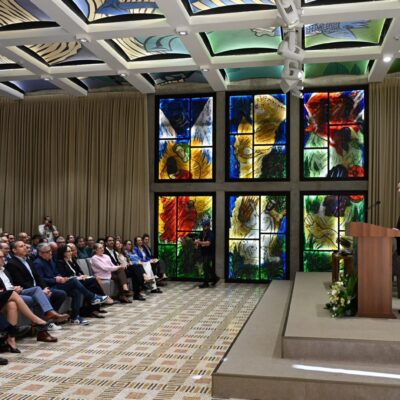
Every month, 40 or so of us gather in a large circle in our sunny but intimate sanctuary at Darchei Noam, an independent, post-denominational congregation in Ambler, Pa. Some wear tallitot, others do not; some are dressed in suits, others in activewear. Ages range from people in their 20s to octogenarians. Jews in all hues, from diverse backgrounds, gather in sacred companionship to dwell in the delicious energy of Shabbos morning.
And every month we begin, not with announcements or formal liturgy, but with a version of “Hinei Ma Tov” by Cantor Becky Mann that has become something of an anthem for our community:
“Open the door, open your eyes, open your heart, see what’s inside.
Lay down your walls, lay down your fears, lean into love.
You are welcome here.”
We sing it together softly at first, then with more confidence, letting the words wash over us. Before we have studied a single verse of Torah or recited a single prayer, we are already practicing something essential. We are reminding one another that this is a place where we can arrive exactly as we are. A place where we can let go of our defenses, loosen our grip on whatever burdens we have carried in from the week and remember what it feels like to belong.
From there we move into meditation and chant, repeating the words, “Bar’chi nafshi et Adonai, gadalta me’od,” “Bless the Eternal, o my soul, You are exceedingly great.” As we linger with the phrase “gadalta me’od,” I often invite people to embody the words “exceedingly great” by opening their arms wide, bringing spaciousness to the heart center. The vastness of the Holy One and the vastness within us begin to mirror one another. For a few precious moments we step outside the noise and urgency of daily life and enter a different way of being, one rooted in presence, wonder and the possibility that we are held by something larger than we could ever imagine or comprehend.
As the morning unfolds, Torah becomes less an ancient text to be analyzed and more a living conversation about what it means to be human. We linger with the week’s portion, searching beneath the surface of the words for ancient wisdom to help us navigate grief and joy, uncertainty and hope, loss and love. Later, we step outside for a silent Amidah, standing together beneath an open sky overlooking a nature preserve. Some pray with the traditional words. Others speak intimately to the Divine in their own language. The birds, the wind, the warmth of the sun and the silence itself become part of our liturgy.
When we return for the Torah service, people are invited for communal aliyot inspired by themes of the Torah portion or rhythm of the Hebrew calendar. Community members stand in their place or are called to the bimah for different reasons — for healing, courage, gratitude, new beginnings, remembrance or simply the desire to stand among others and feel held. Sometimes, 20 people or more find themselves wrapped together beneath a canopy of interwoven tallitot as I offer a spontaneous blessing from my heart to theirs. In those moments we can often feel the Shechinah, God’s in-dwelling presence, resting among us as we open ever more deeply to the truth of our vulnerability and authentic longing.
This is what it feels like to experience a Contemplative Shabbat at Darchei Noam. Five years ago, when Darchei Noam was founded, I never could have imagined that a monthly gathering centered on meditation, chanting, silence, mystical Torah and communal blessings would become our most popular service. And yet, month after month, people continue to come, many of them carrying a longing they can barely name, searching for meaning, connection, healing and depth. Each month I hear some echo of the same words: “I didn’t know Judaism could feel like this.” “I’ve been searching for something like this for years.” “I finally found my home.”
Their words have stayed with me because they name something I have been witnessing ever since Darchei Noam opened. So many people arrive carrying a quiet ache, a longing for something they cannot quite name. Some grew up Jewish but drifted away because synagogue life felt overly institutional, performative or spiritually thin. Others spent years seeking meaning through yoga studios, meditation groups, healing circles and retreats, unaware that Judaism itself contains profound mystical wisdom and transformative spiritual practices. Still others carried wounds from Jewish spaces where they never quite felt seen, accepted or understood.
Our name, Darchei Noam, comes from a verse in Proverbs that is sung every time the Torah is returned to the ark: “Deracheha darchei noam,” “Her ways are ways of pleasantness.”
Noam is one of those Hebrew words that cannot be translated neatly into English. It can mean “pleasantness,” “well-being,” “healing” or “peace”; but over the years, I have come to understand it as something else entirely.
To me, noam is the feeling of finding home. Not a physical home, but the feeling of coming home to yourself. The feeling of being able to exhale. The feeling of setting down the masks we wear and the stories we tell ourselves about who we are supposed to be. The delicious feeling of belonging.
Looking back, I realize that Darchei Noam was born out of my own search for that kind of home.
Five years ago, a small group of families and I, along with my teacher Hazzan Arlyne Unger, made the decision to leave another congregation in the area and create something new: an intentional community rooted in joy, spiritual depth, belonging and authentic connection. At the time, I was navigating my own profound journey of becoming. Years of self-doubt had left me carrying a story about who I was and what I was capable of doing. Beneath the surface lived a familiar collection of insecurities that I suspect many people know well: I wasn’t learned enough. I wasn’t accomplished enough. I wasn’t disciplined enough. I simply wasn’t enough.
And then something shifted. Life forced me to look directly at the stories I had been telling myself and to ask whether they were actually true. The moment I stopped trying so hard to become enough was the moment I realized I already was. It sounds simple now, but it transformed everything. More importantly, it gave me better insight into what it takes to cultivate a sacred community.
I realized that the deeper I stepped into my own truth — as a rabbi, teacher, mystic, seeker and imperfect human being — the more I noticed others doing the same. When I shared my vulnerable self, it gave others permission to do the same. I began to realize that many of the people walking through our doors were carrying their own versions of the same story: They believed they were not Jewish enough, observant enough, knowledgeable enough, spiritual enough or worthy enough to belong.
From the beginning, our goal was never simply to create another synagogue. We wanted to create a barrier-free community where people could arrive exactly as they are and feel fully welcomed into Jewish life. A place where prayer could be contemplative and joyful; where Torah could be intellectually rigorous and spiritually nourishing; where grief and laughter could dwell side by side; where questions were welcomed; and where belonging was not something people had to earn.
Over time, I have come to think of this as a kind of radical spiritual hospitality — not simply welcoming people into a building, but welcoming them into an experience of belonging. At Darchei Noam, nobody slips quietly into the sanctuary unnoticed. Any member who walks through the sanctuary door is greeted by name. Whether they arrive at the beginning of the service or not until the Torah is taken out of the ark, I personally greet them with a big smile because I am genuinely thrilled to see anyone who longs to be part of our sacred Shabbat culture.
Our Contemplative Shabbat service has also evolved as a co-creation. Community members share poetry, offer meditations, lead chants and offer their own gifts on the communal altar of prayer and longing. That same need for depth and authenticity eventually gave rise to our Seekers’ Circle, a monthly gathering devoted to Jewish spirituality, meditation, mysticism and soulful conversation. What began as a small experiment quickly revealed a much deeper need. People were hungry for spaces where they could wrestle with life’s biggest questions within a Jewish framework. Why are we here? How do we heal? What happens after we die? How do we make meaning from suffering? How do we awaken?
At our recent Seekers’ Circle closing retreat, participants reflected on what the community had meant to them over the past year. One after another, people spoke about searching for years, sometimes decades, for a spiritual community that felt authentic. Several described exploring other traditions because they assumed Judaism had little to offer their inner lives. Others spoke about the relief of finally finding a place where they could ask difficult questions without fear of judgment. Listening to their reflections, I found myself moved by how many people used the language of home — not because they had found all the answers, but because they had found sacred companions for their respective journeys.
Another such offering which arose in response to one member’s grief journey is the Audrey Minyan: a monthly gathering that meets in my living room and was created in memory of the beloved wife of one of our members. I never had the privilege of knowing Audrey, but I sensed that creating a space where her legacy could continue to bring healing into the world might itself become a source of healing. What began as an offering of solace has become a space of connection and renewal for all who gather.
Each month, we explore the rhythms of the Hebrew calendar and the weekly Torah portion through a variety of spiritual practices such as text study, meditation, prayer, creative expression and reflection. There are often tears mixed with laughter. There is always coffee and a little nosh. But most importantly, there is the quiet reminder that none of us are alone; we can always find refuge in the embrace of community and awaken to the holy Presence that flows within, around and between us.
Five years into this journey, I still do not know exactly what Darchei Noam will become. Like all living communities, it continues to evolve in ways I never could have predicted. But I am increasingly convinced that we are living through a moment of profound spiritual hunger. People are hungry for meaning. They are hungry for beauty, healing, wisdom and connection. But perhaps, beneath all of those longings, is something even deeper: They are hungry for home. They are searching for places where they can bring their grief and their joy, their questions and their doubts, their wounds and their gifts. They are searching for communities where they can stop striving long enough to remember who they are or who they were meant to be.
Perhaps that is why the words I hear most often at Darchei Noam continue to move me so deeply: “I finally feel at home.” For me, that is the deepest meaning of noam. And in an age of spiritual hunger, helping one another find our way home may be one of the most sacred tasks of all.
Danielle Parmenter is the Reconstructionist founding rabbi of Darchei Noam, an independent post-denominational Jewish community in Ambler, Pa. She is an alumna of the Clergy Leadership Incubator (CLI), a two-year fellowship for rabbis on transformative leadership directed by Rabbi Sid Schwarz.