Opinion
SPEAK UP
As Jews focus on Israel and America, a consequential rule is taking shape in Washington


 Add EJP on Google
In Short
The Treasury Department wants to decide for itself what counts as “fundamental public policy.” Jewish institutions have particular reason to worry about where that power could lead.
With so much attention focused on Israel and the political future of the United States, another consequential question is taking shape in Washington: Who decides which beliefs and practices are acceptable for our community institutions?
On September 3, the Treasury Department and the IRS proposed a rule that would strip 501(c)(3) status from any private school that “adopts, maintains, or enforces any policy or practice that discriminates on the basis of race, color, or national or ethnic origin” in any program, “for any purpose.” Treasury estimates that about 18,000 schools would be affected. A school that loses its exemption would owe taxes, and its donors could no longer deduct their gifts.
Saul Loeb/AFP via Getty Images
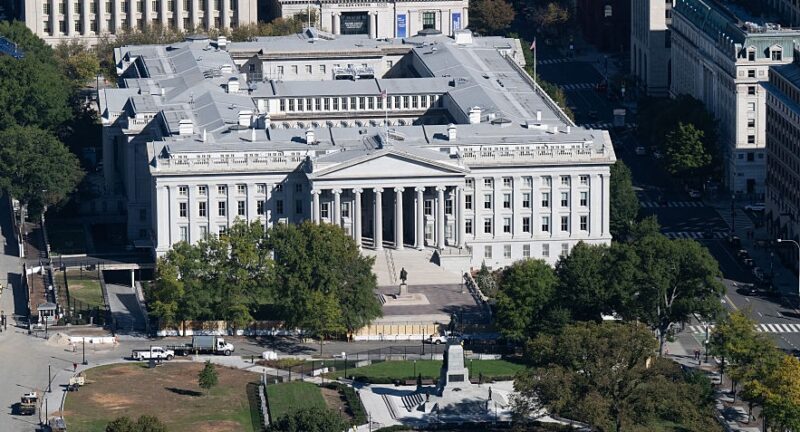
The US Department of the Treasury building in Washington on Oct. 22, 2026.
No one should defend racial discrimination in schools, and we certainly don’t. But the rule rests on a dangerous premise: that the Treasury Department may decide for itself what counts as “fundamental public policy.” Jewish institutions, other faith communities, and the nonprofit sector as a whole, should oppose it before the comment period closes on November 3.
The rule relies on Bob Jones University v. United States (1983), in which the Supreme Court upheld the denial of tax exemption to a school that banned interracial dating, because racial discrimination in education violated “a most fundamental national public policy” embraced across all three branches of government for decades. The majority itself denied that its ruling gave the IRS “authority to decide which public policies are sufficiently ‘fundamental.’”
This rule would lower the bar. To show what counts as public policy, its preamble cites Eisenhower’s order sending troops to Little Rock, and alongside it two 2025 executive orders on DEI and school discipline: contested directives of one administration, not settled national consensus. President Biden’s first-day executive order called advancing equity and racial justice the responsibility of the whole government; four years later, President Trump ordered an end to DEI. As the law professor Roger Colinvaux has written, that is “public-policy whiplash, not a sign of the fundamental agreement necessary to invoke Bob Jones.” If an executive order can define “fundamental public policy,” every new president can rewrite the terms of tax exemption, and every school – and potentially every nonprofit – will have to guess what comes next.
This is not an isolated move. The administration has publicly threatened Harvard’s tax exemption, and in August, reporting described a Treasury Department plan to revoke the exemptions of disfavored advocacy groups. Walter Olson of the libertarian Cato Institute, which has long criticized such targeting from both the left and the right, called that plan “dangerous and constitutionally suspect.” Even some conservatives who share the rule’s goal see the danger. Writing this month for the right-leaning Capital Research Center, Kali Fontanilla warned that a future administration could turn the same reasoning against a Christian college’s policies on LGBTQ staff. “A boomerang,” she wrote, “does not care who throws it.”
The temptation to grant the government this kind of power reaches the Jewish community as well. At least one Jewish organization has urged the Treasury Department to go further: to treat participation in boycotts of Israel, which it calls “discriminatory,” as relevant to a school’s tax exemption, and to build a portal for submitting allegations against schools. At a time when antisemitism is a serious concern and debates over Israel are increasingly contentious, I understand the impulse to use government authority to protect Jewish communities.. But a power that can be aimed at causes we oppose can also be aimed at causes we cherish.
In 1896, a New York judge refused to approve the incorporation of Agudath Hakehiloth, a Jewish communal organization, because it planned to hold its annual meeting on a Sunday. That, he wrote, would be “an aggression upon the Christian Sabbath” and “contrary to the public policy of the state.” In 1974, the Ohio Supreme Court allowed the secretary of state to refuse a nonprofit charter to the Greater Cincinnati Gay Society, agreeing that promoting homosexuality “as a valid life style is contrary to the public policy of the state.” In both cases, “public policy” meant the majority’s discomfort with a minority.
Nor is the risk confined to one side of politics. In 2022, a Cornell Law Review article by Alex Zhang urged the Biden Administration to extend Bob Jones to discrimination on the basis of every protected trait as part of its expanded civil rights enforcement. Consider what that logic could mean for Jews. Many Orthodox schools educate boys and girls separately. Jewish schools serve Israeli families, students from the former Soviet Union, Sephardi and Mizrachi Jews, and Jews of Color through programs designed to help students find community and belonging. Many Jewish institutions hold traditional teachings on marriage and gender. Nearly all teach a love of Israel, at a moment when Zionism is described in some quarters as racism. A Treasury Department empowered to define public policy on its own could, in a different political season, treat any of these as disqualifying. The party in power changes; the tool stays the same.
Two justices in Bob Jones pointed to a better way. Justice William Rehnquist, dissenting, argued that “Congress itself intended to decide what § 501(c)(3) requires,” leaving no room for the IRS to add conditions of its own. Justice Lewis Powell, concurring only in part, rejected the idea that tax-exempt organizations exist to carry out “governmentally approved policies.” That view, he wrote, “ignores the important role played by tax exemptions in encouraging diverse, indeed often sharply conflicting, activities and viewpoints.” “The contours of public policy,” he concluded, “should be determined by Congress, not by judges or the IRS.”
That does not mean the 1983 Court was wrong for its time. Then, opposition to segregated schooling was a rare principle that Congress, the courts, and presidents of both parties had affirmed for a generation, and the IRS could fairly claim to be enforcing a national consensus rather than picking a side. We no longer live in that world. In today’s polarized politics, the tools of government are increasingly turned against the other side’s institutions, and a power to decide which nonprofits offend “public policy” will not stay confined to questions of genuine consensus.
Treasury cannot overrule the Supreme Court. But it can stop building on this doctrine. It should withdraw this rule and leave any new conditions on tax exemption to Congress. That would protect yeshivas and progressive synagogues, Catholic schools and Black churches alike.
The public comment period for this proposed rule closes on November 3. Anyone with a stake in education should submit comments describing real programs, students, and funds, and explaining what a standard that shifts with each administration would put at risk. They should urge Treasury to withdraw the rule and leave the definition of public policy to Congress. Comments can be filed at regulations.gov, in docket IRS-2026-1189.
Then they should recruit others to do the same: the day school across town, the Greek Orthodox or Korean church school down the street, the foundation that funds scholarships at all of them. Rules like this advance when affected institutions assume someone else will object.
At a moment when Jewish attention is understandably focused on Israel and the future of American democracy, we should not overlook the rules that shape the freedom of our own institutions at home. The judge who balked at a Sunday meeting in 1896 believed he was defending public policy. The surest protection for every minority community is to make sure no official, of any party, gets to make that call again.