Aid Alliance
Pushing back on quiet boycotts, delegation highlights Jewish, Israeli aid workers at global confab
Group spearheaded by Olam brings 22 Jewish and Israeli humanitarian figures to AidEx, amid reports of shunning and antisemitism in the field
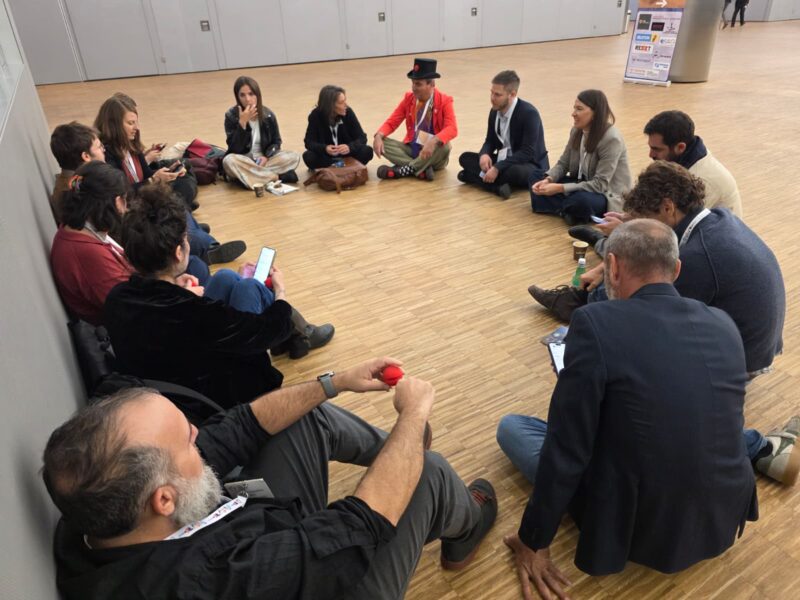
Courtest/Olam
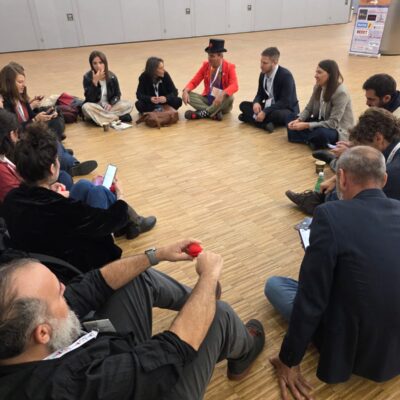
Olam's delegation gathered at AidEx


 Add EJP on Google
In the wake of the Oct. 7 terror attacks and the ensuing war in Gaza, many Israeli and Jewish humanitarian-aid professionals have felt isolated. Their peers have often adopted strong anti-Israel views, with many calling the war a genocide and some even celebrating the Hamas-led massacres. Due to boycotts, Israeli aid initiatives have struggled to attain funding from foreign sources, and aid workers have reported being exposed to discrimination and hostility at work and international conferences.
So it was perhaps no surprise that the State of Israel had no official representation at last week’s AidEx conference, one of the largest gatherings of humanitarian-aid professionals in the world, despite the country regularly taking part in international relief operations following natural and man-made disasters. At the same time, other countries — including South Korea, China, the U.K., Ireland, Denmark, and Sweden, as well as countries Israel doesn’t have diplomatic relations with such as Qatar and Saudi Arabia — had a large presence.
To ensure a Jewish and Israeli presence and to have a seat at the table at AidEx, despite the lack of an official welcome, Olam, Society of International Development Israel and Nura Global Innovation Lab partnered to bring a 22-person delegation representing eight countries to Geneva for the conference, which was held on Oct. 21-22.
The event was attended by 3,500 workers representing U.N. agencies, NGOs and governments and is actually two conferences under one banner — the core AidEx conference, which is focused on humanitarian aid, and Development2030, which focuses on sustainable development goals — with programming overlapping. This year’s theme was “Beyond Delivering ‘More with Less.’”
It was important for aid workers, Jewish and non-Jewish, to attend this year because the field is struggling after the closure by the Trump administration of the United States Agency for International Development (USAID) and global budget cuts, Yael Shapira, Olam’s director of network engagement and programs, who led the delegation, told eJewishPhilanthropy. “The whole sector has changed immensely,” she said. “So it’s a good place to hear about that and learn about some best practices and what people are shifting towards.”
Attending with a delegation offered Jewish aid workers a built-in support system. More than ever, delegates said, their presence was essential to show the world that Jews and Israel were making a difference in the humanitarian aid sector. While there were several fraught interactions on the floor, the conference overall was positive, delegates said, and attendees made relationships that crossed borders and ideologies.
The Olam group represented workers in global health, refugee support, climate resilience, disaster response and social impact. They were chosen from Olam’s global network of humanitarian aid workers, SID Israel’s network of Israeli aid workers and Nura Global’s community of tech innovators who support the Global South. The three umbrella organizations’ networks overlap, so the partnership was natural, Shapira said.
Delegates came from Mexico, the U.S., the U.K., South Africa, Canada, Germany and Spain, but the delegation was heavily Israeli. The goal was to bring leaders from organizations who can pass on what they’ve learned.
When Shapira last attended AidEx in 2022 in Belgium, she didn’t worry about other attendees’ reactions to her Israeli background. “It was just like, ‘I come from the field of international development. This is a great place to learn,’ and people didn’t think twice about who I was, and [I didn’t worry about] how I would introduce myself,’” she said.
Arriving at this year’s AidEx “was almost like landing in a parallel universe where Israel almost doesn’t exist,” Nicole Kuttler, one of the delegates and the general manager of the Nitsan Lab for Sustainable Development at Tel Aviv University, told eJP.
The conference avoided the topic of Israel and Gaza completely, Shapira said. She only heard Gaza mentioned once at the event, and it was in relation to other crises, such as in South Sudan. Even at a session on humanitarian crises in the Middle East, which featured experts from Lebanon, Syria and other countries, the topic of Israel and the Palestinian territories was avoided.
“It’s almost refreshing because we don’t want to be bad news all the time,” Kuttler said. “But then I’m thinking, there’s so many incredible things that the people in this [Olam] delegation do and these [Israeli] organizations do, and in that way we’re also not represented.”
It was important for Olam delegates to simply raise their hands and ask questions, saying their organization’s names with pride, Kuttler said, especially organizations with Israel or Israeli cities in their name, including IsraAid and Engineers Without Borders, Israel.
“I don’t think there’s any dispute that these organizations that we were representing in the delegation are important and are very much doing good,” Kuttler said. “Very much helping people in emergencies. Very much helping people in vulnerability. Very much doing research. It’s undeniable, and the world needs to know that.”
The three years following the Oct. 7 terror attacks have seen Israelis being passed over as speakers at conferences and their academic papers rejected by journals due to explicit and quiet boycotts. According to 2025 Olam research, the majority of Jews working in secular aid and development organizations reported anti-Jewish bias at work, and 85% expressed a strong desire to join a dedicated network for professional connections and mutual support. A recent SID Israel study showed that 60% of Israeli NGO respondents had greater difficulty raising donations or attracting investors after Oct. 7, and 40% reported a decline in international partnerships.
Even as it becomes increasingly difficult for Jewish aid workers and organizations to maintain partnerships outside the Jewish world, the conference offers Jewish aid workers “a blessing in disguise,” Kuttler said. “We’re looking at our colleagues and we’re learning about our own ecosystem and we’re finding things in common and we’re supporting each other.”
At AidEx, one Olam delegate told another aid worker that they were from Israel — the other aid worker responded by saying that the Hamas massacres were justified. Another delegate watched as other attendees left a conversation mid-sentence because they realized the delegate was Israeli. When Shapira and another delegate greeted workers at the Turkish booth, representatives refused to talk to them because they were “Zionists.”
Kuttler, who was shaken by one of the incidents, said that the antisemitism the delegates had experienced “is insignificant compared to the whole experience, and also we thought that it could happen.”
She came back home to Israel with a stack of business cards from delegates from Nigeria, Uganda, Rwanda, Italy and France.
“You bond with people even when you’re taking a bathroom break or a coffee break,” Kuttler said. “For the most part, not everyone hates us. A lot of people will hear Israel and be like, ‘OK,’ and continue talking, and that happens way more often [than the antisemitic or anti-Israel incidents], but it’s not sexy to talk about it.”
The day before the conference began, delegates spent time with Geneva-based aid organizations and Israel’s U.N. delegate in Geneva, Ambassador Daniel Meron, who shared his experiences in the U.N., an organization that has historically been harshly critical of Israel. At night, the delegation met with the local Jewish community, including local aid workers who don’t often get to overlap their Jewish and humanitarian identities, Shapira said.
Delegates will receive two years of support post-conference, including briefings, curated side events and networking opportunities. Although none of the Israeli delegates spoke on panels at the conference, a couple of Olam members did, though none were from Israel. The delegates connected with other Israelis and Jews at AidEx, many of whom did not know about Olam, SID Israel or Nura Global, offering the potential for the community to grow.
“It’s absolutely critical to be able to be in the spaces where you are meeting people from other communities, other governments that you wouldn’t necessarily come across on a micro-project level or behind a Zoom screen and be able to understand what they’re looking for,” Shawna Novak, one of the delegates and executive director of the Canada International Scientific Exchange Program, told eJP.
Novak came home with a spreadsheet of new partners, from the non-Jewish world and the Olam delegation. “It’s the small exchanges that were so valuable,” she said. “What really matters is what happens from this point moving forward. Do those conversations turn into more practical cooperation, and did we make the impact with the people that we met with at the conference that we hope to have, and are we able to transition that into the types of outcomes that we’re hoping to have?”
Olam, SID Israel and Nura Global are looking to future conferences to which they can bring a delegation. Their eyes are trained on COP32, the 32nd United Nations Climate Change Conference, scheduled to take place in November 2027 in Addis Ababa, Ethiopia. The conference is where aid workers from across the world gather to discuss environment and climate interventions, and Olam, SID Israel and Nura Global want to ensure Israeli and Jewish voices are in the room.
Related News
ADVANCING A VISION
N.Y. federation donates $1M toward building shared-society center named for peace activist killed on 10/7

EXIT INTERVIEW
Elizabeth Sokolsky, longtime EVP of Birthright Israel, to retire next year
CLOSING WORDS
In AZM address, Cosgrove links communal ‘orthodoxy’ on Israel to rising anti-Zionism among young Jews
EXCLUSIVE
Detroit-based philanthropists Nancy, James Grosfeld donate $8M to renovate JDC’s Israel campus

MAJOR GIFTS
Center for Jewish History celebrates 25 years with a $25M matching grant