Funding Founders
‘No experience necessary’: Spin Master’s Ronnen Harary wants to fund the next generation of founders
Through November, the Spin Master co-founder is touring U.S. and Canadian campuses, giving students $500 on the spot for winning pitches and a shot at one of 10 grants for $25,000
Nira Dayanim/eJewishPhilanthropy
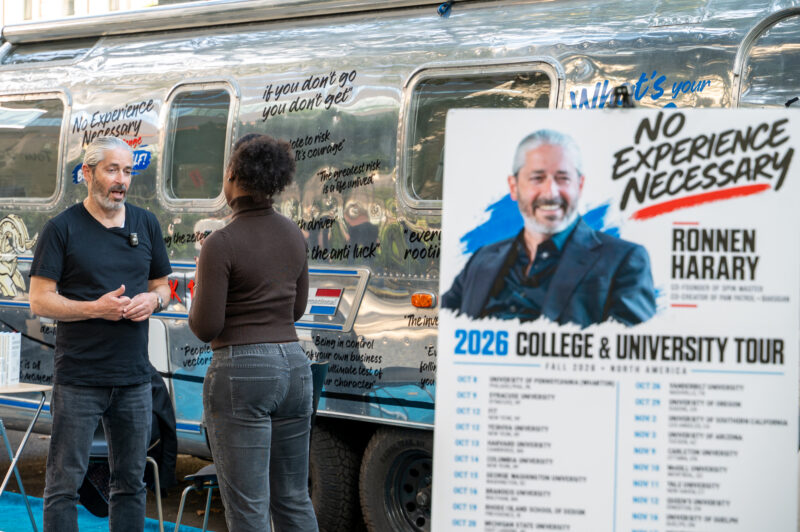
Ronnen Harary hears a pitch from a Barnard College student as part of a national tour on Oct. 14, 2026.


 Add EJP on Google
It was a sunny autumn day in Morningside Heights, in Upper Manhattan, and parked outside Barnard College, amid a thicket of food trucks and students’ e-bikes and scooters, sat a 30-foot 1976 Airstream Sovereign.
Somewhat out of place on Broadway and 117th, the travel trailer, plastered with vinyl decals bearing slogans like “No experience necessary” and “Doubt is the enemy of luck,” belonged to Ronnen Harary, the Jewish philanthropist best known as a co-founder of Spin Master, the Canadian toy and entertainment company behind “Paw Patrol” and “Bakugan,” and one of the largest toymakers in the world.
Through November, that airstream will be Harary’s home base as he embarks on an unorthodox cross-continent tour for his book, No Experience Necessary: Why Betting on Yourself in Your Twenties Is the Best Decision You’ll Ever Make.
Specifically, Harary is taking to the road to enact what could be described as pre-seed philanthropy, stopping at campuses across the U.S. and Canada, inviting students and passersby to deliver minute-long business pitches — and handing $500 on the spot to the ones he deems “winners.” In the 20 minutes that eJewishPhilanthropy observed the competition while waiting to speak with Harary, there were three winning pitches: one for an app for families to preserve their cultural heritage, one for a business combining a fashion marketplace with an art gallery, and a third from a student who hurried back to campus before eJP could inquire about the idea.
By the end of his tour, Harary is aiming to cast a cadre of eager young people who will then participate in a competition to become one of 10 winners of $25,000 grants that will allow them to further develop their idea; it’s a model borrowed from pre-seed investing, where backers bet on a founder long before there is a business to evaluate. The key difference is that Harary is donating, not investing, as he will not be taking any equity.
The idea for the book and the challenge came from his own life story, he told eJP. He founded his first venture at 23, building the company around Earth Buddies, a grass-growing novelty toy that took off in the mid-1990s. Now, traveling the country in his personal Airstream, he’s looking for bright-eyed, ambitious entrepreneurs like he once was, hoping to give them their first big yes and set them in motion.
Last week, at the fifth stop of 24 on his campus tour, Harary spoke with eJP about his new book, taking his Airstream to Burning Man and what he looks for in a pitch.
Nira Dayanim: So what’s happening to the Airstream after this?
Ronnen Harary: What’s happening to the Airstream? It’s a good question. It’s my personal Airstream from my house, and we drove it from Toronto. If we ever do another NEN pitch competition, we will use it again. Or I will probably take it on a nice road trip.
ND: A multipurpose piece of equipment.
RH: Yeah, no, I built it myself. I took it to Burning Man in 2018.
ND: And it has a history! So for the actual meat of what I want to ask you about, I know that in past interviews you’ve described this book as a form of giving back. I’m wondering why you chose this exact format — the book and the tour — as your way of giving back to people in their 20s.
RH: Well, the book was me, sharing my insights about why your 20s are such a magical decade and all the things that occur to you in your 20s, and I wanted to share that and highlight that everybody’s rooting for it: Everybody wants you to win when you’re in your 20s. No one sees you as competition. People want to help you out, and when you’re starting a business or anything in your career, everybody needs breaks, right? I also talk about the power of not knowing.
There’s something very magical about being inspired by something and wanting to bring something to life, and not knowing everything that’s needed to actually manifest it, other than your passion, and passion de-levers risk. Sometimes when you know too much, you overthink things, right? And then you get stuck. And doubt is the anti-life.
I wrote the book for people to give themselves permission to do what they want to do in their lives. I was very lucky that I did what I wanted to do in my 20s, and I had a lot of support and encouragement to go and do what I was doing.
For the contest itself, after the book came out, people said to me, ‘Ronnen, you need to try to put the book into action and put it into practice. It’s one thing for you to write something, but how can people experience what you wrote?’ And so the pitch competition is an opportunity for people to pitch an idea.
I’m a big believer in that, when you verbalize things, you’re able to make them happen, especially in this type of environment. You synthesize your thoughts, especially in like a one-minute pitch. I think the biggest thing is actually starting. And when you’re in motion, you create your own luck.
It’s teaching kids how to get into motion and also how to take a risk. Because the biggest thing that holds people back is actually just starting and taking the risk.
ND: I suppose you’re also giving people permission to ask, right? Asking their network and also asking you for your insight?
RH: A lot of it’s in the feedback too. If you saw me, I was workshopping a few people’s businesses.
ND: Right. So I was told there was also a philanthropic element, where you’ve given to some nonprofits tied to this campaign as well. Is that the case?
RH: Yeah, there were a few in Syracuse where people pitched, but it was actually a nonprofit. Actually, through my foundation, we donated support to their causes, but it was outside the contest.
ND: I know you wear a couple of hats. You’re a business founder and a mentor and also a philanthropist. Are there ways that you think the philanthropic ecosystem specifically could leverage this mindset?
RH: The book is all about making things happen. It’s about birthing ideas, and you can apply that to any aspect of your life. I wrote a whole chapter on luck, how you can generate luck. If you’re running a nonprofit and you want to be successful, you can learn stuff from my luck chapter. A nonprofit is very similar to starting a business, so a lot of the lessons are transferable. Finding partners, who you’re going to build your nonprofit with, zeitgeists. A lot of things are applicable.
I would say they can leverage the mindset if people actually want to get into philanthropy and they want to give back, and that is something that they are passionate about, and they feel that that is how they want to contribute, then they can start, right? They can start nonprofits and spaces that they’re super curious about, they’re passionate about, where they’re driven.
A nonprofit is exactly the same as a business, but it doesn’t have a revenue-generating model attached to it. But it’s a nice thing if nonprofits actually can become self-sustaining, then that would be an instant combination to put together, right? Where you can be a nonprofit, but there is some sort of revenue-generating mechanism to support the nonprofit.
ND: So your stated hope and goal in this project is that young people bet on themselves. Coming at it from the other side, what can people who are more established in their careers take from the book in how they approach younger colleagues and mentees and people at that stage?
RH: First of all, it’s the ideas. I think young people have so many amazing ideas, and so drawing out what they have in their heads and what they’re seeing in terms of trends and what’s happening in the zeitgeist, and letting them take on more tasks than you normally would. I’m a big believer that everybody has something to contribute.
So if you ever sat in a meeting with me in my office, I’d start with two people, and I end up with 10. And I bring people in that don’t necessarily have the domain or subject matter expertise, but they can contribute something. In our business, we’re all about diversity of thought and having the ideas, having multiple ideas, generating new ideas, and that only comes through diversity of thought.
So I would include lots of young people in conversation and discussion that you may not think that they should be included in. When people come to Spin Master, I’m like, “Don’t let HR map your career for you. You need to advocate for yourself.” But creating that environment where it’s more of a meritocracy. That’s really worked well for us in our business.
ND: So I know that you’re early into the campus tour. Can you tell me about some of the most compelling pitches that you’ve heard so far?
RH: I just had a woman. She’s from India, just rocked up. She saw the airstream, and her idea was so wonderful. She’s all about preserving families’ recipes and voice notes of grandparents, and it’s all about family history. She’s from India, and they speak like 100 languages there. And she’s like, “Even people in my own family don’t even speak the same languages.” So it’s all about preservation of history and families. I loved her idea. I thought it was really cool.
There was a guy who pitched the other day in Boston. I think he was from MIT. He had this cool camera, OK, in this Lego box, and he wants to film people who are doing science experiments and collect the data, and that’s going to output something that will reduce the error rate because it’s actually filming what they’re doing live in the lab. I was like, “Wow, what an ingenious idea!” I think this guy’s a pure genius. He was just waiting for somebody to tell his idea. And you should have seen how excited he got when he won. He was shocked.
You know, it could work, or it could not work. My team gets upset with me because I’ve given out a lot of $500 checks. But you know what? It’s so wonderful because it’s getting people in motion.
And it dawned on me today that this other woman that we just funded, you see her crying. It’s actually someone believing in them. That they can do it. She was in the class where I spoke before, and she had so much doubt. It clicked for me when I said yes to her, and we workshopped her idea because her pitch wasn’t perfect, that maybe no one’s ever believed in her. I was like, okay, there’s something here. And so you don’t know, and so you give people this magical start, and off they go, and they’ve got to get done in seven days, and let’s see what happens, and and start to they start to create magic in their own life, and someone believed in them,
ND: What are you looking for in a pitch? What is it that sticks out to you?
RH: I’m looking for originality. OK, I’m looking for execution, and I’m looking for the person at the end of the day. Is this person switched on? Are they doing it for the right reasons? Are they going to? Do they really want to put their time into this idea and do they want to be in business for themselves? And then I really adjudicate based on how they’re going to spend the $500. If they actually have a great use for it, then I’m much more likely to actually give it to them. If it goes towards certain things where it doesn’t have a really applicable grassroots in the moment of use. Then I’m less inclined.
ND: It’s like pre-seed funding.
RH: Yeah, but it’s like, don’t overthink it. Like, tachlis, it’s got to be tachlis for 500 bucks. Only your readers will understand that.
Related News
CLOSING WORDS
In AZM address, Cosgrove links communal ‘orthodoxy’ on Israel to rising anti-Zionism among young Jews
HIGHER EDUCATION
As Jewish donors reconsider academia, Jan Koum doubles down, endowing Israel studies at Stanford
ADVANCING A VISION
N.Y. federation donates $1M toward building shared-society center named for peace activist killed on 10/7

MAJOR GIFTS
Center for Jewish History celebrates 25 years with a $25M matching grant
PRESIDENTIAL REBUKE
Israel’s Herzog: Mamdani ‘makes no effort’ to hide disdain for Israel, Jews must fight back