Opinion
MOVED TO ACT
I was a little girl hiding from a mob. Now I’m standing up for my grandchildren.


 Add EJP on Google
I was 7 years old, hiding under a bed at my cousin’s compound in Tehran, while a mob outside screamed “Kill the Jews!” and banged on the gates; that was during a 1965 assassination attempt on the shah. Someone poisoned our family’s two dogs, I remember lying awake wondering whether the people who worked in our house, people we trusted, might turn on us too.
I didn’t read about antisemitism in a book or watch it in a movie. I lived it as a child. That’s why I smell antisemitism before other people can name it. It has a scent I learned before I knew how to read.
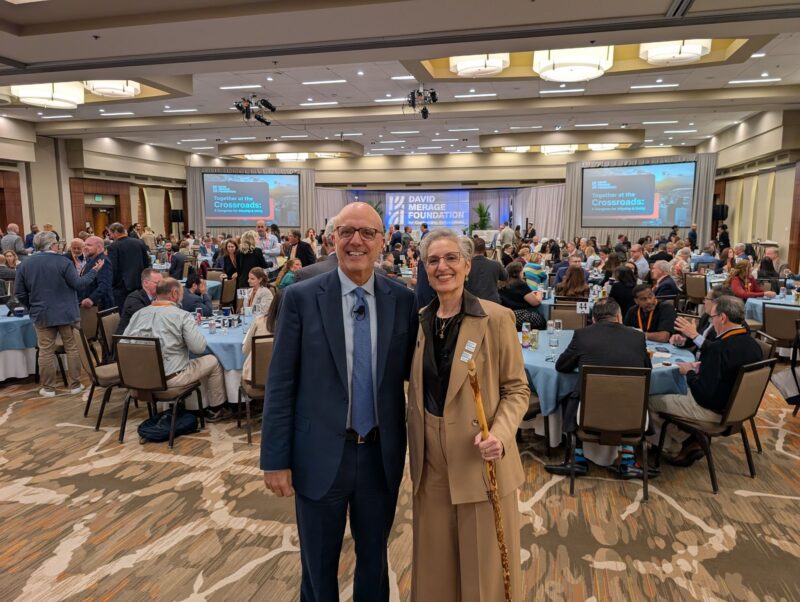
David Merage Foundation for Confronting Antisemitism/LinkedIn
Laura Merage, co-founder of the David Merage Foundation for Confronting Antisemitism, and Ted Deutch, CEO of the American Jewish Committee, pose at Together at the Crossroads: A Congress for Allyship & Unity in Denver, October 2026.
As a teenager in Iran, I wore a Star of David necklace openly, against my mother’s warnings. When I left for America at 15, I found a sanctuary I never had before. I have spent much of my adult life trying to describe that scent from my childhood to people who have never had to learn it. For years, I warned that antisemitism was rising in America. I was told repeatedly that it couldn’t happen here.
Then came Boulder. When I heard last year that people had been set on fire for the “crime” of walking for Israeli hostages, I got in my car and drove straight from Denver to a synagogue in downtown Boulder to sit with my community. The symbolism — Jewish Americans burning in the streets because of who they were — broke something open in me that I had kept sealed for decades.
Here is what history has taught me, at great cost: When people tell you what they intend to do, believe them. Iran’s ayatollahs have spent 45 years explicitly promising the destruction of Israel and the Jewish people, and much of the West treated it as rhetoric.
Now I catch myself watching my grandchildren head to the mall in Denver wearing their Star of David necklaces, wanting to tell them to tuck them under their shirts — the exact words my mother once said to me. I bite my tongue, but it breaks my heart. That is the arc of my life. I was a girl hiding under a bed in Tehran, and now I’m a grandmother hiding her fear from children who deserve to walk freely.
I refuse to pass down the feeling of fear to my grandchildren. So on Oct. 19 and 20, my family’s foundation brought 450 people to downtown Denver for the inaugural Together at the Crossroads: A Congress for Allyship & Unity.
The diversity in that ballroom was something I have never seen before in support of this issue. Roughly three in four people were not Jewish. Christians, Muslims and Jews sat beside elected officials, religious leaders, educators, students and business owners. A pastor from Tulsa came with the head of his city’s Jewish federation, saying he feels “inextricably linked to the Jewish fight.”
We launched the Boulder Firebombing Collection, so that the attack on Pearl Street and the life of Karen Diamond, who died three weeks later from injuries sustained during the attack, are never reduced to a passing headline.
Asked onstage how we move beyond hate, Mohammed Al Samawi, a Yemeni-American Muslim and the founder of Abrahamic House, said: “You need to actually create a connection, a bridge, so when a conflict happens, this bridge stands.”
“Don’t build it based on the conflict,” he said. “Build it based on relationships.”
The energy in that room was something I will carry with me for a long time: people who had never met, sitting at the same tables with a shared sense of purpose. One attendee told me, “For the first time since October 2023, I feel hopeful.” I felt it too.
But a feeling is not a result. We built this congress around action, and action is what people carried home. Leaders from 55 communities arrived as local action cohorts committed to working together before the next crisis rather than meeting for the first time after it. New cohorts even formed on the spot: Two different cohorts from the same state organized a new group and set a date for their next meeting before they left. Everyone went home with data-based tools, grounded in new research on what drives antisemitism and what actually works against it, and with public commitments to specific next steps.
In Denver, I asked everyone in the room for three commitments, but the same should be asked of everyone:
First, awareness. Most antisemitic incidents never make the news: a defaced synagogue in a town you’ve never heard of, a threat scrawled in a school bathroom. Awareness is the discipline of actually looking, and trusting the pattern when you see it forming.
Second, allyship. This is not a problem for Jews to solve alone. A society that tolerates hatred against one group has already signaled to every other group how it will eventually be treated. Real allyship means non-Jews speaking up in the rooms where Jews are not present — the boardroom, the dinner table, the group chat — not just at the vigil after something terrible has happened.
Third, ambassadorship. One person willing to stand up changes what is deemed “normal” or “acceptable.” Ambassadors are ordinary people who refuse to let antisemitic moments pass in silence, and who carry that refusal into the next room, and the next. More than 400 of them just went home from Denver. Each of us can be one more.
I don’t expect to eliminate antisemitism in my lifetime. But I believe more firmly than ever that we can push it back to the margins, out of respectable conversation — the way it was, imperfectly, when I first came to this country.
This is the same fight I’ve been having since I was a little girl under a bed, except now I’m not hiding. I’m standing up so that my grandchildren never have to hide. And after our congress in Denver, I know I am not standing alone.
Laura Merage was born in Tehran and moved to Los Angeles at 15. An artist, photographer and philanthropist, she lives in Denver and co-founded the David Merage Foundation for Confronting Antisemitism with her family in 2024.