Opinion
OUR ROLE
Why Israel’s election must be a unifying moment for American Zionists


 Add EJP on Google
When Israelis go to the polls on tomorrow, they will make electoral decisions that belong to them alone. They will choose their representatives, weigh competing visions for the country and help determine the makeup of Israel’s next government.
Simultaneously, millions of us will follow closely across the Jewish world, knowing that the outcome will resonate far beyond Israel’s borders. For American Zionists, this election also poses a question about ourselves: Can we remain united in our commitment to Israel even when we disagree about its political future?
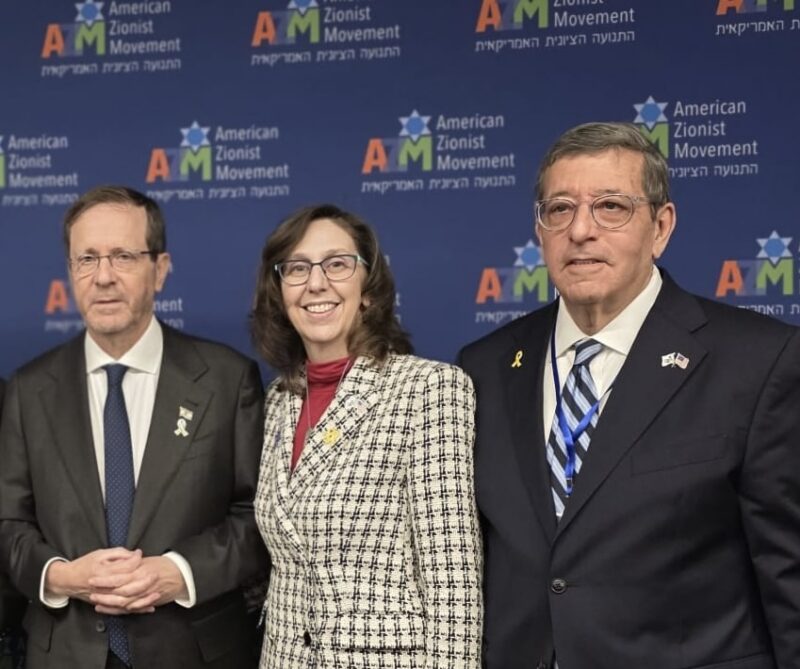
Courtesy/American Zionist Movement
From left: President of Israel Isaac Herzog; Shoshana Dweck, national board chair of the American Zionist Movement; and Mark Levenson, AZM president.
Our answer must be a resounding “yes.”
As lay leaders for the American Zionist Movement, we are proud to step forward once again for the unity of the Zionist movement at this critical juncture. Yes, we come from different places on Israel’s political spectrum, bringing varied lenses and perspectives. Naturally, we do not agree on everything. That is not a weakness to overcome; it reflects the diversity of the Jewish People that has been our hallmark across the generations and it is our strength. Our shared commitment to Israel, Jewish peoplehood and the Jewish future gives all of us both the foundation and the obligation to work together. That commitment will endure regardless of which parties gain seats or which coalition ultimately emerges in Israel.
Zionism is the Jewish People’s movement for national liberation and self-determination in our ancestral homeland. Its meaning reaches across generations, connecting our history to our responsibility for the future. No government or political party can encompass the full breadth of that connection.
Israel’s election presents an educational opportunity for us. Security, governance, accountability, the relationship between religion and state and the strength of democratic institutions matter deeply to Israelis and to Jews around the world. American Zionists should learn about these issues, listen to competing arguments and recognize that thoughtful people who care profoundly about Israel may, and often will, reach different conclusions.
Our differences become destructive when we turn them into tests of whether someone else belongs in the Zionist movement. A person who supports a different Israeli party does not thereby care less about Israel. Someone who questions a government policy does not by virtue of that challenge, reject Zionism. Nor should someone who defends that policy be dismissed as indifferent to Israel’s democratic future. We owe one another the respect of engaging with what people actually believe.
Israel’s legislative election also has a tangible impact on the Diaspora because the composition of the Knesset will determine approximately one-third of the representation in the next World Zionist Congress, the body that makes key decisions regarding the leadership and priorities of the World Zionist Organization, the Jewish National Fund-Keren Kayemet LeIsrael, The Jewish Agency for Israel and Keren Hayesod. These decisions dictate the course of over $1 billion in annual funding that is allocated to support Israel and world Jewry. Delegates from the United States, in turn, comprise about one-third of the Congress.
AZM — which administers the World Zionist Congress election once every five years — brings together 51 national Jewish Zionist organizations across a broad religious, political and ideological spectrum. Our shared principles include Israel’s right to exist as a Jewish and democratic homeland, its people’s right to live in peace and security and Israel’s central place in Jewish identity and life. These principles reflect our commitment to the Jerusalem Program, the official platform of the global Zionist movement, which calls for “mutual respect for the multi-faceted Jewish people, rooted in the vision of the prophets, striving for peace and contributing to the betterment of the world.” Such a commitment makes cooperation possible even when reaching consensus on particular policies is not realistic.
Unity does not require anyone to surrender convictions. It requires us to recognize that our common responsibilities endure through disagreement. For American Zionists, those responsibilities begin with remaining informed and involved. We should seek out Israeli voices across society and attempt to understand the unique pressures shaping their choices, especially as the continued aftermath of Oct. 7, 2023, means that those choices carry significant consequences for their lives. At the same time, we should ensure that the spectrum of our voices is heard in Israel, deepening the ongoing dialogue that reflects our entwined destinies.
We must also keep building relationships that reach beyond the election cycle. Visiting Israel, learning the Hebrew language, supporting educational and communal partnerships and connecting young American Jews with their Israeli peers give substance to Jewish peoplehood. Those relationships help us understand Israel as a living society, with all its creativity, complexity, challenges and promise — and it helps Israel understand the diverse American Jewish community.
This is especially important for the next generation. If young Jews encounter Israel only through political controversy, we have given them an incomplete understanding of a country central to the Jewish story. They deserve opportunities to ask difficult questions while discovering the history, culture, people and aspirations that make the connection meaningful.
The present moment is also a time to defend Israel’s legitimacy with clarity and confidence. No electoral outcome should make us hesitate to affirm that Israel has an enduring right to exist and that its citizens deserve peace and security.
Whatever coalition emerges, our work will continue: strengthening the relationship between American Jews and Israel, confronting antisemitism and efforts to delegitimize the Jewish state and sustaining a movement capable of respectful debate and collective action.
Some American Zionists will welcome the election’s outcome. Others will be disappointed or concerned. All of us should stay engaged in this conversation and keep listening to one another. That is what Zionist unity truly looks like in action.
Mark Levenson is the president of the American Zionist Movement.
Shoshana Dweck is the national board chair of the American Zionist Movement.