Opinion
BEST PRACTICES
‘Where did you come in from today?’


 Add EJP on Google
In Short
Engagement lessons from a cancer hospital.
“Where did you come in from today?”
I’ve been asked that question more times than I can count. It’s the first question you’re asked at the Dana-Farber Cancer Institute. Everyone has their answer, especially since many patients and staff travel far to reach the premier research institute. Mine is that I drove two hours from Western Massachusetts into Boston traffic.
mihailomilovanovic/Getty Images
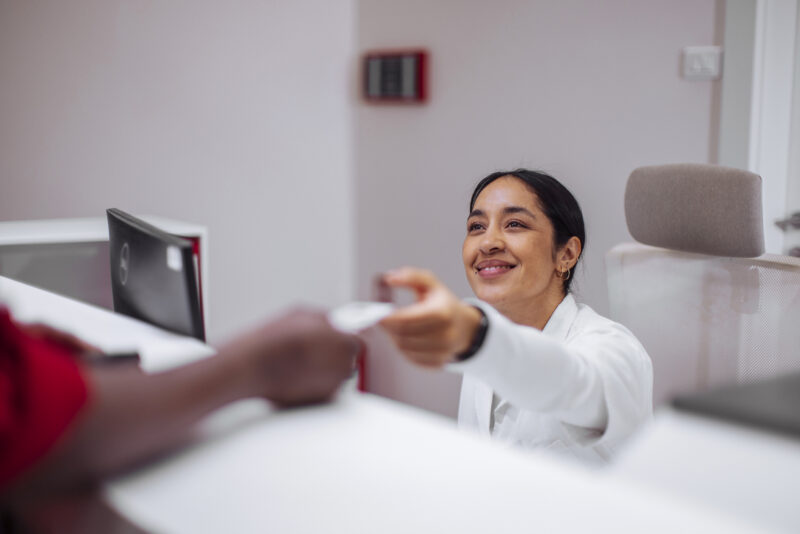
Illustrative. A medical receptionist accepts a card from a patient across a front desk.
Most importantly, the question sidesteps an obvious and painful one: “How are you doing today?” Most people would simply answer, “Not good.”
I have cancer. Not good.
I’m nauseous and tired. Not good.
I just got a frightening diagnosis. Not good.
Someone I love has cancer. Not good.
Every single time I went to Dana-Farber, it was clear that all the staff had been trained in this protocol, ensuring anyone could start a conversation in a way that created genuine connection without making me feel awkward or unwelcome.
Over the course of the past year of treatment for breast cancer, I’ve experienced top-tier engagement strategies. While Dana-Farber is one of the best-funded institutions in the country, much of what I saw could be replicated in any nonprofit. Small (and free) shifts in culture can have a big impact.
Anticipate needs
When I received my diagnosis, my doctor gave me my likely protocol — Page 68 of the “Treatment at a Glance” binder. It mapped out the next year of treatments week by week and listed common side effects alongside basic contact information. I kept a photo of the page on my phone and shared it with family, colleagues and friends. The simple flyer worked because my doctors anticipated that I’d need basic information readily accessible, over and over again.
During that same first visit, someone also checked my veins to determine whether I should have port surgery before chemo, and they took measurements for a cooling cap I didn’t end up using. The scheduling staff works hard to stack multiple appointments into one day so I don’t have to make unnecessary trips to Boston.
Most of us have developed enough empathy through our work to know common needs are likely to arise and create simple solutions. Working with families with kids under five? Have a special bin for dirty diapers and used food pouches, especially at off-site locations. Working with middle-aged folks? Make the print on everything a little bigger; there’s a reason for reading glasses. By anticipating even the small or mundane needs, people more easily trust us and our work. We’re sending a clear message: This isn’t our first rodeo.
Keep track of people
When you step into Dana-Farber, you’re given a small pager-like device. Throughout the building, there are boards that medical staff can see, showing exactly where people are located. This is essential in a hospital, where people have medical emergencies. But the idea behind this system can be applied anywhere.
Where are people likely to get lost in your system? In an email marketing journey? Between attending a large event and receiving individualized outreach? After a child ages out of school? As a college professor in both online and in-person classes, I’ve learned that when I haven’t heard from a student during the early weeks of the semester, I need to reach out more urgently than during the last week when they are focused on final projects.
Anticipate the moment of transition when someone may be alone and in need of help. How can you deploy resources to go find them before it’s been too long?
Have a double-checker
The infusion nurses at Dana-Farber are among the best in the country, and it’s still frightening work. They don a full-body apron, extra-long gloves, and a mask before administering chemotherapy. They’re essentially poisoning their patients to make them better. After they’ve set up the infusion and calibrated the machine perfectly, they step out and ask for a check. A second nurse comes in and reviews everything the first nurse did: not to give feedback or to make small changes, but to affirm the decision. That check never takes longer than 60 seconds, but it builds confidence — in the patient, in the staff, in the institution. It shows humility (no one is perfect) and meticulousness.
Before you make a big decision or a major shift in your work, it’s wise to find a teacher, friend, or colleague and gut-check your assumptions.
I don’t wish this cancer journey on anyone. But this year at Dana-Farber has changed how I think about connection and care more than any professional development I’ve attended in my field, most of which echo the same messages in the same way.
One in eight women will have breast cancer in their lifetime. That number is higher in the Jewish population, given genetic risks. Whether it’s them, a parent or a friend, the people we serve are walking into places like Dana-Farber, and they’re carrying those expectations back to us. They deserve to find the same care when they walk through our doors.
Go see for yourself: Shadow in a system radically different from yours and pay attention to what they do that you don’t. Or come with me; I’m always looking for a waiting room buddy.
Just tell me where you’re coming in from.
Meredith Lewis is the managing director at UMass Hillel and a member of the faculty in the Hornstein Jewish Professional Leadership Program, where she teaches about management, leadership and career advancement. She is thankful for the compassion and dedication of the entire staff at the Dana-Farber Cancer Institute during her treatment for triple-negative breast cancer.