Opinion
FRIENDS IN DEED
True community partners


 Add EJP on Google
In Short
Hebrew Free Loan Detroit’s landmark $1 million interest-free loan to Temple Israel in West Bloomfield, Mich., helped reopen the damaged synagogue in time for the High Holy Days.
In the Jewish community, we often talk about the value of relationships in terms of friendship, community and belonging. These traits are essential to who we truly are as Jewish communal professionals, and what we desire our institutions to reflect.
They are often revealed in the moments we never expected, and never wanted to face, but it’s true that when a crisis comes, you discover who your partners truly are.

Courtesy
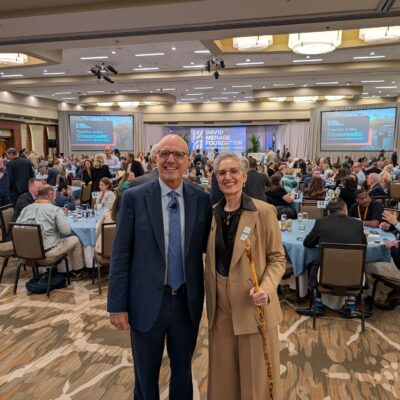
Hebrew Free Loan Detroit’s landmark $1M interest-free loan to Temple Israel helped reopen the damaged synagogue in time for the High Holy Days.
Here in Michigan, we experienced one of those moments of crisis on March 12, when Temple Israel in West Bloomfield was attacked by a terrorist trying to cause harm to our community.
In the wake of that horrific event, not only was Temple Israel’s physical structure damaged, but our community’s emotional well-being was damaged as well – especially for our clergy, staff, faculty and family members.
At Temple Israel, we continue to multitask in order to maintain the continuity of services our members have come to expect – from childcare to religious programming and learning opportunities – all while our leaders work on security initiatives, navigate logistics with off-site locations, coordinate the rebuilding of our campus, raise funds for the long-term health of this community and work with our insurers.
While the added attention and responsibilities have been a heavy load for the synagogue leadership to carry, we truly experienced a miracle: just six months after the attack, Temple Israel was able to open its sanctuary to celebrate joyous and gratitude-filled Rosh Hashanah services in our newly revitalized space, even as construction continues across our campus.
But there is no way Temple Israel could have done this alone: $1 million of the Temple’s rebuilding assets have come as a no-interest loan from Hebrew Free Loan Detroit (HFL), which exists so that Jewish individuals, families and businesses can tap interest-free funding for a wide variety of needs.
Prior to the March 12 attacks, HFL and Temple Israel were already partners in a program created to benefit Temple staff members who wished to access interest-free loans. Temple Israel would act as co-signers, and employees would repay their loans through payroll deduction. On the surface, this quiet program was a practical benefit for Temple’s employees, but as we would soon learn, it was also the building block for something much bigger.
After the March attack, the critical need for cash on hand to immediately pay vendors sent Temple to approach HFL for financial assistance. HFL’s response was rapid, and the subsequent $1 million loan is 10 times larger than any other loan the agency had ever disbursed in its 131-year history in Michigan.
Hebrew Free Loan’s Michigan Jewish Organization Loan Program, created with a generous matching grant from The Ravitz Foundation, disburses 0% loans that typically max out at $100,000 each, and are generally used for Jewish institutions to expand their buildings, increase security or make critical repairs. In some cases, these loans replace cash in hand when the insurance or grant money have not paid out, or capital campaigns are underway, yet the construction is in progress.
HFL’s board president, Jonathan Sterling, and board secretary, Jonathan Fellows, connected with Rabbi Josh Bennett of Temple Israel and got right down to “talking tachles.” It was obvious that HFL’s standard $100,000 loan limit was not going to do much to cover the immediate need of the rebuilding efforts at one of the largest synagogues in North America, which serves more than 3,200 households.
Temple Israel’s situation was extraordinary, and in extraordinary circumstances, HFL guidelines allow for its board to make extraordinary exceptions — and in this case, HFL’s board members proudly and unanimously approved the massive no-interest loan.
Symbolically, the loan agreement, utilizing a repayment plan over three years that works within Temple Israel’s cashflow needs, was finalized a week before Tisha B’Av, an observance of the destruction of the First and Second Temples thousands of years ago in Jerusalem.
That morning, the leaders of our two organizations met for breakfast, and HFL presented TI with the $1 million check. This was a warm and celebratory gathering where the leaders of our two organizations connected and shared all that had gone on since that horrible March day.
It is one thing to say “we’re here for you” after a tragedy, and it is another to say that same sentence while handing someone a $1 million check to help them rebuild. This is how you partner from friendship, community and belonging: Hebrew Free Loan and Temple Israel have become indelible parts of each others’ stories.
This synagogue/agency partnership has come from decades of close friendship and collaboration between our institutions, but also with support from the Jewish Federation of Detroit, which promotes and enhances each one’s work to benefit our entire community.
Michigan Jewish life thrives because we all take “community partnership” seriously.
The March 12 attack changed the way many Jews — in West Bloomfield and across America — think about security, vulnerability and resilience. It also reminded us of something equally important: resilience is not simply about preparing to withstand a crisis, it is about having a community around you who will act when crisis arrives. This is what mishpacha (family) does.
Extraordinary times arrived, and our community relationships became an extraordinary source of strength. For Temple Israel and Hebrew Free Loan, that may be one of the most important investments any of us can make.
Jason Plotkin is the executive director of Temple Israel in West Bloomfield, Mich.
David Contorer is the executive director of Hebrew Free Loan Detroit.