Opinion
A VIEW OF THE FIELD
One year later, are we getting smarter about antisemitism?


 Add EJP on Google
We’ve all been into counting steps for a while now. If you don’t have an Oura ring, you check the step counter on your phone. These pedometers are great, but they can only tell if you are moving, not if you are advancing.
Philanthropy, and Jewish philanthropy in particular, is usually very good at measuring its steps. We know how much money we’ve spent, how many organizations we’ve created and how many millions of impressions we’ve generated on social media. We have a much harder time determining whether any of this has brought us closer to our destination: the long-term impacts we seek.
Alexi J. Rosenfeld/Getty Images
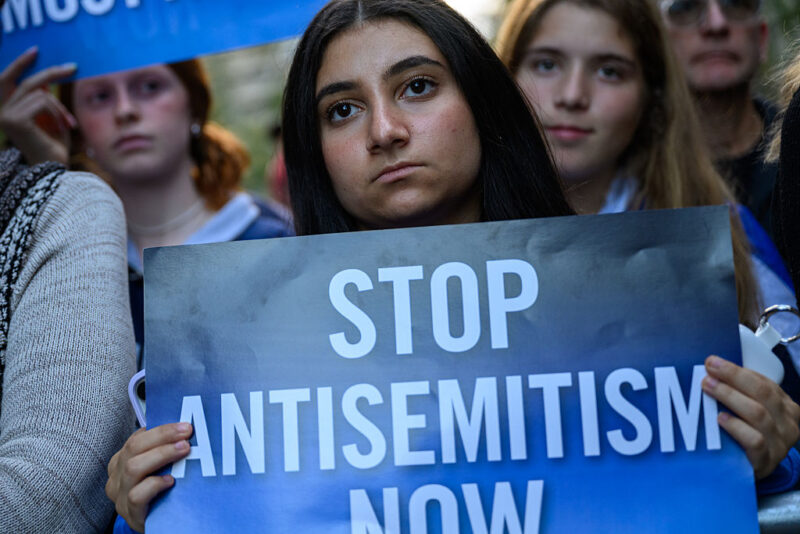
A girl holds a "Stop Antisemitism now" sign during in the "No More Excuses Rally Against Antisemitism" held outside of the 81st session of the U.N. General Assembly at U.N. Headquarters on Sept. 23, 2026 in New York City.
A year ago, the Jewish Funders Network published a study of the ecosystem of organizations fighting antisemitism, led by professor Eitan Hersh of Tufts University and made exclusively available to JFN members. The study examined 160 organizations working to combat antisemitism and the 25 largest funders in the field. The findings were sobering. We found impressive passion, dedication and activity, but also fragmentation, duplication and a striking absence of meaningful measures of success.
Our conclusion wasn’t that we were spending too much money; it was that we frequently didn’t know whether we were spending it effectively. More than half of the organizations examined had failed to establish clear, realistic parameters of success. Many confused distance with destinations, activities with outcomes, social media engagement with persuasion and the satisfaction of their funders with the achievement of their missions.
A year later, it’s time to check in. Have Jewish funders and nonprofits learned anything? Have we advanced, or are we just adding steps to our pedometers?
The answer is a definitive maybe.
Let’s start with the obvious.
The bad news is that antisemitism, the focus of all of these efforts, isn’t going away. I don’t have to bore you with statistics; suffice it to say that we are still at record levels of antisemitic incidents, both domestically and internationally. And these incidents are only part of the picture: Antisemitic ideas are also finding increasingly comfortable homes in mainstream political discourse. On the right, conspiratorial rhetoric and figures such as Tucker Carlson have expanded their reach and influence. On the left, the electoral success of politicians whose rhetoric about Israel and Zionism most Jews find deeply troubling demonstrates that positions once considered politically disqualifying are not necessarily so anymore.
The recent selection of Navi Pillay, who embraced and promoted anti-Israel libel, as this year’s Nobel Peace Prize winner is not catastrophic in its own right, but it reflects a zeitgeist. Lies about Israel and Jews have become acceptable — even normative — discourse among “the enlightened.”
We also have to recognize that, in some cases, our efforts to explain Israel are undermined by Israeli leaders whose statements and actions make the task exponentially harder. We cannot pretend that every public relations problem is merely a failure of communication. Sometimes the problem isn’t how a policy is explained, but the policy itself. Of course, this isn’t our fault as Diaspora funders and institutions, but it shows that our influence in Jerusalem is marginal. That is sobering too.
These realities don’t prove that our strategies failed, nor that we haven’t learned anything about the field in the last year. Antisemitism is driven by political, cultural, economic and technological forces over which Jewish organizations have limited control. It would be intellectually dishonest to assume that a rise in antisemitism necessarily means that our efforts were ineffective, just as a decline wouldn’t necessarily prove that they worked.
Yet the setbacks hurt. We can’t say, for example, that Zohran Mamdani’s victory was “our fault,” but we can say that it demonstrates the limited political effectiveness of our existing approaches.
So what did we learn?
There is some good news in the field. The number of organizations seems to have peaked. Our count of antisemitism-fighting organizations stands at 175. That’s more than last year’s count of 160, but the number has plateaued and is starting to decrease.
An important improvement is that the conversation itself is changing. Perhaps for the first time since Oct. 7, 2023, our community has begun questioning not only whether we are spending enough money, but whether we are spending it wisely.
In February, New York Times columnist Bret Stephens delivered his State of World Jewry address at 92NY. He described much of the fight against antisemitism as a “well-meaning but mostly wasted effort” and called for redirecting resources toward strengthening Jewish identity, education and communal life.
I don’t agree with all of Stephens’ conclusions. Dismantling our capacity to confront antisemitism would be a dangerous overcorrection. Jewish education and fighting antisemitism are not mutually exclusive pursuits, and a strong Jewish identity is not a substitute for legal protection, political influence or physical security.
But Stephens was articulating something that a growing number of funders have begun to understand: The question isn’t simply how much we spend, but what we achieve.
That’s a significant change because these are precisely the questions that a mature philanthropic field needs to ask.
While the field hasn’t consolidated, funders’ collaboration is increasing. The Har Initiative is a case in point: In its first two years, it has brought together funders with different ideological perspectives and mobilized approximately $75 million to support long-term strategies, experimentation and measurement. While there’s no one-size-fits-all answer to collaboration, the Har Initiative represents a more thoughtful approach to funding.
Another promising move is that the community seems to be moving from pleading to exercising power. For decades, much of our communal response consisted of education, awareness campaigns, public denunciations and attempts at persuasion. Those activities have a place, but they aren’t the only instruments available to us.
In a democratic society, citizens can exercise political influence. They can organize voters, advocate for legislation, hold public officials accountable and use the courts to enforce their rights. We’re beginning to see more of that. Political initiatives such as the New York Solidarity Network are spreading across the country, seeking to turn Jewish communal concerns into coordinated civic engagement.
The larger Jewish political landscape is also increasingly active, even if its organizations pursue sharply different and sometimes conflicting political agendas. We may still be losing elections, but our enemies didn’t build a political apparatus in a year — their current victories are the result of sustained, long-term investment.
Legal action, while not new, was identified as an important, and sometimes overlooked, part of the arsenal. Litigation pursued by the Louis D. Brandeis Center for Human Rights Under Law, for example, and by other organizations has produced concrete institutional commitments. In February 2026, for instance, Columbia University reached a settlement with Jewish student plaintiffs and organizations that included additional measures addressing antisemitism.
Not everybody plays the litigation game wisely or effectively, and we should be careful not to confuse winning a settlement with solving a problem. We also need to evaluate the long-term effects of legal interventions. But at least these strategies can produce identifiable, enforceable and measurable outcomes. Funders are funding them more, and that’s salutary.
There’s also a welcome shift in our understanding of where antisemitism is produced and disseminated.
Our community has spent enormous energy fighting on social media platforms, often reacting to an ecosystem that evolves faster than we can understand; an ecosystem dominated by nefarious foreign state actors whose influence seems impossible to curb in the current political environment. We got confirmation of that reality when we saw recently how a single Ukrainian drone hitting a Russian data center may have eliminated more bigoted content from social media than all our campaigns combined.
Meanwhile, the architecture of how people acquire information is changing profoundly.
Wikipedia is not merely an encyclopedia. It is a key part of the informational infrastructure on which search engines, digital assistants and AI systems depend. Large language models are rapidly becoming intermediaries through which millions of people encounter history, religion and politics. A biased or inaccurate answer about Jews, Zionism or Israel can now reach audiences who may never open a newspaper or watch a conventional news broadcast.
We are beginning to pay attention.
At the time of our report, the Kirsh Foundation was the “lone warrior” working on things like gaming and alternative platforms such as Discord. Now more funders have joined them. Several funders are now looking at AI platforms such as large language models, and the manipulation of Wikipedia has been exposed.
We’re also starting to pay attention to the opportunities these new platforms bring. A 2025 experimental study supported by the Anti-Defamation League found that brief conversations with an AI chatbot reduced participants’ belief in antisemitic conspiracy theories. That doesn’t establish long-term effectiveness at scale, but it offers something often missing from our communal work: an innovative intervention subjected to empirical testing.
Of course, this is just a beginning. We have yet to demonstrate that we can meaningfully influence these information ecosystems over time, but recognizing that the next battlefield may not resemble the last one is an important advance.
Along the same lines, funders are looking seriously at exposing networks of foreign influence in universities, government, “protest” movements and news organizations. Whether exposure will be enough without muscular government action remains to be seen, but at least we understand better how our enemies operate and the networks that sustain them.
Finally, in our report we said the problem wasn’t necessarily the number of organizations but the lack of shared platforms, utilities and infrastructure. In other words, most organizations created their own infrastructure, which was both wasteful and subpar. Some shared utilities platforms were created, which is a positive development.
Yet the reality is that the field as a whole still hasn’t been transformed. For starters, we still lack a sufficiently transparent, comprehensive picture of how much money is spent, by whom and on what. We still have far too much duplication. We also still lack an adequate culture of evaluation. While funders have developed a sense of urgency around antisemitism, they don’t show the same urgency in optimizing the field. Or, to put it better: Many recognize the field’s structural problems, but few are willing to let go of their favorite initiatives to solve them.
In general, short-termism remains a problem. As a community, we are still in reactive mode. That’s understandable, given that we face an unprecedented crisis every week, but so far, our enemies still have the initiative, and we respond. Responding is necessary, but it’s not enough.
Since last year, we’ve advanced, but we haven’t fully overcome the tendency to mistake moral certainty for strategic competence. Just because a cause is righteous or makes us feel vindicated doesn’t make every intervention effective.
Also, a warning: We also shouldn’t replace one simplistic approach with another. The conclusion that money alone won’t solve antisemitism doesn’t mean that money is useless. Realizing that education has limits doesn’t mean education is pointless. And discovering that certain forms of advocacy don’t work doesn’t mean we should abandon advocacy.
The fight has different objectives, each requiring different strategies, competencies and standards of evaluation. Fighting antisemitism isn’t a single activity — it’s an entire ecosystem of interventions. Some are traditional philanthropic activities; others require political activism, policy and litigation.
We shouldn’t demand that every initiative eliminate antisemitism, but we should demand that every initiative explain precisely what it intends to accomplish.
The encouraging development isn’t that we’ve found the magic formula. It’s that more people are beginning to recognize that there isn’t one.
That, in itself, is progress.
Andrés Spokoiny is the president and CEO of the Jewish Funders Network.