Q&A
Philanthropy closely monitoring Israeli election, waiting to see next coalition and its priorities
'Funds and foundations are waiting to see what the elections will bring,' Sigal Yaniv Feller, the executive director of Jewish Funders Network-Israel, tells eJP
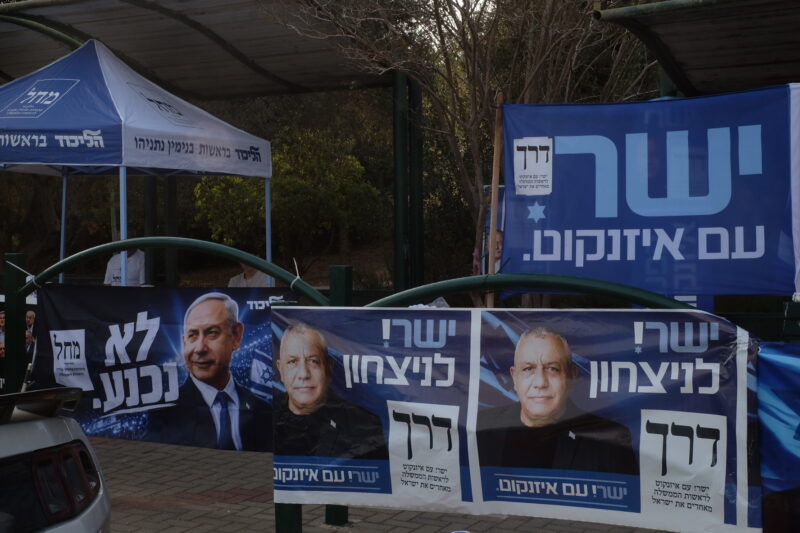
Judah Ari Gross/eJewishPhilanthropy
Signs are seen for the Likud and Yashar parties outside a polling station in Zichron Yaakov, Israel, on Oct. 27, 2026.


 Add EJP on Google
As Israelis cast their ballots today in the long-awaited election, the first since the Oct. 7 terror attacks, much of the Jewish philanthropic world is also anxiously awaiting results, refreshing the news and messaging Israeli colleagues and family. For many, the outcome of the election will not only be a matter of political or ideological concern but also a matter of significant professional consideration, shaping funders’ priorities and opportunities for years to come.
Some major foundations have been holding off on large strategic commitments until a new government takes shape and opportunities for government matching and collaboration grow clearer. Meanwhile, in recent years, some funders have moved into political philanthropy and are waiting to see whether their efforts paid off. Sigal Yaniv Feller, the executive director of Jewish Funders Network-Israel, has watched those shifts from the epicenter of the Jewish philanthropic world and its giving in Israel.
Yaniv Feller joined the Israel arm of JFN in 2015, serving as deputy director and senior director of advisory services before becoming executive director in November 2021. The Jewish Funders Network is nonpartisan, and its members hold a wide range of political views.
In an interview with eJewishPhilanthropy, Yaniv Feller outlined the trends reshaping Israeli giving ahead of the vote, the issues likely to stay on funders’ agendas once a new government forms as well as her reasons for optimism.
Justin Hayet: Israelis head to the polls today. How has the lead-up to the election shaped funders’ decisions over the past year?
Sigal Yaniv Feller: The moment before the elections is generating a lot of sitting on the fence, in terms of philanthropic decisions on the longer term and strategic, larger-scale investments.
Funds and foundations are waiting to see what the elections will bring. Meanwhile, we are also seeing rapid decisions that the government is taking, such as pulling money out of the commitments to the five-year plan for Arab society and shared society and putting that funding into the security and defense needs of the country. A lot is on hold until after the elections, when there will be more clarity about the direction of the country.
We are seeing some philanthropic trends related to the election. The first is that quite a few funders and foundations are actively involved in political philanthropy. They have come out of the closet, so to speak. In previous years, they did it more discreetly. Now they’re out in the open. That does not necessarily mean funding a specific party or candidate. They’re involved in organizations and initiatives related to maintaining the integrity of elections, creating a good pipeline of leadership in the political arena and helping create professional political agendas for the various parties, right and left, on topics like education, employment and gender.
JH: What else are you seeing on the ground?
SYF: The second trend is that we see some foundations put a lot of money into political philanthropy at the expense of other fields that they might’ve funded previously. So temporarily, just like we’ve seen after Oct. 7 — that funders doubled down on emergency [grants] and maybe paused the regular funding — now we’ve been seeing a pause in regular funding in order to support doubling down on elections.
The third trend we are seeing is foundations that have deep collaborations with the government that are afraid to be associated with political involvement and are very, very vigilant and careful not to be seen as politically [against or in favor of the current government] so that it doesn’t damage or impact their collaborations and [potential] match funding with the next government.
The fourth trend is that the high-tech sector is involved in funding political philanthropy at the moment. A lot of the high-tech community is invested in liberal democracy causes and organizations. This is the same high-tech community that was heavily invested in the demonstrations against the judicial reform and also stepped up immediately post-Oct. 7.
JH: How are philanthropic foundations preparing for the next government?
SYF: There are quite a few foundations that have been investing over the past year and a half in in-depth policy papers, white papers, research, mapping, to be able to be ready to whichever government is elected and offer them well-thought-through and strategic plans around different fields in Israel, ranging from education to welfare to domestic violence to gender equality to climate to employment to mental health. These funders want to ensure that the new government has reliable data and policy proposals so the government can move quickly and hopefully promote some of these.
JH: How does this moment fit into the history of Israeli philanthropy?
SYF: If we look at the history of philanthropy [in Israel], the first 50 years of the State of Israel, philanthropy largely invested in nation-building: investing in the infrastructure of Israel, our academic institutions, our health institutions, our infrastructure and the army. In the past 20-25 years, philanthropy has evolved into investing much more into human capital and society-building.
I like to differentiate between the era of nation-building and the society-building that we are currently in. And they are not mutually exclusive. There are still a lot of capital grants and investment in nation-building, but alongside that, there’s been a lot of investment in leadership development, civil society and society-building.
And after Oct. 7, the philanthropic community had to backtrack and go back into investing in nation-building, in the South and in the North, but philanthropy also continued to invest in society. And I think, to the same tone of that, we will see a lot of that after the election: a continuation to invest in the nation’s infrastructure, but also in our society, and our polarization and our leadership and creating trust again and creating optimism and hope.
JH: You mentioned investing in leadership. How could the election affect the people who lead Israel’s nonprofits?
SYF: Throughout the campaign of the last few months, we see human capital moving from the philanthropic and nonprofit sector into political parties, which is natural. That happens every year, every time there are elections, but we’re seeing more of that now. And after the elections, we’ll see movement again of human capital. So if some parties lose, we might see some of their manpower moving into the nonprofit and philanthropic sector, and if some parties win, we might see more movement of good people from the nonprofit sector into the government, both into the professional roles and the political roles. I think there’s another wave coming, depending on the election results.
JH: What do Israel’s nonprofits need most from funders right now?
SYF: The sector that held the country together after Oct. 7 was Israel’s social sector. We need to invest in it to make sure we have a strong backbone to be able to face our future challenges. So I think that’s a critical, critical element to invest in.
Take an additional $10,000 or $20,000 and take your staff on a retreat or maybe finance mental health support for your staff if they need it. It’s not a lot, but it would go a long way, and the fact that these organizations feel that they’re seen by their funders goes a long way. And I’ve seen quite a few funders do this in the past two years, and it’s been amazing.
JH: As emergency giving winds down, which focus areas will stay on funders’ agendas?
SYF: Mental health is a huge focus for funders and it’s going to continue to be very big. Just a few weeks ago, in one week, there were six suicide events of IDF soldiers who had been released from the army and then committed suicide while they were still in service. Regional recovery, especially economic regional recovery, in the South and the North — but necessarily a larger emphasis on the North. That’s a big priority [for many funders].
The erosion of democracy is huge, and I think it needs to be something philanthropy invests in, especially because philanthropy has a critical role in a democracy. And if we are no longer a liberal democracy, it will be much harder for philanthropy to operate, and the nonprofits are gonna be limited in their scope of operation. And so I think having a strong, democratic, Jewish country will continue to be a priority for funders.
And of course, the last two topics that are ongoing but in a very bad situation are our education system and the violence in Arab society.
JH: What gives you hope right now?
SYF: We’ve seen new foundations to Israel. They aren’t necessarily new, but they’re new in their larger-scale investments in Israel. Second is that existing foundations are expanding their infrastructure on the ground by hiring more professional staff, looking for office space, and that means the growth of the professional community, professional philanthropic community, that sustained all this work.
Also, we haven’t seen funders leaving Israel. We haven’t seen Israelis — you know, maybe there are Israelis that are leaving Israel, at least temporarily — but we haven’t seen any of the JFN-Israel philanthropic community funders leave Israel. And we know that they can live anywhere in the world that they want to, but they’re here to stay, and they’re investing and doubling down in Israel. We’ve seen them over the past 3½ years very committed, very deeply involved with giving and with hope and involvement to make Israel a better place.
JH: Wait, there’s more optimism?
SYF: Fourth optimistic note: the scope and level of philanthropic collaboration. In my 25 years of working in the philanthropic sector in Israel, I’ve never seen such a scope. It’s the largest and widest that it’s ever been. It’s the era of philanthropic collaborations, so we are seeing so much collaboration.
Related News
EXCLUSIVE
Detroit-based philanthropists Nancy, James Grosfeld donate $8M to renovate JDC’s Israel campus
HIGHER EDUCATION
As Jewish donors reconsider academia, Jan Koum doubles down, endowing Israel studies at Stanford
ADVANCING A VISION
N.Y. federation donates $1M toward building shared-society center named for peace activist killed on 10/7
PRESIDENTIAL REBUKE
Israel’s Herzog: Mamdani ‘makes no effort’ to hide disdain for Israel, Jews must fight back
EXIT INTERVIEW
Elizabeth Sokolsky, longtime EVP of Birthright Israel, to retire next year