Opinion
LEARNING OPPORTUNITY
What Israel’s community centers taught me about ours


 Add EJP on Google
In Short
North American JCCs and community centers in Israel should build standing partnerships, one center to another, organized around the operating questions we share.
On a Monday afternoon in October, I sat in a room at the Baka Community Center, a matnas (an acronym for merkaz tarbut no’ar sport, or youth, culture and sports center) in the Baka neighborhood of Jerusalem. With me were the top executives from JCCs across North America; we were in Israel for Kivunim, a leadership seminar run by the JCC Association. Across the table sat Elad Goldenberg, who directs the matnas, and Adi Schmidt, who leads partnerships and development for the Jerusalem region. We were speaking as colleagues, one community center professional to another, about how to build community and build bridges between communities.
The Baka Community Center was reminiscent of the Aaron Family JCC in Dallas, where I serve as CEO. When we arrived, I felt as if I could have been walking into our own lobby on a weekday afternoon. There were children out front and people of all ages and from all walks of life inside and around the building. That familiarity was the first lesson of the day: Halfway around the world, in a city that lives with pressures we rarely face in Dallas, a community center still looks like a community center — a place where people arrive for different reasons and end up sharing the same doorway.
Courtesy
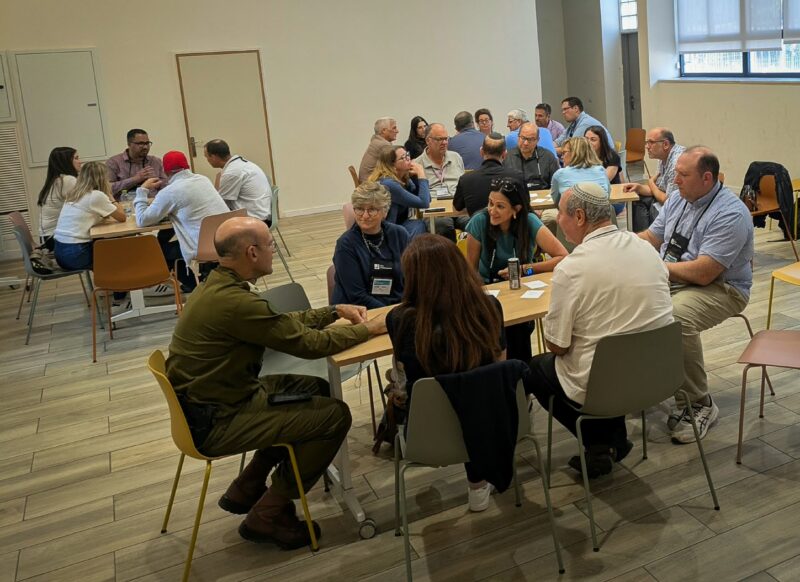
JCC Association Kivunim CEO Seminar participants with Baka Community Center counterparts.
That afternoon in Baka raised the first question I carried home as a JCC CEO, because I face it every week in Dallas: What is a community center for?
Much of what Eldad and Adi face would sound familiar to anyone who runs a JCC. What differs is the setting. Jerusalem is a city where the population changes block by block and war is never far away. A matnas in that city cannot choose one community to serve and leave the others to find their own place. The whole neighborhood is the constituency.
In North America, we often describe the J by what we offer: we have fitness centers, preschools, camps and programs for older adults, and those programs are the reason many families walk through our doors. I am proud of every one of them at the Aaron Family JCC, but a list of programs describes services, and families can buy services elsewhere.
The Baka matnas starts from a different place. It treats the neighborhood itself as the work: Who in the neighborhood is missing from the room and what it would take for them to come in? That is a harder standard than the one most of us use, and I think it is the right one. A JCC that measures itself by membership numbers alone will drift toward becoming a very good gym with a Jewish name. A JCC that measures itself by whether different kinds of people in its community actually meet one another is doing something no one else in town can do.
The Dallas Jewish community, like many others in North America, is more varied than many people outside it assume. Our members include families across the spectrum of observance; Israelis who have made a life in Texas; interfaith households; Jews with no synagogue at all; and neighbors who are not Jewish and come to the J because it is a good place for their kids. They do not always agree, especially about Israel. The second question I brought home from Baka was whether we invite those groups to shape the J together, or only to use it.
Avraham Infeld, an educational pioneer and president emeritus of Hillel International, also addressed our group that day. He spoke about what holds Jews together across geography and practice. Many in our field know his image of Jewish identity as a table with five legs: it stands on three or four of them, falls over on two, and on one isn’t a table at all.
Israel is one of those legs — and for a growing number of American Jews, it is the leg that wobbles.
Back on our first full day in Tel Aviv, we ended the day in the home of chef and two-time New York Times best-selling cookbook author Adeena Sussman. The conversation turned to how food carries Jewish memory from one generation to the next. Infeld’s table was a metaphor, while the table we spoke of at Sussman’s was a more corporeal symbol, but there was a connection to be found there about the role of linking Jews and strengthening today’s wobbling table leg.
A family in Dallas whose teenager knows a teenager in the Western Galilee relates to Israel differently than a family that only reads about it. A JCC program director who has a counterpart at a matnas, someone she can call when a program fails or a crisis hits, understands Israel as a place where colleagues live and work. That is peoplehood as a practice, and community centers are built for it. We already know how to put people in a room and keep them coming back.
So here is my ask of the field: JCCs and matnasim should build standing partnerships, one center to another, organized around the operating questions we share. We know some already exist between JCCs and matnasim and JCC Global, but we need to learn from them, strengthen them and create many new ones. That means counterpart staff who talk regularly, a shared problem each side is working on and visits in both directions when there is something to learn. A certificate on the wall and a delegation every few years will not build that. The professionals carry the relationship, and the members and teens follow.
These partnerships cost little to maintain, and the JCC Association and our federation partners are well placed to match centers, set light expectations and fund the first year of travel and staff time. The return is a generation of JCC professionals who know Israel through people they work with, and Israeli colleagues who know us the same way.
At the Aaron Family JCC of Dallas, I am bringing a proposal to our board to explore this kind of relationship with an Israeli matnas. At a minimum, I want to start a dialogue between our J team and their counterparts in Israel. Instead of describing what I learned, I would much rather my colleagues discover it for themselves.
Kivunim means directions or pathways, and the seminar sent us home with several. The one I intend to follow is the simplest: to find our counterparts and keep the door open between us.
Todd Polikoff is the CEO of the Aaron Family Jewish Community Center in Dallas.