SURVEY SAYS
Israel trips on track for 14% growth after years of war, as costs rise and less-engaged Jews lag
New IETA survey projects 52,000 participants in 2026, a 14% increase from 2025, but participation among less-engaged Jews and non-Jewish and interfaith programs remain significantly below forecasts
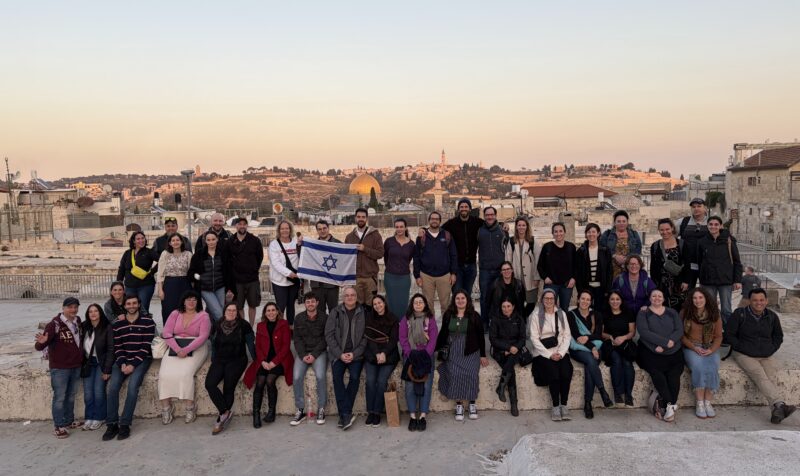
Rabbi Tracy Kaplowitz
Participants from across North America joined a December 2025 Volunteer Birthright trip for Reform Jews.


 Add EJP on Google
After a precipitous drop in participation in Israel trips in 2025 due to the 12-day June Iran war, enrollment is expected to bounce back somewhat this year, albeit significantly less than initially projected, according to a new survey from the Israel Educational Travel Alliance released on Thursday.
This lackluster enrollment comes as costs for Israel trips have increased significantly, putting further stress on the field, the survey found.
Participation is expected to increase by 14% this year compared to 2025, according to the poll by IETA, an umbrella group representing the largest Israel trip providers.
While the average program saw a 20% decrease from original participation projections, attendance among less-engaged Jews is expected to land 40% below original forecasts, and non-Jewish and interfaith programs 50% below, according to the survey’s findings.
Across the 32 organizations that participated in the survey, IETA now projects 52,000 participants for 2026, a 20% drop from projections prior to this year’s war with Iran. As of early October, 37,000 of those 52,000 participants had already gone on their trips, with the rest expected to go by the year’s end.
Providers had projected “close to 70,000” participants for 2026 before this year’s war, Rabbi David Levy, IETA’s executive director, told eJewishPhilanthropy, but now expect participation to bounce back in 2027 to a level that “meets or exceeds” what providers had expected for this year.
Levy cited several reasons for the decreased engagement, including safety concerns and logistical complications. For the audience that saw the biggest decrease, he also pointed to the U.S. political climate around Israel as a factor.
“Unfortunately, the situation in the United States is not necessarily favorable towards travel to Israel. So for some of them, they’re feeling like this isn’t necessarily the most celebratory thing,” said Levy. “It’s not borne out in the data. This is in conversations with trip providers…the mood in the United States is a factor in people’s decisions to come on a trip like this, and that impacts the ability to recruit those participants, which is a larger circle.”
He added that the effect is “more pronounced” among less-engaged and non-Jewish audiences, “but it’s true across the board.”
The demographic shifts come paired with a median 15% increase in the cost of a participant’s participation in an Israel educational travel experience, which Levy attributed to a variety of factors, including increased insurance costs, limited airfare options and the increase in the shekel’s strength against the dollar.
Interruptions to Israel travel since the COVID-19 pandemic have also compounded, said Levy, leading to a smaller pool of alumni who are able to recruit new participants.
“Pre-2020, there were thousands of alum of Israel trips on campus. Today, it’s so much smaller. We’ve seen such a massive decrease in terms of the number of alumni who can recruit other alum. And that was one of the biggest drivers for getting people who were less engaged there.”
The survey did not break down cost drivers, said Levy, adding that among the trip providers he has spoken to, the biggest unexpected increase came from Israeli vendors that had quoted prices in dollars and then switched to shekels. He added that group airfares are also much harder to find, with Delta and United not yet having group desks open after the Iran war, though more airlines are returning to the route.
Because most trips are subsidized, higher costs mainly limit how many participants providers can bring, Levy said. How organizations absorb them varies: “Some will have fewer participants, some will increase their fundraising, some will cut staff.”
Providers are shifting their focus from handling the immediate fallout of the war to making trips more affordable, the survey found. When asked where they most need help, providers named financial incentives for participants first, followed by partnerships with local communities and better ways to measure the impact of trips
Still, with an increase expected for the coming year, the field has remained optimistic and relatively resilient, Levy said, relaying a line from one provider that he said captured the field’s attitude.
“We’ve had seven years of famine,” he told eJP. “God willing, we’re going to have seven years of plenty.”
Related News

EXIT INTERVIEW
Elizabeth Sokolsky, longtime EVP of Birthright Israel, to retire next year
CLOSING WORDS
In AZM address, Cosgrove links communal ‘orthodoxy’ on Israel to rising anti-Zionism among young Jews

PRESIDENTIAL REBUKE
Israel’s Herzog: Mamdani ‘makes no effort’ to hide disdain for Israel, Jews must fight back
HIGHER EDUCATION
As Jewish donors reconsider academia, Jan Koum doubles down, endowing Israel studies at Stanford

MAGICAL EXPERIENCE
Shefa launches psychedelics retreat for Jewish professionals suffering burnout