HELPING HAND
Israeli president hails JFNA post-Oct. 7 loan fund as highest form of giving
Some $100 million was raised for the fund, allowing roughly $350 million in loans, some of which has already been repaid and loaned out again, JFNA says
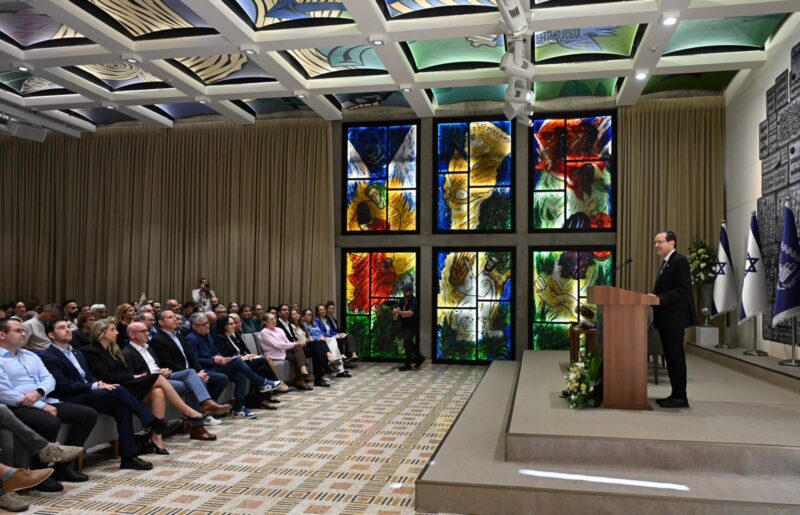
Haim Zach / GPO
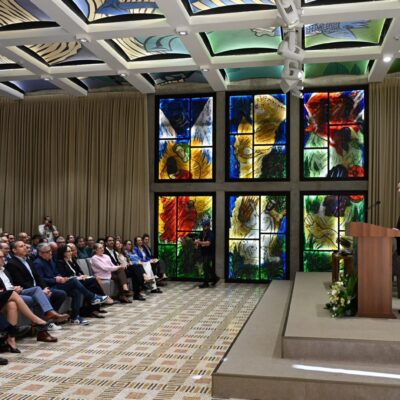
Israeli President Isaac Herzog hosts an event in honor of Jewish Federations of North America's loan fund for small businesses at the President's Residence in Jerusalem on Oct. 29, 2026.


 Add EJP on Google
On Maimonides’ famed eight-tiered ranking of charity, the highest level is taking action to prevent someone from needing to ask for charity.
“The highest level beyond which there is none is a person who supports a Jew who has fallen into poverty [by] giving him a present or a loan, entering into partnership with him, or finding him work so that his hand will be fortified so that he will not have to ask others [for alms],” the medieval scholar wrote in his seminal 12th-century work, the Mishneh Torah.
On Thursday, Israeli President Isaac Herzog cited Maimonides in applauding the Jewish Federations of North America and its partners for precisely this highest form of giving, hosting an event at the President’s Residence in Jerusalem in recognition of a loan fund created in the wake of the Oct. 7 terror attacks to support small Israeli businesses.
“In the reality forced upon Israel since Oct. 7, many businesses have faced tremendous obstacles, including those small- and medium-sized businesses that represent a third of the economic activity of the [Israeli] market,” Herzog said, noting that they did not face these challenges “because of poor business decisions or a lack of demand for their products” but because of displacement and enlistment into the reserves.
“There are people here who really understand that behind every drop in income or every disruption in business activities, there is a person. There are suppliers, employees, workers and managers,” Herzog said.
“And here entered the Jewish People in all its glory,” the president said. “The Jewish Federations of North America understood the ultimate consequences and succeeded in coming to our side and offering assistance, as it did in so many areas and with so many issues throughout the country. … Through this effort, the [loan] fund preserved economic activity, saved sources of income, strengthened communities and returned hope and growth to important regions of the country.”
JFNA’s loan fund was launched in the initial months after the Oct. 7 attack, as hundreds of thousands of reservists were drafted into the military and large swaths of the country were evacuated.
Nearly $100 million was raised for the JFNA loan fund, which was distributed to five partner organizations — Bizi, KIEDF, Ogen, SparkIL and Daroma Tzafona — that provided no- and low-interest loans to small-business owners affected by the war.
That donated money was then leveraged to get even more funds from commercial banks, enabling some $350 million to be loaned to small businesses. Of this, $82.3 million has already been repaid and loaned out again, according to JFNA.
“Every business owner who returns a loan is directly supporting another business and is taking part in a circle of giving,” said Sara Gottlieb, a Toronto-based former investment banker and member of JFNA’s board of trustees, who serves on its Israel and Overseas Committee.
JFNA added that in addition to its loan fund, an additional $33 million has been “committed by local federations and other donors directly to the same [five] platforms.”
In his speech, Herzog singled out several figures for their involvement in the fund, including Rebecca Caspi, the head of JFNA’s Israel office; Sanford Antignas, chair of the board of directors of the United Israel Appeal; Lonnie Nasatir, president of Chicago’s Jewish United Fund; and Gottlieb. (Jeffrey Schoenfeld, who helped found the loan fund when he was on JFNA’s emergency allocation committee, was unable to attend the event.)
Many of those in attendance had attended the Jewish Agency’s board of governors’ meeting earlier in the week, staying in the country for the election.
Reflecting on the election held two days prior, ending with no clear path to a stable ruling coalition, Herzog, who will soon choose which Israeli political party leader is tasked with forming a government, called on politicians to be open-minded going forward.
“Open your heads, open your hearts and widen your vision,” Herzog said, and focus on “what is for the good of the country.”
JFNA estimated that its loan fund has supported 28,000 jobs and 25,000 families over the past three years.
Speaking at the event, one such small-business owner, Atar Lavi, who runs a landscaping business in Kibbutz Sufa, which was attacked by Hamas terrorists on Oct. 7, 2023, noted that while he was displaced and no longer able to run his business — he also served some 800 days of reserve duty over the past three years — he was legally required to continue paying the salaries of his displaced employees.
“The business was completely halted, and it is only because of a loan that I can say that today we’ve grown by more than 50%,” he said.
Similar stories were shared by other small-business owners at the event, including a jewelry maker, whose husband served long stretches in the reserves, and the head of a tutoring company in the northern Arab Israeli town of Shefaram.
“A small business is more than just a source of income,” Gottlieb said, speaking in Hebrew. “It’s the market that opens its shutters in the morning… the studio that supports an entire family. When a business like this closes, the whole community feels it. And when it rises again, it brings back with it stability and hope.”
Related News

MAGICAL EXPERIENCE
Shefa launches psychedelics retreat for Jewish professionals suffering burnout

EXCLUSIVE
Detroit-based philanthropists Nancy, James Grosfeld donate $8M to renovate JDC’s Israel campus
PRESIDENTIAL REBUKE
Israel’s Herzog: Mamdani ‘makes no effort’ to hide disdain for Israel, Jews must fight back
CLOSING WORDS
In AZM address, Cosgrove links communal ‘orthodoxy’ on Israel to rising anti-Zionism among young Jews

MAJOR GIFTS
Center for Jewish History celebrates 25 years with a $25M matching grant