Opinion
SET THE RECORD STRAIGHT
A lie only needs enough people to believe it


 Add EJP on Google
In Short
For centuries, Jews were accused of murdering children for their blood. The demonization of Israel surrounding the anti-Israel film "NAZA" follows the exact same pattern, and too many of us are repeating an old mistake: assuming that because we know the truth, it doesn't matter what others believe.
We grow up conditioned to expect lies to reveal themselves. Pinocchio’s nose grows. A lie detector exposes what someone is hiding. But the truth is that a lie can arrive with confident testimony, compelling images and the approval of people we trust.
The blood libel never had evidence behind it, and its very scale worked in its favor: People who might question a small embellishment in a story did not question an enormous one, assuming no one would invent something so monstrous. It was repeated until familiarity passed for proof and the accused were left to prove their innocence. Jews were persecuted and killed because of it.

“NAZA,” a film written and directed by Yuval Abraham and Rachel Szor and expected to reach tens of millions of viewers when it becomes available online in early November, is a test of whether we have learned how such accusations take hold.
I recently heard Ariel Averbuch describe what it was like to watch “NAZA,” the title of which derives from a military acronym for nezek agavi, collateral damage, and his words stayed with me. Averbuch is an IDF reservist and one of the co-creators of “NAZA: The Real Story,” which brings firsthand testimony and raw footage from Gaza documenting how Hamas operates within civilian areas and how the IDF itself acts to avoid harming civilians.
“I sat and watched it, and I can tell you honestly: If I had not known the truth, I would have left that screening 100% convinced that the Jews, the Israelis and the IDF are Nazis in the fullest sense of the word,” he said.
Coming from a reservist who lived this war, that is a sobering admission of how persuasive a well-built lie can be, especially when the audience cannot see what was left out. What takes hold in a theater can travel into a classroom, a newsroom or a city council. The viewer becomes a messenger.
There is a dangerous moment in the life of a lie: the moment people stop asking whether it is true.
For too long, we have comforted ourselves by saying it doesn’t matter what people think, because we know the truth. But it does matter. It matters what teachers teach, what students learn and what elected officials believe. It matters whether our children feel proud of who they are, or afraid to show it. Knowing the truth ourselves does not relieve us of the responsibility to explain it to others, and silence is exactly where a lie moves in.
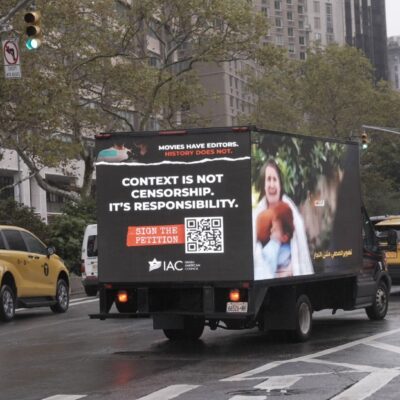
So when “NAZA” had its North American premiere at Lincoln Center, the Israeli-American Council answered on the street outside, with mobile LED screens on trucks showing footage from the Oct. 7 attacks alongside facts that the film leaves out. Since then, Israeli-American and Jewish communities from the Hamptons to San Francisco and Los Angeles to Newton, Mass., have asked for the same response in their own cities.
We are not trying to stop anyone from seeing “NAZA.” We want every viewer to ask what is missing, because every disputed claim deserves a specific answer that names the allegation, cites the evidence, and provides the context.
That standard applies to us, too. Israel’s conduct, like that of any democracy at war, should be open to examination, and our credibility depends on the discipline we ask of others: checking sources, acknowledging what we cannot establish and correcting mistakes.
Many of us have been trained to defend Israel, some in uniform and others through advocacy and community leadership. Now we must bring that same commitment to American civic life. That work has to be organized and sustained: forming relationships with local officials, joining school boards and parent-teacher associations, and confronting antisemitism wherever it shows up in our own communities.
“NAZA” will not be the last film, and this will not be the last lie. The real test isn’t how we respond to one documentary; it’s whether we’ve built the civic muscle to respond to the next one, and the one after that.
Every one of us must be civically trained and engaged. Vote. Meet your representatives. Show up at school board meetings. Build relationships with your neighbors. Speak when something is wrong. And teach our children their history, along with the courage to defend it and the discipline to examine evidence, even when it challenges their assumptions.
A lie only needs enough people to believe it. The truth needs much more. It needs people willing to stand behind it and speak it out loud. For every lie, we will bring evidence. For every distortion, we will bring context. For every attempt to silence us, we will raise our voices. For our children, for Israel and for America.
Noa Peri-Jensch is chief communities officer of the Israeli-American Council. The IAC led the protest outside the North American premiere of “NAZA” at Lincoln Center and organized the first U.S. screening of “NAZA: The Real Story.”