Opinion
FOUNDATIONAL PRINCIPLES
Elie Wiesel never asked us to choose


 Add EJP on Google
In Short
The Rohingya genocide, the war in Ukraine, immigrants and refugees, democracy, antisemitism — working on these issues is not a departure from The Elie Wiesel Foundation’s mission. It is the mission.
There is a question I hear as the executive director of the Elie Wiesel Foundation. It arrives most often in any of a dozen different polite disguises, but underneath it is always the same question.
Why is a Jewish nonprofit working on the Rohingya genocide?
Courtesy
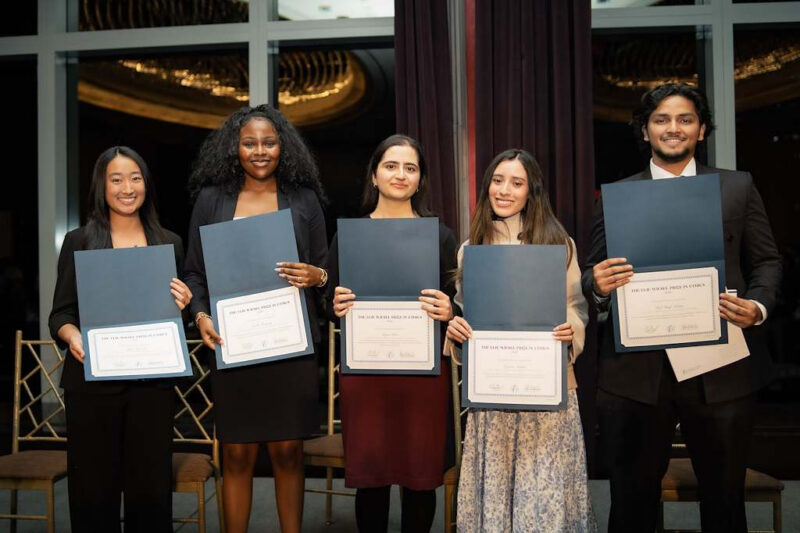
The 2026 Elie Wiesel Prize in Ethics honorees at the award ceremony at the Mandarin Oriental in New York City on Oct. 12, 2026. Since 1989, the contest has invited undergraduate students to engage with difficult moral questions through their own experiences and convictions. From left: Kaia Fujinaka (third prize), Noella Mongony (second prize), Maya Kikov (honorable mention), Cynthia Medina (first prize) and Shah Wasif Fabian (honorable mention).
Sometimes the question is about Ukraine instead. Sometimes it is about immigration. Sometimes democracy.
But occasionally, someone is direct enough to say what they actually mean: Jews are under sustained assault right now. Our institutions are stretched. Our students and young professionals are frightened. Shouldn’t whatever attention and money we have should be spent close to home?
The question is understandable. It also merits a careful answer, because I think our field is making a decision about it and I do not think we are making that decision out loud.
The temptation for any legacy organization is to become a museum. If you are lucky, you have a great name, a body of work, a literary estate, an archive and a devoted and motivated group of people who loved the person whose name is on the door. It would be very easy to spend the next 30 years polishing the nameplate and living in the past.
At the Elie Wiesel Foundation, we are privileged not to be on that path, and the reason is tied to the values of its founder, Elie Wiesel. Wiesel believed that memory is not passive: it is a call to choose differently, to not look away. He left behind a set of principles and values that perhaps matter more today than ever, and they are not complicated.
Notice.
Name it.
Act, even when acting is not easy or popular, and especially when the people suffering are not your own.
Elie Wiesel lived his life by these principles. He applied it to Cambodia and to Bosnia, to Rwanda and to Darfur and to Soviet Jewry, and he did not experience those as competing claims on a fixed budget of moral attention. He experienced them as the same obligation, arriving in different clothes.
That is why our work is organized around education and human dignity — from our youth development and education programs at Beit Tzipora in Israel to the Elie Wiesel Prize in Ethics, and from combatting antisemitism at home and abroad to advocating for immigrant and refugee protections and the importance of democracy.
To some people that list looks incoherent. To those of us at the foundation, it looks like a single argument made over and over again.
I left the private sector to pursue service at the foundation for this very reason. We are living through a period in which a great many people have decided that moral concern is a scarce resource to be rationed and defended. You see it inside our own community, where caring about anyone else is treated by some as a betrayal. You see it outside our community, where Jewish suffering is the one suffering that does not seem to qualify even for acknowledgment. In fact, it is ignored and turned against us. Blamed on us. Used to justify violent attacks against us. Both reflect the same error. Elie Wiesel spent his life refusing it, and he took criticism from every direction for that refusal.
He and his wife Marion created the Prize in Ethics Essay Contest in 1989. That year and every year since, it has asked undergraduates at four-year colleges across the country a single question: What challenges awaken your conscience? They have 2,000 to 3,000 words to provide a real answer. Winners receive financial support for their education and come to New York for an ethics seminar and an awards celebration. Attendance is not optional, because the point was never the check.
Last year, we received a record number of entries. That statistic is usually reported as good news about a contest. I read it as something else: a record number of American undergraduates sat down and wrote several thousand words about an ethical problem that was keeping them up at night. Whatever else is true about this generation, they are not indifferent, and indifference was the thing Wiesel named as the enemy.
Almost 40 years to the day after Elie Wiesel stood in Oslo and accepted the Nobel Peace Prize as a proud Jew, the Elie Wiesel Foundation, together with the Wiesel family, Braman Family Foundation and the Kraft Family Foundation as presenting sponsors, will hold a Chanukah concert called One Light, Many Flames benefiting Beit Tzipora, named for Elie’s little sister who was murdered upon arrival at Auschwitz. On Chanukah, we use one candle to light the others. The shamash gives away its flame eight times and is not diminished by it. Anyone who has held one knows this is not a metaphor. It is simply what happens.
There is an argument that runs exactly the other way: That what we give to others is taken from us. That solidarity is subtraction. Wiesel knew better, and he knew it from the worst possible vantage point. He was not naive about what the world does to Jews. He was, if anything, less naive than his critics. He simply refused to let what had been done to him become a reason to look away from anyone else.
That is the organization doing the important work to turn Elie and Marion’s legacy into action. We would be glad to have company.
LizAnn Eisen is executive director of the Elie Wiesel Foundation.