TAGLIT TIME
Birthright courts global donors at Tel Aviv summit, as some speakers court controversy
Inaugural gathering was meant to answer funders' requests for international networking, streamline donor visits and establish the group as a convener of high-level discussions
Shooka Cohen
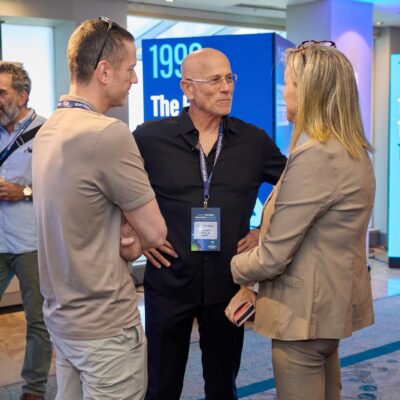
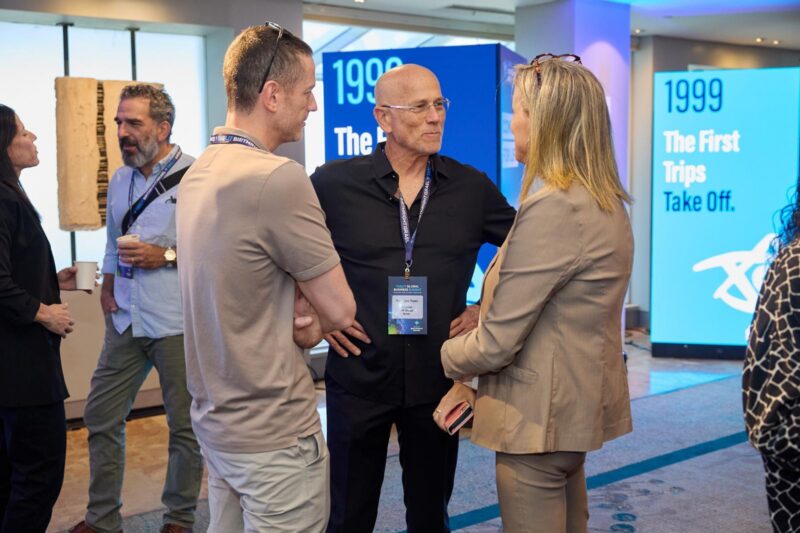
Attendees speak in the hallway of the Birthright Israel Global Business Summit in Tel Aviv on Nov. 2, 2026.


 Add EJP on Google
TEL AVIV — It felt more like a ritzy international conference befitting an Israeli media conglomerate than a Jewish engagement nonprofit — and that was exactly the point. The small talk at the Hilton Tel Aviv’s coffee stations on Monday morning hopped from French to Spanish to Portuguese to English, the sounds of Birthright Israel’s growing global donor base gathered in one place for the first time.
The organization’s inaugural Global Business Summit, which concludes on Tuesday, had the sleek, exclusive feel of a business conference, with mentalist Lior Suchard emceeing and top Israeli tech figures gracing the stage. Some 200 donors, investors and executives from more than 15 countries — including Israel — packed the halls to hear from Israeli Taglit donors, alumni and some of Israel’s biggest names in business.
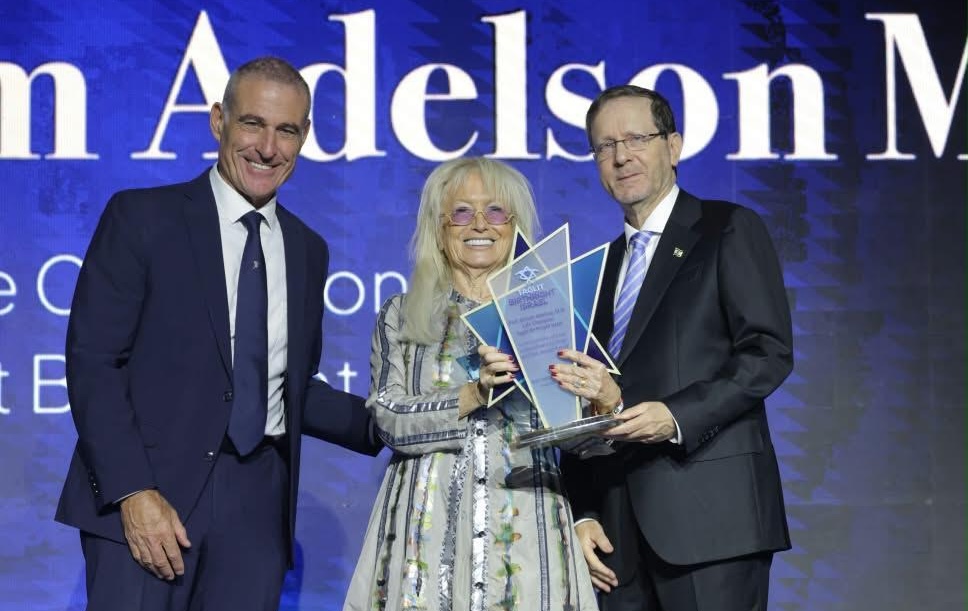
The summit opened on Sunday night with a swanky gala. Miriam Adelson, a matriarch of modern Israeli and Jewish philanthropy, walked into the cocktail reception to a warm welcome in a room stacked with Israel’s heaviest-hitting philanthropists like Danna Azrieli and Ariella Wertheimer. Israel’s President Isaac Herzog mingled throughout the crowd and praised Adelson’s philanthropy while recalling his time as Israel’s cabinet secretary when the government established Birthright in 1999.
A Taglit spokesperson told eJewishPhilanthropy that the strategy with the summit was to gather the biggest donors from around the world under one roof and skip the roughly 15 separate country missions it would otherwise take to reach them.
The summit also appears to help cement Birthright as a major international convener in the Jewish world, capable of bringing together the biggest names in philanthropy, politics and industry in the United States, Israel and around the world.
And indeed, business, philanthropy and Taglit’s mission of bridging the gap between Israel and world Jewry blended together on the plenary stage and filtered into the coffee lines.
Monday’s lineup read like a who’s who of Israeli society. Mellanox founder Eyal Waldman and Nvidia Israel chief Amit Krig talked about AI. Former Mossad chief Yossi Cohen discussed the economics of the Abraham Accords. Philanthropist Sir Ronald Cohen, GSG Impact’s president and founder of the Portland Trust, sat down with Azrieli to talk about making money and making an impact. Author Micah Goodman tackled the intelligence revolution, and NFX’s Gigi Levy-Weiss and ICON founder Yasmin Lukatz discussed building companies in wartime. Tinder founder Sean Rad, a Birthright alum, appeared by video. Birthright CEO Gidi Mark closed the day with tech and finance executives on a panel imagining Israel in 2036.
While some speakers chronicled their personal Birthright story, others promoted philanthropic projects hoping to catch the eye of some of the more prominent philanthropists in the room.
Yossi Cohen, who is now an advisor to Japan’s SoftBank Group Corp., made waves with remarks about Saudi Arabian Crown Prince Mohammad bin Salman’s resistance to normalizing relations with Israel during a session on the Abraham Accords.
“Apparently, he’s not a mature enough person,” said Cohen, before quipping to the packed hall, “Don’t quote me.”
Waldman, one of Birthright’s larger supporters in Israel and a funder of efforts to encourage peace between Israelis and Palestinians, whose daughter was killed in the Oct. 7 terror attacks, lambasted the outgoing government, calling it “one of the worst we’ve ever had in Israel,” and pushing for the formation of a new one. The remarks by Waldman, a longtime critic of Israeli Prime Minister Benjamin Netanyahu drew an awkward silence from the crowd, potentially in part because Birthright receives tens of millions of shekels a year from the Israeli government.
That did not stop Waldman from doubling down, saying, “We have to take the current government of Benjamin Netanyahu out; if not, we will be in serious trouble.”

Birthright’s funding comes from three main channels: the Birthright Israel Foundation, its North American fundraising arm; the Israeli government; and Taglit, the Israel-based organization that courts donors in Israel and everywhere outside North America.
Birthright Israel Foundation raised $74 million in 2024. Its 2025 tax filing has yet to be released, but a source at the foundation told eJP it brought in a record of more than $100 million last year under the leadership of its president and CEO, Elias Saratovsky, who has helped grow the group’s funding base after Adelson pulled back her family’s support in a bid to encourage others to step up.
Taglit’s own fundraising, among Israeli donors and donors in about 15 other countries, accounts for nearly 10% of the organization’s budget according to a Taglit spokesperson. This week’s summit aims to expand Taglit’s international donor base.
Ethy Levy, Taglit’s vice president of resource development and partnerships, said the invitation-only summit was built to plant seeds, with no specific fundraising ask. Still, her message to the Israelis in the room was pointed: Taglit wants Israeli donors to pay for Israel’s own participants.
Each country funds its own travelers, Levy explained, with the Israeli government covering roughly a third of the 10-day trip’s cost and local communities raising the rest. Every group of about 40 includes eight Israelis, mostly soldiers. Their presence makes possible the mifgash, Hebrew for “encounter,” which Birthright considers one of its most impactful elements and a cornerstone of its programming. Some 130,000 Israelis have joined Birthright trips to date. Israeli giving has yet to cover their costs, and Taglit’s goal is to close that gap.
“We need to double what we’re raising in Israel,” Levy said.
Across the Mediterranean, Taglit’s European fundraisers face a different headwind.
“Raising funds for Jewish causes in Europe right now is tough, particularly when the topic turns to Israel,” Antonia Yamin, a Europe-based journalist for Israel’s Channel 12 and managing director of Taglit Germany, told eJP. With Iran tensions flaring again, she said, it meant even more to see donors from around the world make the trip to Israel. Yamin pointed to one guest, Kai Uwe Peter of Berliner Sparkasse, one of Germany’s largest banks, who is not Jewish. After Oct. 7, Peter had ATMs across Berlin display a message condemning the attacks, and he stood by it despite heavy criticism, she said. “Connecting with individuals driven by such deep-rooted conviction is precisely why I do this work,” Yamin said.
Both the gala and Monday’s programming featured donors and their stories. Organizers honored nearly a dozen supporters from outside the U.S., each with more than $1 million in gifts to Taglit; they included Ziv Aviram, Danna Azrieli, Roy and Bracha Ben Yami, Shawna Goodman on behalf of the Morris Goodman Family Foundation, Leon Koffler and Racheli Mishori, Jonathan and Irit Kolber, Regine Konekeir, Joshua Nash, Meir and Adina Shamir, Annabelle Sieleeki, and Paul Wynn and Nirit Gilboa.
One Israeli philanthropist in attendance, who spoke on condition of anonymity, told eJP that Israelis are “finally waking up and learning from American philanthropy.” After 78 years, he said, Israel’s young philanthropic sector is adopting the “culture of philanthropy” American Jews have championed since the state’s founding, the funder said.
On Tuesday, conference attendees traded in hotel conference blazers and coffee stations for field visits to Israeli companies and a day of volunteering alongside current Birthright participants in areas Taglit has supported since the Hamas-led attacks of Oct 7, 2023.
“For 26 years, we have brought young Jewish adults to Israel because we believe that experiencing Israel personally creates a connection that lasts,” Mark told eJP as the summit wrapped. “Now we have brought together the people who made those journeys possible.”
Related News

MAJOR GIFTS
Center for Jewish History celebrates 25 years with a $25M matching grant

EXIT INTERVIEW
Elizabeth Sokolsky, longtime EVP of Birthright Israel, to retire next year

EXCLUSIVE
Detroit-based philanthropists Nancy, James Grosfeld donate $8M to renovate JDC’s Israel campus
CLOSING WORDS
In AZM address, Cosgrove links communal ‘orthodoxy’ on Israel to rising anti-Zionism among young Jews

MAGICAL EXPERIENCE
Shefa launches psychedelics retreat for Jewish professionals suffering burnout