A GENTLEMAN AND A SCHOLAR
OU’s Rabbi Moshe Hauer leaves ‘countercultural’ legacy of openness, empathy
Friends and colleagues mourn Hauer, praise his poignancy, respect for others, willingness to hold debates 'for the sake of heaven'
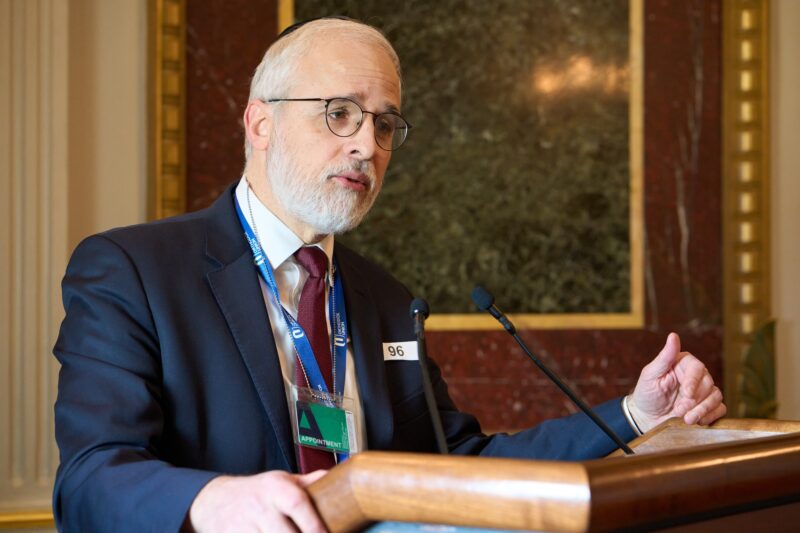
COURTESY/OU
Rabbi Moshe Hauer.




 Add EJP on Google
The last time eJewishPhilanthropy spoke with Rabbi Moshe Hauer was two weeks ago. As the head of the Orthodox Union, Rabbi Hauer discussed how the Orthodox community would mark the second anniversary of the Oct. 7 attacks, which fell on Simchat Torah on the Hebrew calendar, requiring a delicate balance between the halachic imperative to be joyous during the festival and the impulse to mourn.
During the interview, when Rabbi Hauer spoke, he sounded pained to speak about the Oct. 7 massacres and the aftermath. He paused between words, his voice close to breaking. Though the topic verged into politics, his words were laced with empathy and understanding. At the time, the ceasefire deal was far from certain, and there was no sense that the hostages would imminently return.
Israel was more isolated than ever, he lamented. “It’s a lonely Oct. 7,” Rabbi Hauer said.
In his final eJP interview, Rabbi Hauer said that the loss of Oct. 7 made the joy and dancing on Simchat Torah that much more important. He never got to see it. He died of a heart attack on Monday night, just after the start of the Shemini Atzeret holiday, soon after learning about the Gaza ceasefire agreement, soon after seeing the final 20 living hostages released, soon after learning there’d be another reason to dance on Simchat Torah.
Since Rabbi Hauer’s was announced on Wednesday, tributes have poured in from across the Jewish world, from peers within the Orthodox community to leaders of different Jewish movements, from American and Israeli politicians to leaders of other faiths. Rabbi Hauer’s legacy within the OU and the greater Jewish world is one of valuing and respecting diverse perspectives during a period marked by growing polarization, friends and colleagues told eJP.
Doing so was “countercultural,” Rabbi Josh Joseph, executive vice president and chief operating officer of OU, told eJP. They both joined the OU in 2020. Previously, Rabbi Hauer served for 26 years as the lead rabbi at Bnai Jacob Shaarei Zion Congregation in Baltimore.
“Early on, we were putting together our first-ever strategic plan, and we talked about being the voice of the Orthodox world,” Joseph said. “[Rabbi Hauer] said, ‘How about a voice. There are lots of voices out there.”
As the organization’s professional and rabbinic leader, Rabbi Hauer was the face of the OU, and he had a belief that humility needed to be a core value for the organization, which led to greater partnerships within the Orthodox and larger Jewish world as well as with political leaders in Israel and America.
“People didn’t say, ‘Oh, I met with Rabbi Hauer, and he agreed with me,’” Joseph said. “‘No, I met with Rabbi Hauer and he listened to me. He heard me, and I think we disagreed, but I know he respects me for my opinion.’”
Even within the OU, disputes would break out. “Sometimes, [Rabbi Hauer] had an idea, and we didn’t end up going in that direction,” Joseph said. “And he would accept it. He would take the decision of the OU and move forward with it as if it was his own. You never felt like he begrudgingly took it on. He was a team player.”
Rabbi Hauer was also a member of the executive council for the Conference of Presidents of Major American Jewish Organizations, serving as a voice of reason at weekly meetings, William Daroff, CEO of the Conference of Presidents, told eJP.
“When Rabbi Hauer spoke, everyone listened,” he said, “and it was clear that he wasn’t speaking to hear himself speak or to score political points or to check a box, but rather, when he spoke, it was because he had something meaningful to say. So whether people agreed with him or disagreed with him, they paused to listen, and he would always bring a clarity and a calm strength to the conversations that he was engaged in.”
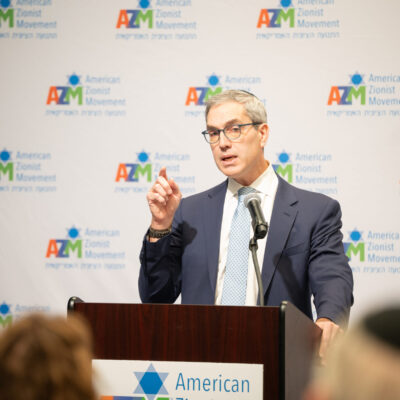
The rabbi would always listen before he spoke, Rabbi Josh Weinberg, president of ARZA, the Association of Reform Zionists of America, and an executive council member, told eJP. Rabbi Hauer implemented his values outside the Jewish world, too, Weinberg said, in his interfaith work with Christian and Muslim leaders.
“We disagreed quite a bit, whether it was on politics or on religion or whatever,” Weinberg said. “It was always machloket l’shem shamayim, a disagreement for the sake of heaven.”
Rabbi Hauer always recognized other rabbis as rabbis, no matter the denomination. Rabbi Ellen Wolintz-Fields, executive director of the Women’s League for Conservative Judaism and a fellow Conference of Presidents executive council member, davens with her arms wrapped in tefillin, counts women in a minyan and holds different politics than Rabbi Hauer, yet when she found out that he had died, it felt like “one of our rabbis” had passed, she told eJP.
In addition to their professional relationship, Wolintz-Fields said she often called Rabbi Hauer for advice as her own children leaned towards Orthodoxy. “He became my own personal Orthodox rabbi,” she said.
After becoming CEO of the Jewish Council for Public Affairs right before Oct. 7, Amy Spitalnick frequently found herself at the same table as Rabbi Hauer at the White House and in federal agencies. Whether discussing antisemitism or federal policies, Rabbi Hauer carried himself with “a level of compassion and kindness and thoughtfulness,” she told eJP. This demeanor allowed everyone in the room to drop their guard. “Every single time I sat around a table with Rabbi Hauer, I learned from him,” she said.
As Orthodox Jews are disproportionately targeted for hate crimes because they are visibly Jewish, “he was able to clearly advocate on behalf of the Orthodox community, but in a way that never lost sight of the greater Jewish community as well,” she said. “That would come through in every remark I heard him make around one of those federal agency tables or frankly anywhere.”
During Rabbi Hauer’s final phone call with eJP, it sounded as if he was nearly crying at times. It was common for him to get emotional, Joseph said, as he would wonder if he and the OU were doing enough for the hostages and Israel.
“He always wants to do better,” Joseph said, struggling with accepting the past tense. “He’s a passionate guy, and he is a sentimental guy. He talks about having a fire in the belly, and those emotions can be overwhelming at times.”
Rabbi Hauer traveled to Israel nearly a dozen times post-Oct. 7, “meeting with the president, meeting with the prime minister, meeting with the different Diaspora ministries and the ministers of finance, trying to help bridge divides within Israeli culture and mediate issues that were tearing Israeli culture apart,” Joseph said.
The Friday before he died, Rabbi Hauer attended what would be his final meeting of the executive committee of the Conference of Presidents, video calling in from his sukkah. Everyone watched as his granddaughter wandered into the frame, embracing him.
“He was grandpa at that moment as well as being a colleague,” Wolintz-Fields said about him.
Wolintz-Fields hopes that others learn from him that “we can continue such open dialogue and support each other because it’s all about our love for Israel and the Jewish people. He radiated that: his love for Torah, God and Israel. We held the whole same values from different perspectives at times.”
Rabbi Hauer’s funeral was held Thursday morning in Baltimore, and he will be buried on Friday at Har Hamenuhot Cemetery in Jerusalem.
Related News

ADVANCING A VISION
N.Y. federation donates $1M toward building shared-society center named for peace activist killed on 10/7

MAJOR GIFTS
Center for Jewish History celebrates 25 years with a $25M matching grant
HIGHER EDUCATION
As Jewish donors reconsider academia, Jan Koum doubles down, endowing Israel studies at Stanford

EXCLUSIVE
Detroit-based philanthropists Nancy, James Grosfeld donate $8M to renovate JDC’s Israel campus
PRESIDENTIAL REBUKE
Israel’s Herzog: Mamdani ‘makes no effort’ to hide disdain for Israel, Jews must fight back