Opinion
PEOPLEHOOD PAPERS
The power of Hebrew immersion




 Add EJP on Google
In Short
How a Hebrew immersion program at one Ramah day camp in New York has shaped Hebrew education at camps around the country.
The following essay, published here as part of a collaboration between eJewishPhilanthropy and the Center for Jewish Peoplehood Education, is from the latest edition of CJPE’s Peoplehood Papers series, “Cultivating Jewish Peoplehood at Camp,” produced in partnership with the Foundation for Jewish Camp.
The sky had just opened up and we were in the midst of a fairly typical July rainstorm, or what we lovingly refer to in camp as “liquid sunshine.” In the course of helping everyone move to cover, Shira, a 9-year-old camper, was having a conversation with her counselor, Dor. Shira was crying and Dor, a 23-year-old Israeli shaliach (emissary), was trying to help her calm down. Shira was sad because the rain had curtailed her time playing ball with her friends.
Courtesy/Foundation for Jewish Camp
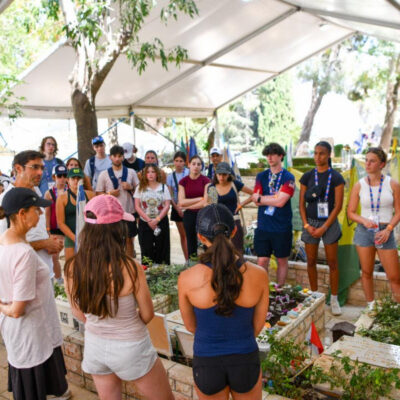
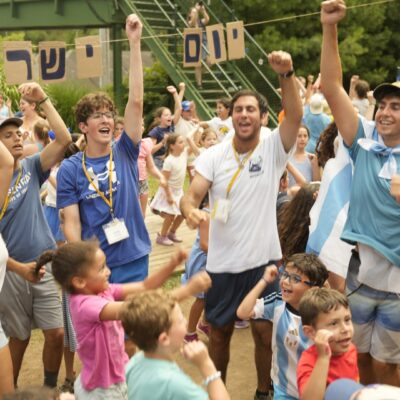
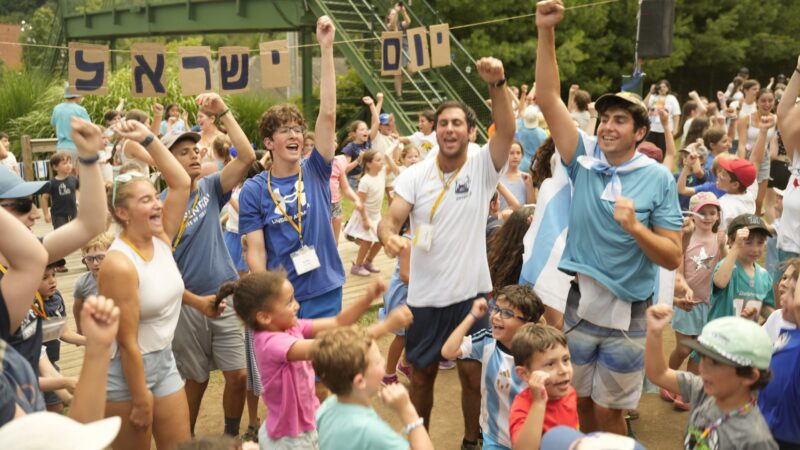
"Yom Yisrael" (Israel Day) at Ramah Day Camp in Nyack (N.Y.).
In this moment, Dor did exactly what he had been trained to do. He kneeled down so he was at eye level with Shira. Using a calm voice, a listening ear and tremendous patience, he helped her relax. Within a couple of minutes, he was able to redirect her, and they moved together to their next activity.
While this might seem like just another day at camp, what made this remarkable was that the entire interaction between Dor and Shira was in Hebrew.
Shira was a camper in the Sha’ar Hebrew Immersion program at Ramah Day Camp in Nyack, located in Nyack, N.Y. This program, designed for non-native Hebrew speakers, enables young campers to participate entirely in Hebrew in their summer day camp experience. As an educator, there is nothing in my career that I have done that brings more pride than the development and growth of Sha’ar. Hebrew is the living thread that binds the Jewish people across generations and geography, allowing us to speak to one another across time and space. The Sha’ar program gives campers in our community the ability to fluently and authentically communicate via the universal language of the Jewish people.
In 2013, Ramah Nyack piloted Sha’ar for 17 children entering kindergarten who were non-native Hebrew speakers. We now annually enroll around 150 campers from kindergarten through fifth grade. This model was initially conceived by our partners at the Arevim Philanthropic Group. Their extensive work on Hebrew education in the day camp setting and their constant support in the early years of Sha’ar’s growth inspired us to push for excellence as we established this program. From our pilot program in 2013, we are proud that Sha’ar programs have spread to all of the other Ramah day camps and over a dozen other camps around the country through the continued efforts of the Kayitz Kef network.
At the most basic level, Sha’ar is a summer day camp program conducted in an immersive Hebrew environment. Counselors, mostly Israeli, commit to speaking entirely in Hebrew to their campers — no English — though campers can always express themselves in any language they choose. Campers play, swim, dance, transition between activities, and even eat in a Hebrew environment.
At another level, there is much more going on than meets the eye. The Sha’ar program was designed in partnership with educators from Middlebury College’s Language Schools and is based on the proficiency approach to language acquisition, regarded as the gold standard in the field of language education. This approach immerses campers in a natural Hebrew environment where they can quickly apply their skills to real-life situations. Counselors are trained in this approach, which encourages active participation and language production.
We have consistently noted that we begin to hear language production from most campers during the third week of camp. Language production continues to grow throughout the summer. These results are lasting. We have consistently seen that within the first two weeks of the summer, returning campers — regardless of Hebrew usage during the year — are back to the same level of Hebrew proficiency that they had obtained at the end of the previous summer. Passing food during lunch, kicking a ball during sports and drawing with various art supplies all become rich opportunities for language comprehension and, eventually, production. Camp has become a Hebrew-language playground and the campers are “wrapped in the language” for the summer.
As noted in previous studies by Rosov Consulting, Sha’ar campers gain a significant increase in their Hebrew fluency and a deeper appreciation for Israel and Israelis. The Rosov reports also indicate that 98% of Sha’ar parents believe that participation in this program helps campers form early and enduring relationships with their Israeli counselors and Israel in general. It is inspiring to be in such a language-rich environment and we routinely see North American staff members push themselves to improve their own Hebrew abilities, further enhancing the already deep relationships that develop between the Israeli and North American staff members. Each summer, Sha’ar has allowed us to significantly elevate Hebrew education in our camp and create a stronger bridge between the North American and Israeli Jewish communities via personal relationships.
On a quiet Shabbat afternoon near the end of the summer, I spoke with Dor about the encounter with Shira that I had observed during the July rainstorm. I shared with him that what he accomplished in that moment was a very high-level display of shlichut — of representing Israel as an educator and ambassador.
He remarked: “I didn’t understand what Zionism meant until I left Israel and came to camp this summer.”
Shlichim have routinely reflected on the impact Sha’ar has had on them and their understanding of both shlichut and tzionut (Zionism). Dor, Shira and hundreds of others leave camp every summer enriched by Sha’ar, ready to reenter the world with greater Hebrew abilities, a deeper connection to Israel and our global Jewish people and relationships across the continents that will last a lifetime.
Rabbi Ami Hersh is the director of Ramah Day Camp in Nyack (N.Y.).