GOOD SPORT
How Seed the Dream saw an opening and helped rewrite the Israel travel playbook with Maccabi USA
courtesy/maccabi usa
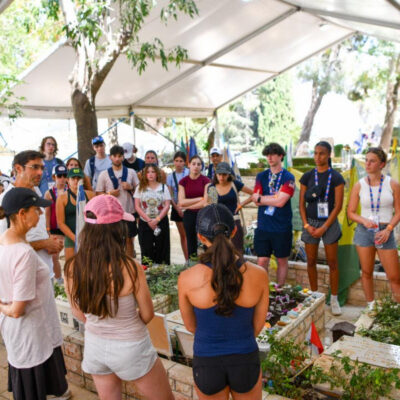
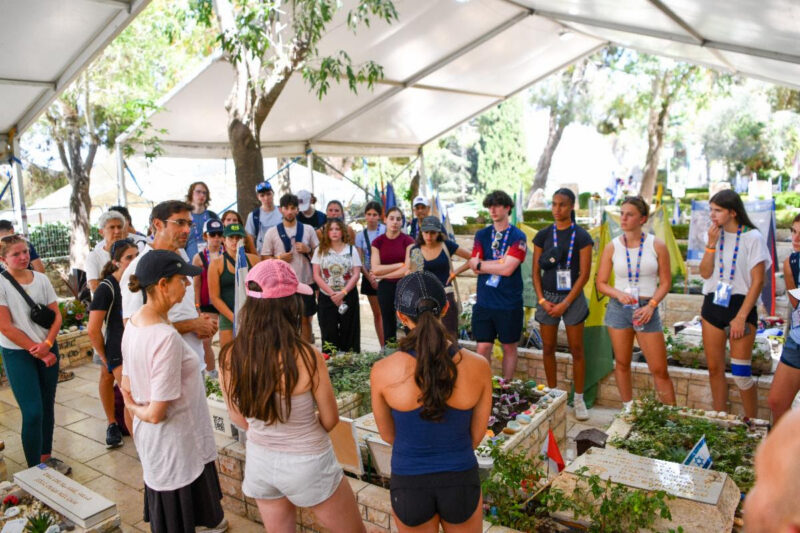
Participants on Israel Connect visit a military cemetery in Israel.




 Add EJP on Google
Most philanthropists name their foundation after themselves. Marcy Gringlas and her husband, Joel Greenberg, named theirs after a conviction: that a strategic, well-placed gift can grow into something far, far larger.
Gringlas and Greenberg’s Seed the Dream Foundation has planted many anchor investments in philanthropic projects in their portfolio, but few as personal as Maccabi USA’s Israel Connect.
When Ellie, her youngest child, competed at the Maccabiah Games in Israel, Gringlas noticed that while some athletes stayed for a few days of touring, many flew home almost as soon as the medals were handed out.
“We saw an unbelievable window and opportunity to build and deepen the connection these kids have to Israel,” Gringlas told eJewishPhilanthropy, reflecting on her foundation’s engagement with Maccabi USA — the U.S. branch of the Maccabi World Union.
Now 28, Gringlas’ daughter Ellie works for a major sporting team as a coordinator of community impact, and she serves on the board of Maccabi USA.
Israel Connect keeps Team USA in the country once the competition ends. This year, more than 700 athletes, coaches and delegation members stayed on after the Games for the program — nearly half the American contingent. Over several days, they traced Jewish history, met Israelis and volunteered. This year, for the first time since the Oct. 7 terror attacks, participants also toured the Gaza Envelope.
Gringlas and the Philadelphia-based Seed the Dream Foundation transformed that window into a wider and more collaborative funding strategy. In 2017, Seed the Dream became the original anchor donor of Israel Connect.
“There’s something really beautiful happening with this cohort of athletes coming together from around the world in Israel,” Gringlas said. “That was the seed we started in 2017, and we’ve done it three times over the last nine years — each time learning and improving and listening to what the kids are saying, but also understanding that we’re dealing with the realities of what’s happening in Israel right now.”
Gringlas said that offering these experiences to high schoolers is critical. “By the time these kids are going to college, it’s too late,” she said.
“The American athletes we’re trying to impact, we’re providing a foundational experience,” Gringlas said. The message is clear: “You’re not alone, there are lots of people out there like you, and we’re going to empower you.”
With sports as its entryway, Maccabi USA CEO Marshall Einhorn told eJP that Israel Connect measures success by “how many young Jews leave feeling more connected to the Jewish people.”
Einhorn praised the partnership with Seed the Dream, saying that, unlike traditional foundations that just write a check, the foundation “really facilitated significant growth in the quality and content of our educational programming… as a thought partner.”
Gringlas describes her style of philanthropy as both “active and collaborative.”
“We are not those funders that just write a check,” she said. She traces the instinct to Philadelphia, a city that she says has long leaned on the just-write-me-a-check mindset of philanthropy that Seed the Dream rejects.
“We’re funding you because we want you to succeed,” she said, “and if we have any expertise or information of value, we want to share it, including sitting with you and planning.”
That mindset led Seed the Dream to do more than fund Israel Connect. The foundation arrived with a model it had already built, the Building Israel Connections Engagement Project, or BICEP. On college campuses, BICEP runs a yearlong slate of Israel education through partner Hillel and Chabad chapters that reach thousands of students across the country. Gringlas and her team brought that playbook, its data and its contacts to the athletes’ Israel Connect trips.
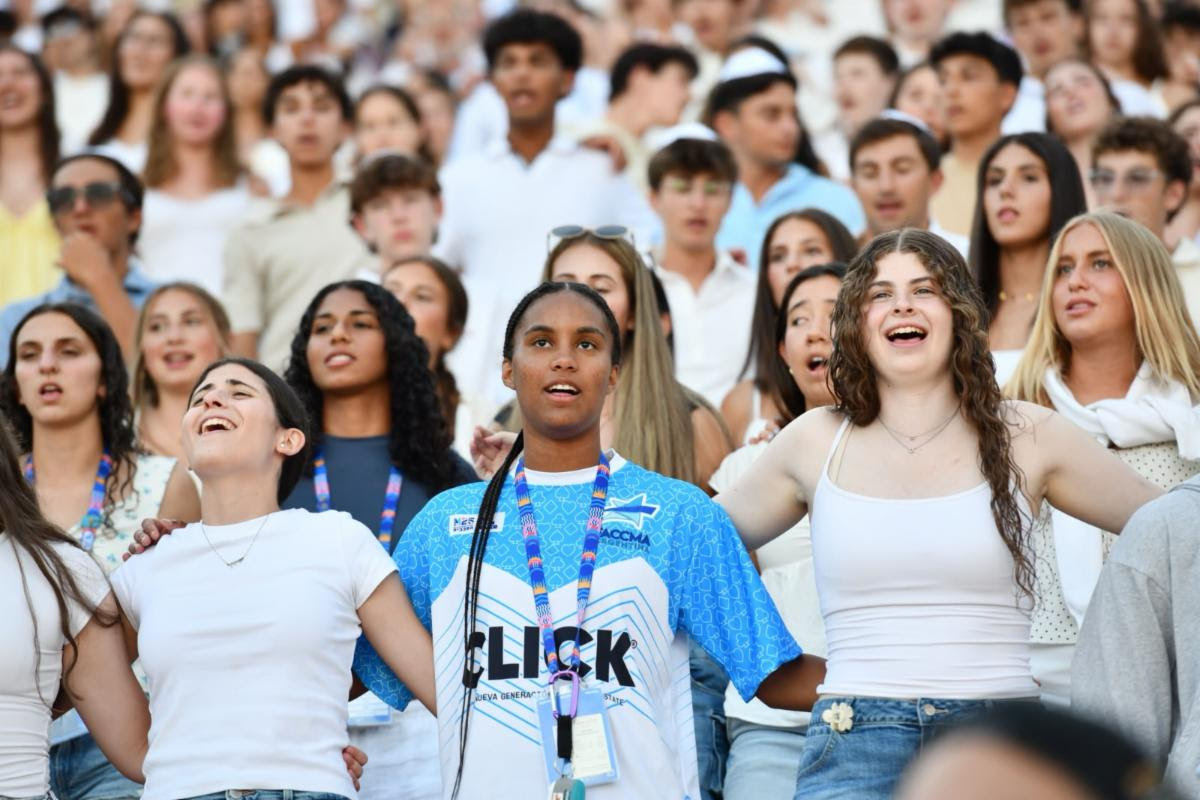
Seed the Dream recalibrated the concept of the mifgash, the encounter with Israeli peers. The foundation built a social-action track, connecting the American participants with Israeli groups doing tangible good, such as volunteering at kibbutzim in the South or with organizations like Save a Child’s Heart. It added experiential education — bringing in speakers and soldiers and organizing firsthand visits to explain the country’s realities; Israeli athletes also joined the cohort.
Seed the Dream credited its partnership with Maccabi USA with maintaining Israel Connect’s participation level over the years and bringing on additional, major funders to support the program.
In 2017, when it launched, 900 participants took part in Israel Connect, followed by 1,200 in 2022. This year, even with the looming uncertainty of war with Iran, 700 teens participated.
Since Seed the Dream provided the anchor funding for the program in 2017, the Paul E. Singer Foundation, Crown Family Philanthropies and the Tina Snider Foundation have joined the roster of Israel Connect funders, though Seed the Dream declined to specify their levels of support, with a spokesperson saying that it does not “share specific grant amounts.
This increased financial support, especially this summer with record ticket prices and a historically strong shekel, was critical to Israel Connect’s survival. In June, Israel Educational Travel Alliance told eJP that Israel travel costs are up 75% since 2019.
The same pressure ran across the season of Israel travel, from Birthright to RootOne to the Maccabiah. The entire season came close to cancellation as Israel settled into a stop-and-go rhythm of war with Iran.
“We are clearly aware that this is a reality — something that every Israel project and program has to deal with, grapple with and address at this moment,” Gringlas said. “We are aware and communicating with our grantees about the impact this has on their programs.”
While the past nearly three years of war in Israel have made educational travel programs more complicated, Gringlas, the daughter of Holocaust survivors, said that it has also reinforced the need for them.
“[The] Oct. 7 [terror attacks] changed the world, changed everything and also changed us,” she said.
Despite these challenges, many funders like Gringlas are doubling down on Israel travel this year, particularly through the prism of the Maccabiah Games and Jewish sports in general. As eJP reported last month, the Samueli Foundation recently pledged $6.25 million to support the JCC Maccabi Games’ expansion in Israel over the next four years.
“[Funders] have to be able to pivot,” Gringlas said.
“This is the world we live in now, and we have to keep our eye on the prize of what we’re trying to accomplish here,” she said. “There’s real power in bringing Jewish teenagers together through sports, in that environment, to have them see they’re not isolated — feeling this pride in their Jewish identity, this curiosity about who they are.”
Related News
CLOSING WORDS
In AZM address, Cosgrove links communal ‘orthodoxy’ on Israel to rising anti-Zionism among young Jews
EXCLUSIVE
Detroit-based philanthropists Nancy, James Grosfeld donate $8M to renovate JDC’s Israel campus

MAJOR GIFTS
Center for Jewish History celebrates 25 years with a $25M matching grant
ADVANCING A VISION
N.Y. federation donates $1M toward building shared-society center named for peace activist killed on 10/7

MAGICAL EXPERIENCE
Shefa launches psychedelics retreat for Jewish professionals suffering burnout