BIG SWINGS
JCC Association plans to expand its Maccabi Games, return them to Israel in 2028
Most of the funding for the $19.5 million campaign has already been raised, anchored by large gifts from the Samueli, Marcus Foundations
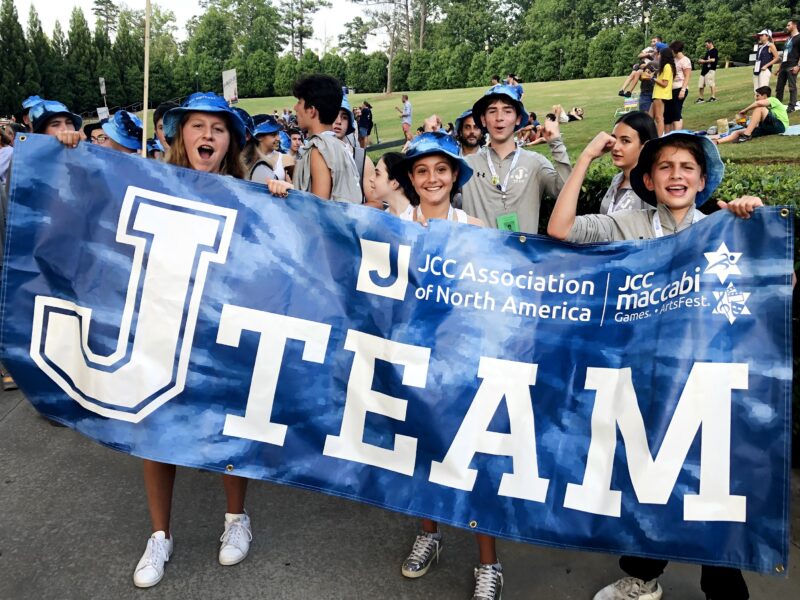
COURTESY/JCC ASSOCIATION
Participants from Atlanta in the 2023 JCC Maccabi Games.




 Add EJP on Google
The JCC Association of North America is taking a big swing, doubling down on Jewish teen sports with a planned $19.5 million investment over the next four years in its JCC Maccabi Games, most of which has already been raised, the organization announced on Thursday.
Through the campaign, the JCC Association plans to grow participation in teen sports by more than 80%, from roughly 2,650 teen athletes to 4,000 in the JCC Maccabi Games (not to be confused with the related but distinct Maccabiah Games). The campaign will also return the JCC Maccabi Games to Israel in 2028.
The four-year initiative has already $12.45 million in funding, nearly two-thirds of its goal, with the Marcus Foundation providing $5 million and the Samueli Foundation giving $6.25 million, JCCA said in a press release. The organization did not identify the sources of the remaining $1.2 million.
The Marcus Foundaiton funding underwrites the first two years of domestic growth, funding new host communities, expanding Jewish and Israel learning, and growing the back-office capacity to manage the larger operation. The organization said it will test a campus-based model alongside the traditional community host format. This summer’s Maccabi Games in Kansas City and Toronto open the four-year push.
The Samueli Foundation commitment revives the JCC Maccabi Israel Games, which JCCA plans to hold every four years thereafter in partnership with Maccabi World Union. The 2028 event is expected to draw more than 1,000 Jewish teens, plus over 500 adults — coaches, delegation heads, volunteers and JCC staff — from North America, Israel and abroad, according to the release. RootOne will supply pre-trip curriculum and, for participants who qualify, travel vouchers to defray the cost of the flight.
The Samueli Foundation’s role represents a widening of its Israel portfolio. Once known chiefly for its giving in Southern California, the foundation has become a fixture in Israeli philanthropy, most visibly through its $50 million grant in April to the Samueli Integrative Cancer Pioneering Institute at Clalit’s Beilinson Medical Center, which followed the foundation’s $25 million launch gift to the institute in 2023.
The Israel push follows the 22nd Maccabiah Games, which ran earlier this month and drew more than 3,000 athletes from the Diaspora alongside some 2,000 Israelis. Organizers billed the competition, run by Maccabi World Union, as the largest gathering in Israel since Oct. 7, 2023, and it went forward under the shadow of a possible renewed war with Iran — the same conflict that forced a postponement of the 2025 Games. Roughly 1,000 youth athletes competed for the first time, and about 1,200 participants marked bar and bat mitzvahs at the Western Wall on the closing day, organizers said.
Barak Hermann, president and CEO of JCCA, said in a statement that JCC Maccabi Games rank among the strongest vehicles for the organization’s goal of building lifelong Jewish engagement, and that it has shaped teens across generations. The Games sit under the JCC Association’s recently formed Center for Jewish Peoplehood.
The Maccabi Games date to 1982 and have drawn more than 500,000 participants and community members across their 44 years. JCC Assocition’s pitch to funders leans on the program’s reach into households with thin institutional ties: 59% of participating athletes do not attend a Jewish day school or a Jewish summer camp. Surveys cited by JCCA found 96% of athletes reported a stronger sense of connection to the Jewish community, 93% called their Jewishness central to their identity and 91% said their Jewish pride had grown.
In a statement, both the Marcus and Samueli Foundations framed the campaign as an investment in long-term Jewish engagement.
The 2028 return to Israel “beautifully weaves together four of our beliefs: that sports have a unique ability to unite people; that time spent in Israel as a young person is formative; that the imperative to invest more in proven Jewish identity-strengthening experiences for youth is huge; and that the time to give generously is now,” Lindsey Spindle, president of the Samueli Foundation, said.
Jay Kaiman, president of the Marcus Foundation, said the campaign reaches teens with no other connection to Jewish life and gives them “an experience powerful enough that they go looking for more.”
He added: “JCC Maccabi’s growth, and its expanding partnerships across the Jewish communal world, make it one of the strongest gateways we have into a lifetime of Jewish engagement.”
Related News

MAJOR GIFTS
Center for Jewish History celebrates 25 years with a $25M matching grant

MAGICAL EXPERIENCE
Shefa launches psychedelics retreat for Jewish professionals suffering burnout
HIGHER EDUCATION
As Jewish donors reconsider academia, Jan Koum doubles down, endowing Israel studies at Stanford

EXIT INTERVIEW
Elizabeth Sokolsky, longtime EVP of Birthright Israel, to retire next year
PRESIDENTIAL REBUKE
Israel’s Herzog: Mamdani ‘makes no effort’ to hide disdain for Israel, Jews must fight back