Opinion
A GRANDFATHER'S LEGACY
The lesson can wait. The child cannot.




 Add EJP on Google
The last conversation I had with my grandfather was about my bat mitzvah.
I was in fifth grade, and he had been in Switzerland for several weeks. My bat mitzvah was still about a year away, but before we hung up the phone, he made me a promise:
Courtesy
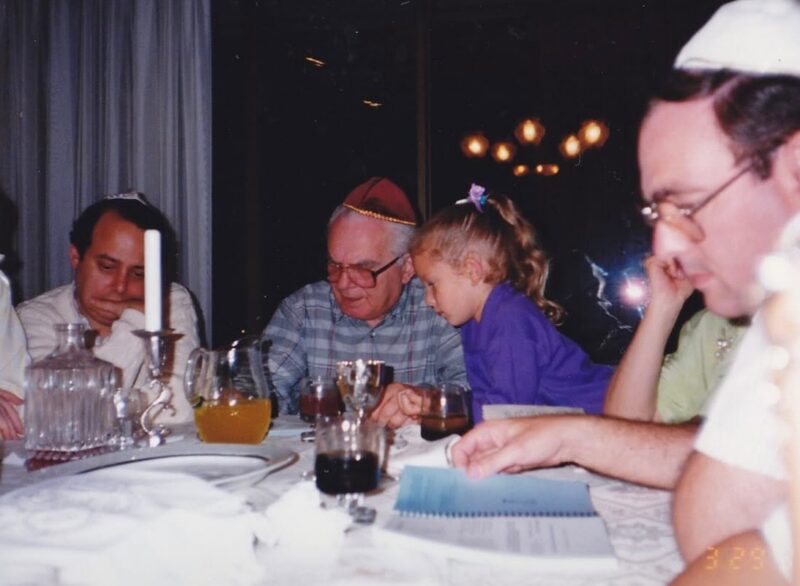
Pam Alcala as a child with her grandfather Marcos Pollak at the Passover table. "I would go sit with him during the meal to ask him questions that I had accumulated during the Seder," she says.
“When I get home, we’ll start learning your Torah portion together.”
It was not a dramatic goodbye. It was not a moment I understood as sacred while it was happening. It was simply the next thing we were going to do.
He never came home.
My grandfather, Marcos Pollak, an askan dedicated to strengthening Jewish life in Israel and in Chile — where he helped establish the country’s board of Jewish education — died on the seventh day of the month of Av. My mother and her siblings traveled to Switzerland to bring him home. My father, my siblings and I stayed behind. By the time he was buried, it was Tisha B’Av.
For years, I thought what I had lost was the chance to learn my Torah portion from him. I imagined us sitting side by side with a Chumash open between us, my grandfather helping me sound out the words I would one day chant from the bimah. I imagined him stopping every few verses to tell a story, because that was how he taught. A question about Torah would become a story about his childhood. A story about his childhood would become a story about our family.
Only much later did I understand that the Torah portion was never the whole lesson.
I did not know then that this unfinished lesson would shape the way I understand Jewish education: not as the transfer of information alone, but as the creation of belonging.
My grandfather inspired my entire career in Jewish education, though he never taught me Hebrew. He commanded every room he entered, not because he demanded attention, but because people wanted to listen. He filled family gatherings with stories of resilience, migration, rebellion, growth and Jewish life. His Judaism did not feel like something preserved behind glass. It felt alive, joyful, honest and deeply his own.
One of my favorite family stories was about the day he cut off his peyot. Raised in an Orthodox home, it was his teenage act of rebellion. But he never told the story as the moment he rejected Judaism; he told it as part of the journey toward a Jewish life that was authentic, meaningful and his.
That distinction shaped me. My grandfather understood that Judaism could not simply be handed to the next generation as an obligation. It had to be made meaningful enough for them to claim.
Recently, my family began the process of replacing a plaque at Instituto Hebreo Jaim Weitzmann, the first Jewish school in Chile, which my grandfather helped build. The school has an award they give to graduating seniors called the Marcos Pollak Award for Jewish Identity, recognizing students for exemplary dedication to Zionism and cultural values.
The sentence we chose comes from Ta’anit 23a: “Just as my ancestors planted for me, I too plant for my descendants.”
I cannot think of a more fitting tribute.
When my grandfather helped build Jewish education in Chile, he was not only helping create a school. He was planting for children he might never teach, families he might never meet and generations whose Jewish lives would grow in ways he could not fully imagine.
That image of planting has changed the way I understand both his legacy and my own work. Jewish education is not only what happens when a teacher opens a book. It is what happens when one generation creates the conditions for the next generation to feel that Judaism belongs to them.
That feels especially urgent in part-time Jewish education, where time is limited, expectations are high and students often arrive after already giving so much of themselves elsewhere.
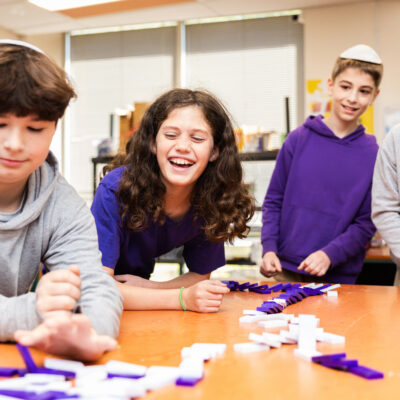
I teach during the week, after students have spent a full day in school. By the time they enter the classroom, they are carrying backpacks, homework, sports schedules, friendship drama, family expectations and the ordinary exhaustion of children who have already been asked to sit, listen, transition, perform and keep it together for hours.
And still, they show up.
That matters. By the time a child enters a Jewish classroom, we are not the first adults who have asked something of them that day. They may be ready to learn. They may also be tired, distracted, anxious, hungry, overstimulated or simply done.
That reality should shape how we teach.
I always have a lesson prepared. There are Hebrew words to practice, Torah stories to explore, conversations about Israel to facilitate, values to unpack and students preparing for b’nai mitzvah who are eager, nervous, resistant, proud or some combination of all of it.
But before we begin, I almost always open with the same prompt: “So, tell me about your week.”
It sounds simple, and sometimes it is. Sometimes I hear about soccer games, tests, birthday parties, camp memories or forgotten homework. Sometimes a student wants to tell me every detail of something that seems, on the surface, entirely unrelated to the lesson I planned.
And sometimes I hear almost nothing.
But over time, I have learned that the quiet answers deserve just as much attention as the excited ones. I notice the student who usually runs into the room but walks in slowly that day. The one who avoids eye contact. The one who keeps interrupting because they are desperate to be seen. The one who insists they are fine in a voice that tells me they are not.
Sometimes I pull up a chair and sit beside them before we ever open a book. We may talk, or we may not. Sometimes they simply need to know that someone noticed.
The lesson can wait. The child cannot.
This is not a rejection of curriculum. It is the condition that makes curriculum matter.
I care deeply about what our students learn. I want them to build Hebrew confidence, understand Torah as a living text, ask meaningful questions about Israel and Jewish history, and see themselves as part of the Jewish story. But I do not believe Jewish education begins with information. I believe it begins with relationships.
A child who feels unseen may memorize a prayer and still experience Judaism as one more demand placed upon them. A child who feels known may encounter that same prayer as an invitation. A child who is exhausted may not remember every detail of a lesson, but they may remember that a Jewish adult noticed they were having a hard day and chose to sit beside them.
That memory matters because Jewish identity is not built only in the moments we can measure. It is built in the small, repeated experiences that tell a child, “There is a place for you here.”
In supplemental Jewish education, we often worry about time. There is never enough of it — not enough hours, not enough weeks, not enough years before a child reaches b’nai mitzvah and families begin to decide what comes next.
But limited time is precisely why relationships cannot be treated as an extra. If our students experience Jewish learning only as something squeezed between school, homework and activities, then every moment must communicate more than content. It must communicate belonging.
That requires investment not only in curriculum, but also in the educators, time and culture that allow students to feel seen while they are learning. If we want children to carry Jewish life forward, we have to give them more than material to remember. We have to give them relationships worth remembering.
Maybe that is why this memory returns to me each year on Tisha B’Av.
Tisha B’Av asks us to sit with loss. We mourn what was destroyed, what was broken and what could not be restored in the way people hoped it would be. But Jewish history has never ended with destruction. Again and again, what remained was carried forward by people who chose to plant anyway.
My grandfather was one of those people.
He planted through stories. He planted through Jewish education. He planted through the belief that Judaism was strong enough to be questioned, joyful enough to be loved and spacious enough to belong to every generation in its own way.
I did not get the Torah lesson he promised me. We never sat side by side with the text open between us. He never taught me the words I would chant from the bimah. And yet, all these years later, I understand that he was teaching me long before that phone call.
The future of Jewish education will depend not only on what we teach children, but on whether they experience Jewish learning as a place where they are known.
Now, when I pull up a chair beside a student, I think about the chair that was supposed to sit beside mine. For years, I thought it had been left empty. Now I understand that it was not empty at all.
It was waiting to be passed on.
Pam Alcala is a Long Island, N.Y.-based Jewish educator, curriculum developer and program leader whose work focuses on relationship-centered Jewish learning, Israel education and helping students find personal meaning in Jewish life.