Opinion
BOOKSHELF
Learning about Judaism in unexpected places




 Add EJP on Google
In Short
The spaces where Jews and non-Jews are learning about Judaism are more numerous, more varied and more generative than our communal conversations often acknowledge.
When Emma, a young Jewish woman in her early thirties, moved back home after college and found herself weighing the cost of a synagogue or a gym membership, she chose the gym. By most conventional measures used to track Jewish engagement, that choice would likely have categorized her as an unaffiliated, unengaged young American Jew drifting away from communal life. But Emma’s Jewish story does not end there. It is only the beginning.
Missing the Jewish community she had found at her college Hillel, Emma turned to a website she had come across, myjewishlearning.com, and started exploring. One link led to another. She discovered that synagogues were livestreaming their Friday night services and landed on one from a Reform congregation in San Antonio, Texas, far from where she resided. She tuned in every Friday night, she said, because “you have to have good singing.” The same website led her to something else she had never imagined: a Torah-learning yoga retreat at a Jewish farm in Connecticut, which she loved so much that she signed up again the following summer. What had begun as a casual search on a half-remembered website had become, link by link, a meaningful Jewish life rooted in learning.
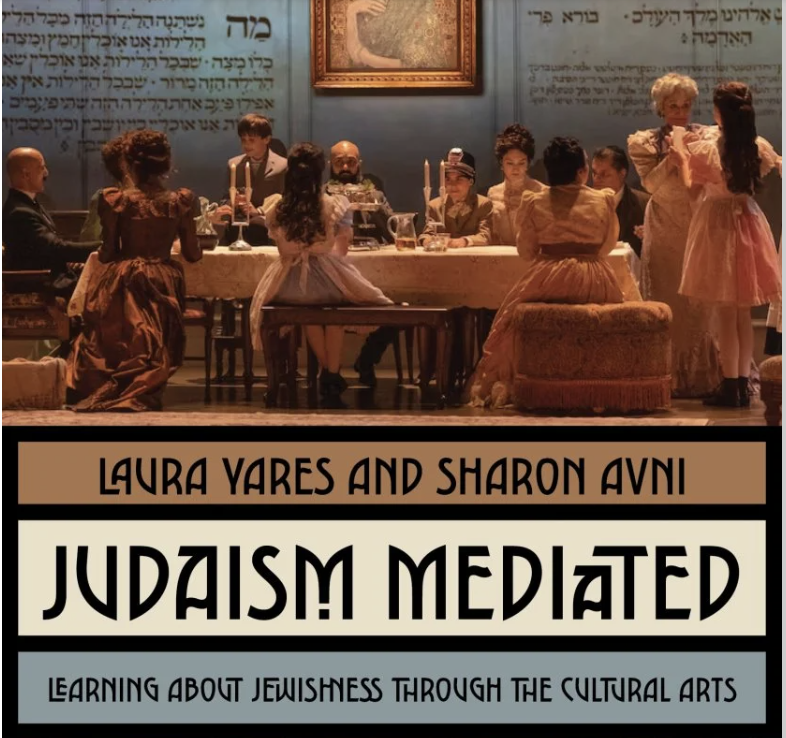
Screenshot/NYU Press
From the cover of the book "Judaism Mediated: Learning About Jewishness Through the Cultural Arts," by Laura Yares and Sharon Avni.
Emma’s story is at the heart of our new book, Judaism Mediated: Learning About Jewishness through the Cultural Arts (NYU Press), and it illuminates something important about where Jews encounter Judaism today — and where researchers, communal leaders, and funders might fruitfully turn their attention.
American Jewish institutional life is, by many measures, undergoing significant change. A 2021 Pew Research Center survey found that only 12% of American Jews attend weekly religious services, and more than half say religion is not important in their lives. These numbers have generated considerable communal conversation about Jewish continuity, prompted serious reflection at board meetings and inspired substantial investment in programs designed to deepen Jewish engagement among younger generations.
But the same Pew survey contained a finding that received far less attention: Over 70% of American Jews reported that they often or sometimes participate in Jewish cultural activities such as cooking Jewish food, reading Jewish literature, watching television shows with Jewish themes and visiting Jewish museums. This figure points to a community seeking Jewish connection across a range of spaces outside traditional institutions. The question our book asks is simple but surprisingly understudied: What are American Jews learning in these cultural spaces, and what does that learning mean for how they understand themselves as Jews?
For the past several years, we have been studying American Jews (and non-Jews) as they engage with Jewish cultural arts in a range of settings: a national museum of American Jewish history in Philadelphia; an online Passover concert that raised millions for COVID-19 relief; a 30,000-member Facebook community devoted to the Israeli television show Shtisel; a live performance of Ladino music in Boston; Broadway shows grappling with anti-Jewish hatred. In each of these spaces, we sat with audiences, conducted interviews, observed interactions and asked participants: What do you make of all of this? What are you thinking about and learning?
What we found consistently surprised us.
Learning about Judaism, based on their answers, is rarely a linear process. It is episodic, meandering, often serendipitous, and deeply shaped by the interests and experiences that people bring with them. Emma did not set out to learn about Judaism when she joined the YMCA, but one encounter led to another, each a link in what we came to think of as a chain connecting websites to synagogues to retreat centers, with Emma at the center of each new discovery. This kind of learning does not often show up in demographic surveys. It is not captured by questions about synagogue membership. But it is real, it is widespread and it is reshaping what Jewish engagement looks like among 21st-century American Jewry.
What surprised us even more was who we found doing this learning. Again and again, non-Jews showed up in these spaces, not as intruders or outsiders, but as genuinely engaged participants in conversations about Jewish history, culture, identity and experience. This finding challenges us to think differently about Jewish learning, not only what it is, but who is doing it and why it matters. What does it mean when non-Jews are enthusiastic consumers of Jewish cultural productions? What happens to Jewish culture when it travels beyond the boundaries of the Jewish community? And what might American Jews learn about their own tradition from the questions that outsiders bring to it? These questions are not peripheral: understanding where and how Jews and non-Jews are learning about Judaism is central to understanding Jewish life in America today. It has never been more necessary, nor more consequential.
We do not pretend to have all the answers. Our book argues, however, for a more expansive understanding of what counts as Jewish education and who counts as a Jewish learner, one that takes seriously the full range of spaces where Jews and non-Jews alike are encountering, questioning and making meaning of Jewish life today. The museum visitor who spends several hours reading about the history of American Jewish immigration and walks out with a new understanding of Jewish life in Colonial America. The Shtisel fan who joins an online community of 30,000 strangers and finds herself in genuine conversation about Haredi life, gender and tradition. The concertgoer who hears Ladino sung live for the first time and leaves wanting to know more about the diversity of Jewish heritage. These are learners of Judaism, discovering, exploring and finding meaning in Jewish life in a variety of cultural arts spaces.
Emma may or may not ever join a synagogue. She has sat with Torah text in a yoga pose in a field in Connecticut. She has found a way of learning and expanding her knowledge of what being Jewish is and its importance in her life. She needed the freedom to follow her curiosity wherever it led and a cultural ecosystem rich enough and diverse enough to meet her with meaningful Jewish content and experiences. American Jewish life has that ecosystem. The spaces where Jews and non-Jews are learning about Judaism are more numerous, more varied and more generative than our communal conversations often acknowledge. Our book, we hope, is a contribution toward seeing Jewish learning in the unexpected places where it is happening today.
Sharon Avni is a professor of literacy and linguistics at the City University of New York (CUNY-BMCC).
Laura Yares is a professor of religious studies and Jewish education at Michigan State University.