ISRAELI PHILANTHROPY
The long game: Yadin Kaufmann’s 24-year bet on tomorrow’s tech philanthropists
Through his Israeli and American organizations, Tmura and A Good Option, the former venture capitalist has raised millions for nonprofits by getting companies to donate equity, not cash
Einat Levron
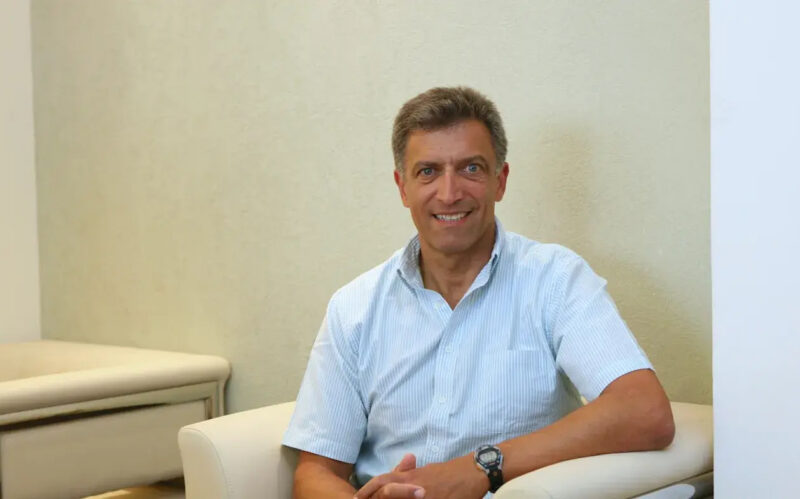
Yadin Kaufmann, the founder of Tmura and A Good Option




 Add EJP on Google
Israeli tech founders, the conventional wisdom has it, are cash poor but potentially equity rich. Inside that simple truism, Yadin Kaufmann found a model for how the drivers of wealth in the Startup Nation could also become philanthropists and spread some of that wealth.
Kaufmann entered Israel’s venture capital arena in 1987 just as the country’s tech sector was getting its footing. He recalls spending the next 15 years watching fortunes get made and noticing how little of that money ever found its way into Israel’s nonprofit ecosystem.
“All this wealth being created,” he remembers asking himself, “why aren’t we seeing more money supporting philanthropy from Israel?”
His answer was Tmura, meaning “return,” which he launched in 2002. The idea was simple: Instead of asking a startup founder for money from his own wallet, Tmura asked for a sliver of equity from startups while it was still cheap enough — and abstract enough — to give away. If the company eventually exits, then the proceeds from the liquidated equity gets donated to Israeli nonprofits. Twenty-four years later, 978 companies have donated equity, 200 companies had exits and Israeli nonprofits have collected $37.8 million in philanthropic funds. In recent years, Tmura has averaged 50-60 new companies signing up each year.
Kaufmann didn’t stop with Israeli tech founders. Two years ago, he founded an American version of Tmura — A Good Option — in his hometown of New York City, where he grew up before making aliyah in 1985. Now, the nonprofit has attracted 10 companies that have already donated equity.
Udi Mokady, former chief executive of Israeli cybersecurity giant CyberArk, donated equity long before his company was a household name in the Israeli startup world. Mokady said the board resolution to commit equity to Tmura was the easiest one he ever brought to a vote. “The team just loves it,” he said. “I think you get great ROI for all the right reasons when the team is involved in giving back.”
The money is only half of what Kaufmann is after.
“We’re not only creating more dollars,” Kaufmann said. “We’re creating more philanthropists. We’re enabling people to be philanthropists years before they could through traditional models.”
Kaufmann said that founders say the donation changes how the company feels from the inside — it shows up in recruiting pitches, retention conversations, the story a company tells about itself. Eight Tmura companies have crossed $1 million in donations so far, among them Waze.
Former Waze CEO Noam Bardin, whose company’s Tmura equity donation was transformed into $1.5 million when Google bought Waze in 2013, said he keeps coming back to that same vote when he talks about why the model works. Speaking at a joint Tmura and A Good Option event earlier this year, he framed it as something that runs alongside the job rather than competing with it: “You’re not asking people to go and volunteer time, you’re telling them to build a better product, do a better job, and we’ll also help some people. That’s what I love about this organization — it’s aligned with what we do.”
Asked about the vote itself, Bardin’s answer was short: “Everyone was involved.”
Building off the connections that placed Tmura as a major player in the Israeli tech ecosystem, Kaufmann looked east to his hometown. Kaufmann saw a similar disconnect in American Jewish philanthropy that he had observed in Israel two decades earlier. Young Jewish tech entrepreneurs don’t have much cash or free time yet, but that did not mean altruism wasn’t on their minds.
So Kaufmann did what any other entrepreneur would do: he started a second venture, A Good Option, which seeks to engage American and Israeli-American tech foundations in New York the same way Tmura does for Israeli techies in Tel Aviv. Launched in 2024, A Good Option has 10 companies under its umbrella, and Kaufmann has recruited Sivan Aloni Olidort, an Israeli “super-connector” and former senior advisor to the consul general in New York, as executive director.
Kaufmann noted that traditional American Jewish nonprofit requests — money or time — typically don’t fit young tech entrepreneurs’ lifestyles as they lack spare cash before an exit and spare time while building their companies; equity, he said, is the resource Tmura has found a way to tap into instead.
Ron Gonen, founder and CEO of Closed Loop Partners, who has donated to A Good Option, told eJP that the model resonated with him because it aligned with core Jewish values. “When I learned about A Good Option and its Israeli predecessor, it aligned with all of these Jewish values in a beautiful way — it involves tikkun olam, it involves business and entrepreneurship, it involves Jewish community,” Gonen said.
“I’ve tried to build my career around being mission-driven — building organizations that protect our environment and create economic value. Being able to turn that into a donation of shares for Jewish causes was as aligned as you could get.”
Gonen intends to give his donated equity to three organizations: the Israel ParaSport Center, BBYO and MEET, which creates collaborative technology, educational and entrepreneurial opportunities for Israelis and Palestinians to work together.
Kaufmann maintains that reaching donors early, before they even have liquid funds, builds a habit that outlasts any one moment.
He sees a straight line between how he used to invest and how he thinks about giving now. “When I was investing, we always placed major emphasis on the quality of the entrepreneurs, rather than on trying to predict the future.”
“We looked to invest in people who were smart, honest, hard-working and leaders — and who we thought would be able to respond well to the inevitable changes in the business landscape.”
The nonprofits get the same test.
“They’re dynamic, innovative initiatives started and run by people who share those same qualities. These social entrepreneurs very likely could have been successful in the private sector too — but they chose instead to focus on addressing a social need.”
Related News

MAGICAL EXPERIENCE
Shefa launches psychedelics retreat for Jewish professionals suffering burnout

EXCLUSIVE
Detroit-based philanthropists Nancy, James Grosfeld donate $8M to renovate JDC’s Israel campus

EXIT INTERVIEW
Elizabeth Sokolsky, longtime EVP of Birthright Israel, to retire next year

MAJOR GIFTS
Center for Jewish History celebrates 25 years with a $25M matching grant
CLOSING WORDS
In AZM address, Cosgrove links communal ‘orthodoxy’ on Israel to rising anti-Zionism among young Jews