Opinion
ZACHOR AND MORE
The AMIA tragedy does not belong to the past




 Add EJP on Google
In Short
Violence never appears out of nowhere, and combating antisemitism requires far more than condemning each incident after the fact.
July 18 marks one of the most painful chapters in Argentina’s history. Thirty-two years ago this week, the headquarters of the Argentine Israelite Mutual Association (AMIA) was attacked when a suicide bomber drove a car filled with explosives into the building, killing 85 people and wounding more than 300. It was the deadliest terrorist attack in the country’s history, and one of the most devastating terrorist attacks on Jews globally.
This was not just an attack targeting the Jewish community but an attack on Argentine democracy, social coexistence and the values of a pluralistic society — making remembrance the entire country’s responsibility.
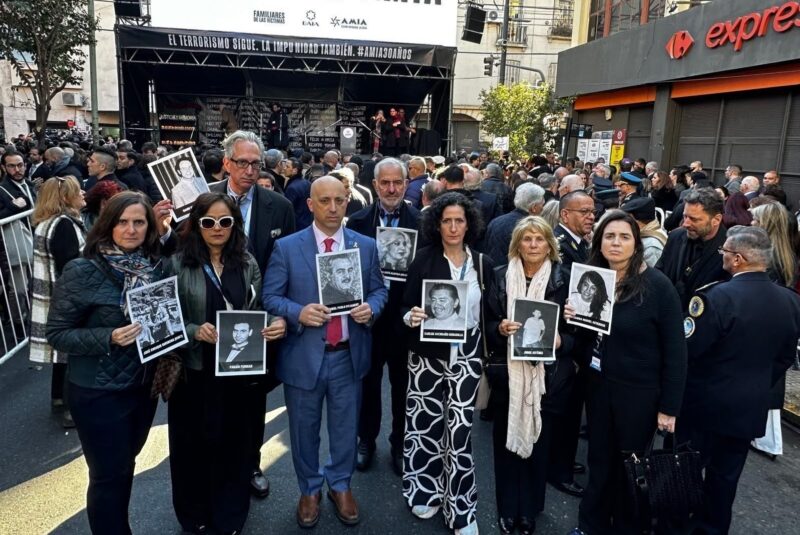
Courtesy/StandWithUs
Senior ADL staff and leadership, including CEO and National Director Jonathan Greenblatt (third from left), and Senior Vice President of International Affairs Marina Rosenberg (fourth from left), at the 30th AMIA anniversary ceremony in Buenos Aires.
That responsibility isn’t over.
As time passes, these memorials risk becoming routine, losing their power to educate, challenge and unite, especially as antisemitism surges across the globe. The drastic rise of antisemitic incidents since Hamas’ horrific terrorist attack on Oct. 7, 2023, has been fueled by polarization, disinformation and the speed at which social media amplifies extremist rhetoric.
Within this current landscape, Argentina occupies a distinctive place. It’s home to one of the largest Jewish communities in the Diaspora — some 200,000 strong — and remains one of the safest places in the world for Jewish life; still, it isn’t immune to the broader global trends.
The Delegation of Argentine Jewish Associations, the official representative body of the Jewish community in Argentina, recorded 713 antisemitic incidents in 2025, a 67% increase compared to 2022. While Argentina recorded only four violent incidents between 2021 and 2023, that number rose to 19 over the following two years: 10 in 2024 and nine in 2025. Behind these figures lies a warning that goes beyond any one community: When prejudice is normalized and extremism circulates without resistance, society as a whole becomes more vulnerable.
Violence never appears out of nowhere. First come words that dehumanize, then conspiracy theories that erode public trust and narratives that turn the “other” into a threat. That violence finds fertile ground when the lessons of history, from the Holocaust to the AMIA attack itself, are no longer passed on with the force they demand.
Argentina’s judiciary established that both the AMIA attack 32 years ago and the bombing of the local Israeli Embassy 34 years ago were planned by the Iranian regime and carried out by its armed proxy, Hezbollah. That pattern hasn’t changed; the Iranian regime remains the world’s leading state sponsor of terrorism and a driving force behind global antisemitism. It backed Hamas in the Oct. 7 massacre and continues to support Hezbollah and other terrorist groups that attack the world’s only Jewish state. When hatred of Jews is sponsored by a state, it becomes a global threat.
That’s why leadership matters. While many governments haven’t adequately responded to the rise of antisemitism, the Argentine government has unequivocally rejected antisemitism and taken concrete steps to protect the Jewish community. That commitment has impact: When public officials condemn hatred, they set a standard that helps society clearly distinguish between legitimate debate and intolerance. But institutional leadership alone is not enough.
The experiences of the large Jewish Diaspora communities in the J7 Task Force — the United States, Canada, the United Kingdom, France, Germany and Australia— offer a lesson that should not be ignored. For decades, Jewish communities in these countries expressed their identity freely and built thriving communal life without fear. The steady rise in antisemitic incidents in recent years, combined with recent deadly attacks targeting Jews in Australia, the United States and the United Kingdom, has shown that even the most open societies can be caught off guard when intolerance is allowed to fester.
Combating antisemitism requires far more than condemning each incident after the fact. It demands education, strong institutions, a justice system that acts decisively and a civil society willing to reject every form of discrimination before it turns into violence.
There is also a debt still owed: 32 years later, the victims of AMIA and their families are still waiting for full justice. While there have been important advances, impunity prolongs the pain and sends a dangerous signal that terrorism can go unpunished. No society can afford to accept that message.
That conviction is what brought me to Argentina now with my ADL colleagues. I am here this week to stand with the Jewish community on another AMIA anniversary: to embrace the families of the victims, to strengthen cooperation with authorities and civil society and to recognize the Argentine government’s commitment to the Jewish community. Our visit also comes at a significant moment: Argentina has just assumed the presidency of the International Holocaust Remembrance Alliance, an opportunity to deepen international cooperation and promote effective tools to confront antisemitism.
The AMIA anniversary should not be merely a moment to look backward. Above all, it should be an opportunity to renew a shared commitment: to confront antisemitism, combat terrorism, defend social coexistence and our democratic values.
A democracy is not defined solely by the strength of its institutions. It is also measured by its ability to protect its minorities, defend human dignity and act before hatred once again turns into violence.
Marina Rosenberg is the senior vice president for international affairs at the Anti-Defamation League.