Opinion
WASTE NOT, WANT NOT
Jewish communities and the reuse economy




 Add EJP on Google
In Short
Community "buy nothing" groups on social media platforms like WhatsApp can offer peer-to-peer opportunities for acts of kindness and community-building.
Love it or hate it, WhatsApp has been a game-changer for synagogue communications. At Temple Beth Am (TBA), the Los Angeles synagogue where I serve as the cantor, the messaging app served up the first sustainable solution in decades to the challenge of gathering a quorum for our daily minyan. Every day, the minyan gabbai sends out a poll to the minyan WhatsApp group, followed by intermittent reminders until at least 10 adults have signed up. This is one of many productive chats under the umbrella of our synagogue WhatsApp “community”: there are also chats for the board members, a private subgroup for our hevra kadishah, and more.
A few months ago, one of our community members, Sharon Sadgat, suggested that we use WhatsApp as a platform for exchanging used goods. In recent years, social media platforms have served as hosts for digital swap meets. Some of these groups are organized by neighborhood; many are officially “Buy Nothing” groups — all items advertised are completely free, no buying, selling or trading involved — local spokes on a larger wheel of the popular hub of the reuse economy. Sadgat proposed that the synagogue host a hyperlocal model for such a goods swap, allowing members to safely rendezvous at the synagogue to rehome items.
Natalie Weiss
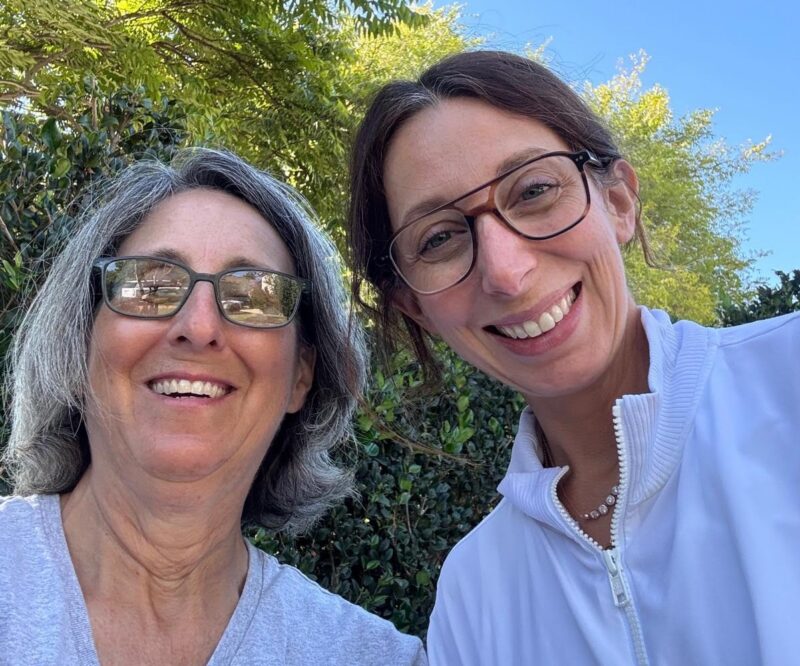
Temple Beth Am members Debbie Abeles (left) and Orly Amsalam meet at a TBA Buys Nothing handoff.
Introducing ‘TBA Buys Nothing‘
Together with our director of membership and engagement, we established a WhatsApp-based goods-exchange platform: TBA Buys Nothing. Any member of the greater synagogue WhatsApp community may join the platform, where we set out a short list of rules:
- The group is for our synagogue members only, and entry is subject to approval by the group administrators.
- The platform is exclusively for offering and/or receiving free goods — no buying or selling, no trades or bartering.
- Members should represent the quality of their goods with integrity.
- When picking up goods on our synagogue campus, be respectful of staff and spaces.
Within hours, we had over 100 members in the group, and the posts were flowing. From baby goods to Purim costumes, kids’ sweatshirts to couches, we watched as dozens of exchanges took place every day. Months later, the group is active at a sustained and impressive scale.
The success of the goods exchange reveals some of the underlying gaps that exist even in thriving Jewish communities like ours and can be addressed through this type of platform.
Affordability
However expensive you imagine Jewish life in Los Angeles to be, it’s worse than that. The TBA Buys Nothing group is an island of reprieve from the incessant consumerism that surrounds us. Every day, there are dozens of exchanges: from backyard tables to baby swings; train sets to havdalah sets; puzzles to nursing pillows; Purim costumes to Pressman Academy school uniforms. While I can’t properly estimate the collective money saved by these free exchanges, I can attest that the savings, both in money and in time, are real.
Safety
We’ve come a long way from the era of classified ads and Craigslist posts, but exchanges with strangers still feel quite vulnerable. My local Buy Nothing group has thorough administrators, but I still feel exposed when messaging my address to relative strangers in the course of arranging a pickup for an old cat bed or a trampoline.
The TBA Buys Nothing group administrators only admit members of our synagogue. While not everyone in the group knows one another yet, we do know that every post is made by a member of the community. Exchanges are always welcome to take place on the campus at TBA for the sake of security and convenience, too.
Connectivity
In a synagogue as large as ours — nearly 1,000 families — there are plenty of regular attendees and engaged congregants who don’t know one another. The TBA Buys Nothing group has brought together disparate sub-communities: Grandparents are exchanging car seats and swaddles with new parents. Empty nesters who’ve belonged to TBA for ages are handing over stacks of board games to new members.
Occasionally, we get digital snapshots of these moments, selfies of members meeting on our doorstep or our outdoor field. Every exchange is a two-way street of gratitude and relief as people unburden themselves from things they no longer need and receive great items for free.
Restoring the Jewish value of shared costs
TBA Buys Nothing has restored a critical artifact of 20th-century Jewish community-building. Jewish immigrants to the United States from Eastern Europe popularized the notion of pools of goods available for free or on loan at a time when most Jews who were new to the country had limited resources: the gemach (short for gemilut chasadim, acts of kindness). You can find gemachs in many Jewish communities even today, including Los Angeles, places where one can borrow without shame. TBA Buys Nothing shares a premise with the gemach: that your collective community may have the very things you need.
TBA Buys Nothing is a platform for generosity. Jewish communities of every type and size could benefit from similar platforms. In this difficult economy, imagine a shift in mindset where community members pause before throwing something away to consider: “Is there someone else in my community who might make good use of this item?”
Most of the time, it turns out, the answer is yes.
Rabbi Cantor Hillary Chorny lives in Los Angeles, where she serves as clergy at Temple Beth Am. Her forthcoming book from Ben Yehudah Press about redesigning Jewish ritual is expected to hit bookshelves in Spring 2027.