Q&A
After 30 years, Latet’s founder warns persistent poverty is an ‘existential threat’ for Israel
Gilles Darmon, who launched Latet a year after immigrating from France, believes the country is strong, wealthy enough to tackle income inequality
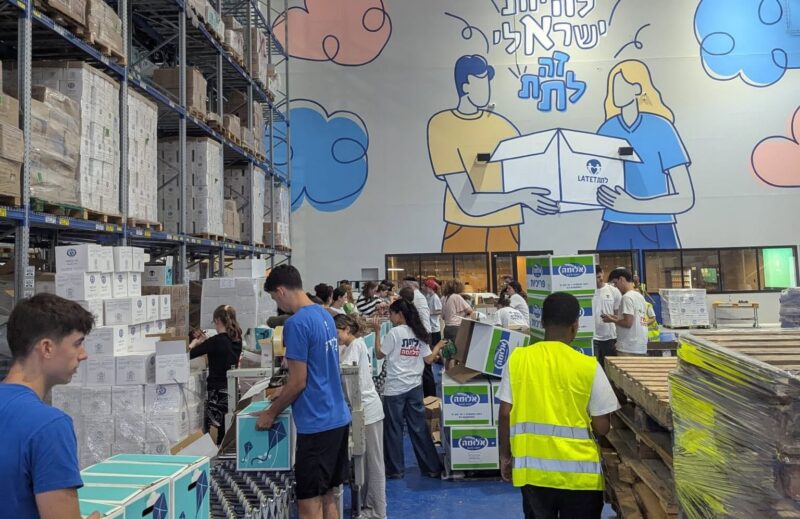
Latet/Facebook
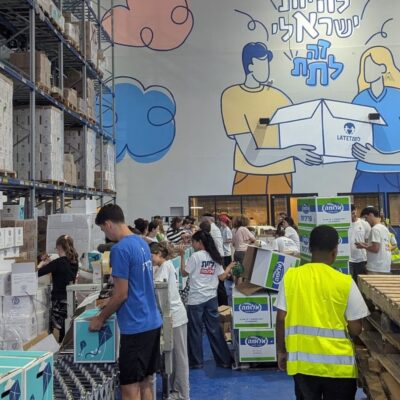
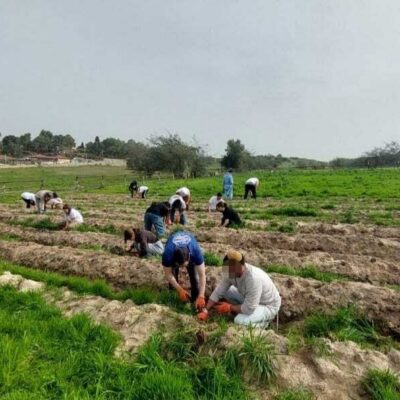
Volunteers work in a Latet warehouse in June 2025.




 Add EJP on Google
Gilles Darmon arrived in Israel from France in 1995 with almost nothing but chutzpah. A year later he founded Latet, recruiting the poverty-fighting nonprofit’s first volunteer on the street. With an immigrant’s eye for those on the margins of society, Darmon set out to take on poverty in Israel.
He built the organization slowly, from the ground up, into a nonprofit behemoth, on a premise few shared at the time: that Israeli civil society could shoulder its own most urgent problems, funded “only, or mostly, on Israeli resources” rather than leaning on government subsidies or Diaspora donors.
Thirty years later, Latet runs an operation worth roughly NIS 250 million ($84 million) a year, supports about 100,000 families through its food bank and delivers physical and social support to some 2,000 Holocaust survivors living in need. Roughly 85% of what it raises comes from within Israel, and today every shekel of its activity goes to programs at home. Its Alternative Poverty Report has become a fixture in the national policy debate, a yearly measure of the country’s progress in combating systemic poverty — or lack thereof.
Thirty-one years after he first made aliyah, and 30 years after he founded Latet, Darmon spoke with eJewishPhilanthropy for a wide-ranging conversation about why he frames poverty as an existential threat to Israel, the limits of what philanthropy can do and why he believes the country is finally wealthy enough to solve its own problems.
This interview has been edited for length and clarity.
JH: Describe for people who don’t know Latet, in a few words, what the organization does and what makes it unique.
GD: Our biggest and most important operation is the food bank. We are the first Israeli food bank. We support approximately 100,000 families across the country through more than 135 different distribution centers. We do this based on universal values: we are here to assist the Israeli mosaic.
Most of the food we distribute through this channel is rescued food through operations set up in close cooperation with the food industry. We have almost exclusive partnerships with the largest food manufacturers in Israel.
The second channel, which we launched 20 years ago, we call Aid for Life. It is dedicated to Holocaust survivors and elderly people living in Israel. The idea is to provide them with 360-degree assistance — whatever they need, we provide, and we bring it to their home. We have volunteers who, throughout the month, provide everything they need. Twice a month, there is a food box, but there is also renovation work — in the bathroom, the kitchen, the toilet, the corridors — to keep decent living conditions.
JH: How has Latet’s role evolved over its 30 years?
GD: Our impact has grown from zero to it’s current level within 30 years. We have significant impact through more than 135 distribution points and beyond that a youth movement active in more than 50 municipalities. When we started to publish the Alternative Poverty Report, the idea was to give a first voice to poor people. Today, year after year, it has become a tool for analyzing the situation of poverty in Israel — one that is influential and widely used.
JH: How has the ecosystem in which poverty exists changed over the past 30 years?
GD: Significantly. According to Israel’s National Insurance Institute, food insecurity increased significantly between 2000, 2010 and 2020. Since we started to measure, the number of families in food insecurity has grown; we now talk about 867,000 families.
The environment became more challenging. Poverty and food insecurity became a problem. It is unsustainable for Israeli society — it is an existential threat. You cannot keep a strong economy with such a level of poverty. You cannot keep a strong army with such a gap of social inequality between such large groups of the population. You cannot keep a good level of education when you have more than one million children in food insecurity. There is a social, existential threat that must be addressed now.
[With] Latet alone, I never had the resources to solve the issue. As an emergency organization, we do not pretend that tomorrow we will solve food insecurity. We provide a minimum, limited, emergency answer thanks to the involvement of Israeli citizens, and the idea is to leverage that public support. This awareness is so important to us. Last year, we had 450,000 donors making a philanthropic contribution. If Latet were a political party, we would be the biggest party in Israel. Our idea was never simply to raise money from the state and a few big donors. The idea was to build public opinion around poverty and food insecurity in Israel — to explain to Israeli citizens that they can do something themselves, and then to turn to national players, to the government, to the public debate, and say: we have a problem, we cannot stay at such a level of poverty, something must be done.
JH: Is Israel now wealthy enough and mature enough to solve its own social problems?
GD: Israeli society has the capacity and the responsibility to address its own biggest issues. The whole organization is built around this idea — that Israel is mature enough to handle these issues, and that we have a responsibility to do so. In the last few years, we have seen more organizations duplicate the Latet model. For me, that is a success — it means other organizations understand that the solution is here and that we can do it ourselves. It is a question of maturity, responsibility and wealth.
We are in a country with a GDP of around $60,000 per capita, and we need to leverage it. We are no longer in the situation of the 1950s. Now we have enough resources to manage — enough resources on the side of Israeli philanthropy, including the high-tech industry, which has grown over the last 20 years because of the kind of economy Israel built. High tech has to find its place in philanthropy and I believe we are only at the beginning. It is not enough for me.
The government budget will reach more than NIS 600 billion ($200 billion). To fund the war effort, we found a way to finance almost NIS 350 billion ($118 billion) without endangering the Israeli economy — Tel Aviv did not collapse. If you look at the latest economic figures, inflation is decreasing, and the state deficit is lower than we thought. The Israeli government has the resources to significantly address poverty and food insecurity. It is only a matter of political decision. It is doable to bring poverty back to an average level.
It all comes back to my point: Israel has to take responsibility. The state, the government and the leadership must address it seriously.
The problem is that leadership is mostly trained around security issues. Look at everyone who wants to be prime minister in the next elections — they are all security specialists. No one is a specialist in social issues. We are in a paradox: there are 2.8 million people in poverty who have no political home, because no one speaks to them. It is a blind spot. Everyone works to keep social issues out of the election debate. We need leadership on social issues because the government is the only player with the real resources to make a real change.
JH: Roughly 85% of Latet’s overall resources originate in Israel. What, if any, is the role of Diaspora philanthropy in partnering with Latet?
GD: Philanthropy can only be a catalyst. We go to the Diaspora and to philanthropy and say: We did everything we could by ourselves, but given the emergency that followed Oct. 7, we also need your help. Not to replace us, but to complete us. It is a totally different game, a totally different conversation. If Israel matters to you, we need you — but we need you after we have done everything ourselves.
Diaspora philanthropy has to help us to mature, and help Israeli society to mature — not only in terms of donations, but in professionalism and impact. We need everyone’s help to be more efficient. All the donors should ask Latet painful questions. They should ask for transparency, for details of the operation, for reporting — everything that shows we care about the donation and about the rules of assisting people with limited philanthropic resources.
At the end of the day, there is an obligation to maximize impact, and that has to be an obsession for every manager of the organization: how can I do more with the same level of donation and volunteering? That is the mantra for all managers if we want to remain legitimate in asking for support.
Professionalism and efficiency matter enormously to us. Our overhead rate is 5.6%, which is really difficult to reach. That covers the salaries and the systems we built to achieve a complicated mission.
JH: What do you say to individuals or philanthropists, inside or outside Israel, who say the work you’re doing should not be done by a nonprofit — it should be done by a functioning government?
GD: They are right.
Latet cannot solve an issue that is much bigger than what we do across the entire field of food insecurity. The government has to do something big. If my goal were only to finish my food drive and distribute the food I collect, I would be missing the point. This whole operation is built to push the government to turn toward this field.
When we started, the government’s investment in food security — what we call the second social-security safety net — was essentially nothing. The argument was: There is no need to distribute food, because we already distribute those benefits. We told them: look at the numbers — it is not working. There is a need for a social-security network that includes food distribution.
Again, this should be the government’s responsibility. If I stayed quiet and did not ask the government to do anything, we would be in danger. When we publish the Alternative Poverty Report, we say everywhere that the government has to act. As a result, we do not have many friends in the government, and it does not matter whether the government is left or right. We keep shouting and explaining that the government has to act. We do see a little movement, very far from what is required.
JH: What budget do you need to dramatically decrease that 2.8 million number of Israelis living in poverty?
GD: Governmental committees have tried to define the map to decrease it significantly. The conclusion was that an investment of NIS 7 billion ($2.3 billion) a year over five to 10 years could bring the level of poverty in Israel close to the OECD average. The cost of the war is around NIS 350 billion of additional money that was found. We [the Israeli government] always find money for an emergency situation.
JH: Throughout the interview, you’re framing poverty and food insecurity as an existential threat to Israel. Given the physical and terror-related existential threats, why do you see this on the same playing field?
GD: We are in a situation where we have to maximize the resources to defend our country. How do you expect people to go to the army and defend their country if they live in a situation where they feel that they have been abandoned by the country, because they live a totally different reality from the Israel you see in Tel Aviv? So first, this is about social justice and social perception.
We need cohesion. Cohesion is the cement that holds Israeli society together. If you do not pay attention to social inequality, it will blow up the equation of Israeli society, and with no cohesion, there is no army. Remember, the army is the army of the people of Israel — if there are no people, there is no army.
It is both an issue of social cohesion and social trust, and of producing wealth for the country. All three matter, and all three are tied to the security of Israel.
JH: Do you ever reflect on the chutzpah of your being a new immigrant to Israel trying to tackle such an enormous societal challenge?
GD: I can see how far we have come, but above all, how much remains to be done to advance social justice in Israel. What still drives me personally is the sense that our work is never finished: the determination to pursue an ideal, some can say utopia, through action.
Related News

MAJOR GIFTS
Center for Jewish History celebrates 25 years with a $25M matching grant
EXIT INTERVIEW
Elizabeth Sokolsky, longtime EVP of Birthright Israel, to retire next year
CLOSING WORDS
In AZM address, Cosgrove links communal ‘orthodoxy’ on Israel to rising anti-Zionism among young Jews

EXCLUSIVE
Detroit-based philanthropists Nancy, James Grosfeld donate $8M to renovate JDC’s Israel campus

MAGICAL EXPERIENCE
Shefa launches psychedelics retreat for Jewish professionals suffering burnout