Opinion
COMBATTING ANTISEMITISM
If we want Holocaust education to fight antisemitism today, we must invest in teachers




 Add EJP on Google
In Short
Meaningful Holocaust education depends on sustained investments in teachers, communities and professional networks.
As students return to school, educators across the country face the grave responsibility of navigating increasingly polarized classrooms. Young people are consuming a steady stream of misinformation online, often without the historical knowledge or critical thinking skills to evaluate what they encounter. Over the past several years, more than half of all U.S. states, including Kentucky (where we live and work), have enacted mandates for Holocaust education at multiple grade levels. At a time of rising antisemitism, Islamophobia and racism, this legislation reflects a growing recognition that young people must understand how hatred takes root — and where indifference can lead.
But passing a mandate is only the first step. The real question is whether we can significantly invest in teachers to make that mandate effective rather than simply symbolic.
Courtesy
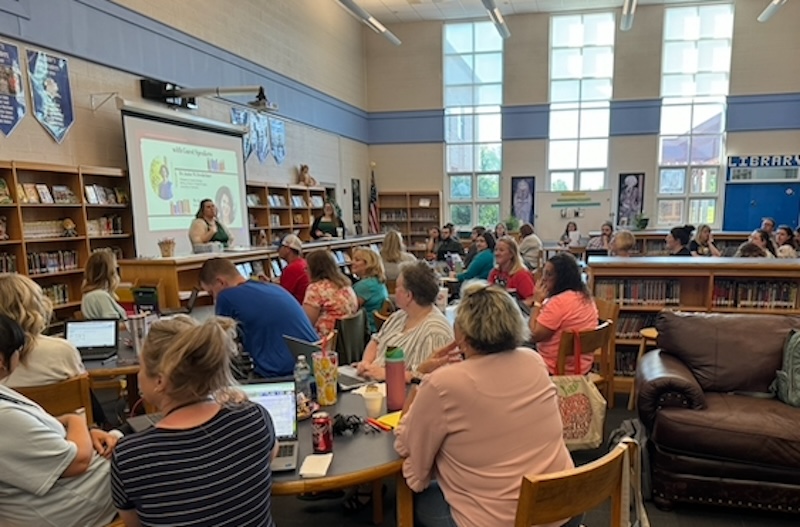
Kimberly Thompson leads a workshop for teachers at East Middle School in Bullitt County, K.Y.
After five years leading the University of Kentucky-Jewish Heritage Fund (JHF) Kentucky Holocaust Education Initiative, we have learned that meaningful Holocaust education depends on sustained investments in teachers, communities and professional networks. To date, the Initiative has supported 87 teacher leaders across 41 school districts, reached more than 1000 educators in public schools in 88 Kentucky counties and helped shape learning for an estimated 100,000 students. We have also connected Kentucky educators with regional and national expertise through partnerships with Brandeis University, the Nancy and David Wolf Holocaust and Humanity Center, the Association for Teaching Black History in Kentucky, the Olga Lengyel Institute and the United States Holocaust Memorial Museum.
Along the way, we’ve gleaned several insights that can inform the way we approach Holocaust education nationwide.
1.) We cannot teach the Holocaust in isolation.
Too often, Holocaust education begins and ends with Nazi Germany. While understanding the Holocaust itself is essential, teaching it as a discrete historical event misses the broader civic lessons students need today. Students must understand the centuries-long history of antisemitism that made the Holocaust possible. They also need to encounter Jewish people not only as victims, but as members of vibrant communities with rich traditions, diverse identities and deep contributions to American life — including in Kentucky. They must wrestle with difficult questions about propaganda, civic responsibility, bystander behavior and democratic institutions. Holocaust education is ultimately civic education. When taught well, it helps students recognize how hatred develops, how misinformation spreads and how ordinary people make choices that either strengthen or weaken democratic society. That is why our work centers not only on teaching about the Holocaust, but also on teaching about Jewish life, antisemitism, ethical decision-making and the responsibilities of citizenship.
2.) Pedagogies and lesson plans must be rooted in local contexts.
Even though Kentucky has mandated Holocaust education since 2018, it is frequently overlooked in conversations about Holocaust education. In Kentucky, many of our students have never knowingly met a Jewish person. Without intentional education, Jewish people and cultures are often encountered only through stereotypes or tragedy. That reality requires something different than importing lessons developed elsewhere. Our teachers curate the outstanding Holocaust curricula that already exist, adapt it to Kentucky standards and contexts and create peer-reviewed curriculum connected to Kentucky’s own Jewish history. Students learn about Holocaust survivors who rebuilt their lives in Kentucky and Kentucky’s Jewish communities. They visit sites connected to local stories. They discover that Jewish history is not something that happened somewhere else — it is part of their own communities’ histories.
This approach is especially important in states like Kentucky, where conversations about identity and history can easily become politicized. Local history creates common ground and invites curiosity instead of defensiveness. In turn, students are far more likely to see Jewish neighbors as part of the fabric of their own communities instead of as abstract historical figures.
3.) Teachers must tailor their strategies to meet the moment.
Teachers today are being asked to address antisemitism, polarization, misinformation and increasingly complex conversations about identity. Many tell us they feel unprepared. Some worry about saying the wrong thing. Others fear backlash from students, parents or communities. We go beyond asking teachers to attend a single workshop, and instead we treat them as professionals whose expertise deserves investment. Teacher leaders participate in an intensive year-long program that combines historical scholarship, pedagogical training, collaborative inquiry and generous stipends that acknowledge the value of their time and leadership. We don’t hand teachers a curriculum; we build it alongside them. Pairing effective pedagogy with a collaborative model changes everything. We work with teachers to introduce contemporary, research-based strategies like inquiry design that reshape their instructional approach throughout the year — including building a culture for critical thinking and a safe space for hard history. Teachers become active co-creators of what students learn. They adapt lessons to their classrooms, improve them with colleagues and share them across districts. The result is locally-inspired education that is both more rigorous, effective and more sustainable.
4.) One workshop alone doesn’t change practice. Ongoing mentorship does.
Professional development is often designed as a one-day event. Teaching is not. The difficult classroom conversations emerge months later. The challenging parent email arrives long after the conference has ended. A student repeats an antisemitic trope in September after a training held in July. That is when teachers need colleagues. Our teacher leaders spend an academic year together in twice-monthly seminars while receiving continuous coaching from university faculty, experienced educators, assistant directors and regional network leaders. Many step into leadership roles themselves, mentoring future cohorts and expanding the network across Kentucky. Our research shows dramatic gains in teacher confidence and efficacy, with 92.3% of workshop participants reporting increased content knowledge about the Holocaust, Jewish culture, communities and religion, and 86% reporting greater confidence in their ability to engage students in hard conversations and respond to antisemitism. But perhaps more importantly, teachers say they no longer feel alone. The vast majority of our teacher leaders note that the professional relationships they formed through the Initiative have become an essential source of ongoing support. In education — as in democracy — relationships are infrastructure.
5.) Communities of practice make real change possible.
As another school year begins, legislatures across the country will continue debating what schools should teach. That conversation is necessary. But it is no longer sufficient. The real question is whether we are willing to invest in the people who make those aspirations real every day. Laws can require Holocaust education, but only teachers can transform it into the kind of learning that equips young people to challenge antisemitism, defend democratic values and build communities where all people belong. If we truly want Holocaust education to matter, we should spend less time debating mandates and more time investing in the educators who bring them to life.
Janice W. Fernheimer and Karen Petrone are the co-directors and Lauren Hill is the chief learning officer of the University of Kentucky-Jewish Heritage Fund Kentucky Holocaust Education Initiative.