MAJOR GIFTS
An Israeli nonprofit sent a cold email to a bank’s general inbox. It responded with $1.7 million.
The donation to the network of therapeutic farms is part of Bank Hapoalim's larger recovery efforts following the Oct. 7 terror attacks and resulting wars
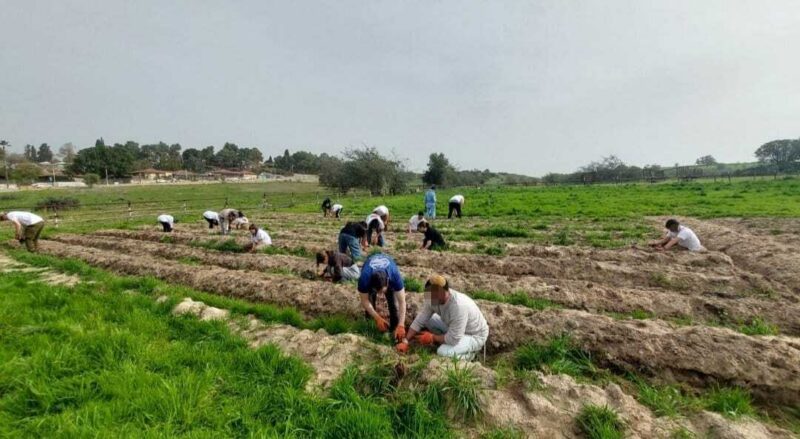
courtesy/Rimon Farms
Clients work on a therapeutic farm run by Rimon Farms in Israel's Negev desert, in an undated photograph.




 Add EJP on Google
It started with a cold email to a general inbox for Israel’s largest bank — a shot in the philanthropic dark.
But it worked. Some six months after Nir Amitay clicked “send” on his email requesting support for his network of therapeutic farms in southern Israel, Bank Hapoalim announced that it was donating NIS 5 million ($1.67 million) to his Rimon Farms, which specifically caters to survivors of the Oct. 7 attacks struggling with post-traumatic stress disorder.
Amitay frames the bank’s donation as emblematic of the resilient character of Israeli society. “The companies helping us and government and philanthropy together — it strengthens that resilience,” he told eJewishPhilanthropy last month. “I don’t take it for granted.”
Like many similar initiatives throughout the country, Rimon Farms pairs farming — working in agricultural fields, herding sheep — with more traditional therapies to treat PTSD and related mental health conditions.
The donation follows a banner year for Hapoalim, which booked a record NIS 9.8 billion ($3.3 billion) profit in 2025 even as the war in Gaza ground on, and is on pace to exceed that amount this year.
The bank’s philanthropic commitment flows through its Poalim LeTkuma Fund (a play on the bank’s name that also means “working for recovery”), a NIS 100 million ($33 million) initiative aimed at helping communities recover from the war launched just days after the attacks of Oct. 7. The fund is built around three pillars: education, economic recovery and emotional and community resilience.
This specific funding for Rimon Farms will establish two farms in the Western Negev kibbutzim of Holit and Nahal Oz, communities among the hardest hit on Oct. 7, according to Sharona Tarshish, the bank’s head of community relations.
Amitay founded Rimon Farms in 2020 and now runs seven therapeutic sites across the Negev.
The organization grew out of his own experiences with trauma and loss. A resident of Kibbutz Lahav in the Negev who served in elite IDF units for 17 years, Amitay returned to service after the Oct. 7 terror attacks. But he traces the project’s founding to the New Year’s Day 2016 Simta Bar terror attack in Tel Aviv, when a terrorist opened fire at the restaurant. Amitay was at the bar when the gunman started shooting. His friends Shimon Ruimi and Alon Bakal were killed in the attack, which also injured five people.
The Rimon Farms model rests on four elements: group psychotherapy, agricultural work, acupuncture to calm the nervous system, and communal life meant to restore meaning and belonging. The work is deliberately hands-on, with participants baking bread, pressing olive oil and making wine, so their labor produces something tangible. Returning participants to the workforce is a central goal. Since the war began, the farms have served more than 10,000 veterans and residents of the South.
Amitay stressed his appreciation for Diaspora Jewry’s support for his organization. Rimon Farms is supported by several American philanthropic groups, chief among them UJA-Federation of New York. The federation has contributed more than $1.25 million to the organization since Oct. 7, 2023, helping it establish and expand its therapeutic farms for communities in the Gaza border region in light of the major mental health needs in the wake of the attacks.
“For too long we took the partnership with the Americans for granted,” Amitay said. “After Oct. 7, we realized we couldn’t have done it without you, and we realized we have to respect it — we need to see you as a partner.”
“We need support, and it’s not only about money,” Amitay said. “I don’t see the money, I see the hug. We see the soul of our Jewish brothers and sisters. It helps us overcome what happened, because the situation is still fragile.”
For Bank Hapoalim, the Rimon Farms grant is one piece of its broader Poalim LeTkuma portfolio that also backs pre-military preparatory academies, rehabilitation programs for wounded soldiers and reservists, a business-recovery hub in Israel’s North and a therapeutic surf center at Zikim Beach. On several of these, the bank has partnered with Jewish philanthropies abroad, including the Schusterman Family Philanthropies, UJA-Federation of New York, Combined Jewish Philanthropies of Greater Boston and UJA Federation of Greater Toronto.
The increasing overlap between Israeli philanthropy — both corporate and individual — and organized American Jewish philanthropy is “a trend to notice and [also] an opportunity to expand philanthropy in Israel and professionalize it,” said Galia Feit, the executive director of the Institute for Law and Philanthropy at Tel Aviv University.
In a statement to eJP, Bank Hapoalim said it “views partnership as a force multiplier for social impact and has worked alongside leading Jewish philanthropic organizations in Israel and around the world.”
Feit said the expansion of these partnerships is driven by a specific need. “It’s because of the [Oct. 7] atrocities — the need for emergency support and then rehabilitation — and that’s also what draws corporate donors in Israel, because these are uncontested causes,” she said, pointing to rehabilitation and PTSD intervention. “There is a growing need for rehabilitation. We are not seeing the end of it yet. We are just at the beginning.”
Related News
ADVANCING A VISION
N.Y. federation donates $1M toward building shared-society center named for peace activist killed on 10/7
EXCLUSIVE
Detroit-based philanthropists Nancy, James Grosfeld donate $8M to renovate JDC’s Israel campus
HIGHER EDUCATION
As Jewish donors reconsider academia, Jan Koum doubles down, endowing Israel studies at Stanford

MAJOR GIFTS
Center for Jewish History celebrates 25 years with a $25M matching grant
PRESIDENTIAL REBUKE
Israel’s Herzog: Mamdani ‘makes no effort’ to hide disdain for Israel, Jews must fight back