DECADE DEBRIEF
Prizmah CEO marks 10 years of boosting America’s Jewish day school system
Paul Bernstein discusses lessons learned as leader of the umbrella group, including new challenges that come with success
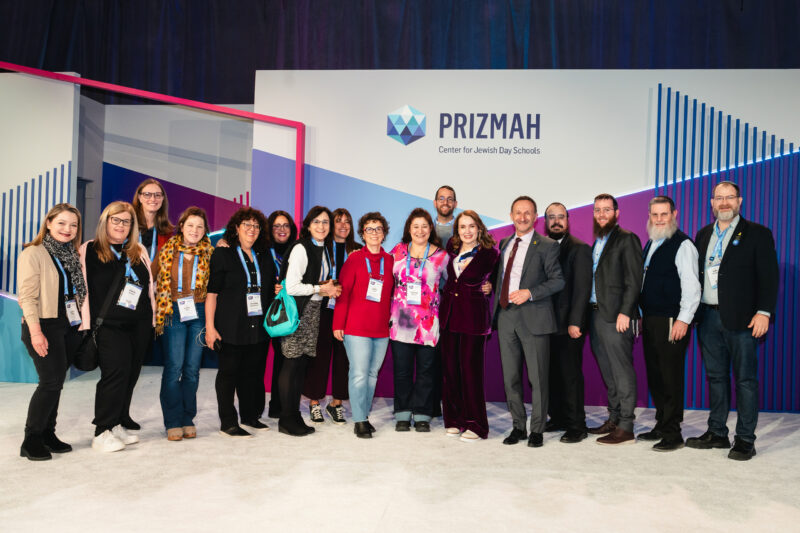
COURTESY/Prizmah
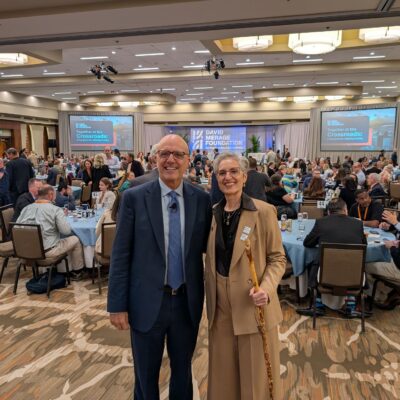
Paul Bernstein, 5th from right, at the February 2025 Prizmah conference in Boston




 Add EJP on Google
Ten years ago, when Paul Bernstein began as the founding CEO of Prizmah: Center for Jewish Day Schools, the philanthropic dollars funneled into Jewish day schools amounted to a trickle. The majority of funding came from a single donor, The Avi Chai Foundation, which was sunsetting its grantmaking in 2019. With many day schools still reeling from the 2008 financial crisis and struggling with enrollment, many Jewish leaders questioned if non-Orthodox day schools had a future.
“It was quite a low period for philanthropy in the Jewish day school world, particularly nationally,” Bernstein told eJewishPhilanthropy.
Before Prizmah, there were five national organizations supporting day schools, separated mostly by denomination: the Progressive Association of Reform Day Schools; the Partnership for Excellence in Jewish Education; RAVSAK (an acronym of the Hebrew words for Jewish Community Day School Network); Yeshiva University School Partnership; and the Schechter Day School Network.
Knowing Avi Chai was shuttering, the Jim Joseph Foundation made it clear to leaders in the day school movement that it was interested in offering support, but it wasn’t willing to fund a fragmented market. And so Prizmah was born, merging the five organizations into a single centralized support agency, with many employees from the prior agencies remaining with Prizmah to this day.
“We had a lot to prove,” said Bernstein, 59, who is a product of the U.K. Jewish day school movement. “Jewish day schools are much more of a norm in other countries, so seeing the relatively low enrollment, particularly in the non-Orthodox world in the United States, was a real [lesson] for me at the beginning of this.”
In the 10 years since Prizmah launched, day school enrollment has surged, with both the COVID-19 pandemic and Oct. 7 massacres leading many parents to move their children from public schools to private Jewish ones. Today, 101,000 students are enrolled in non-Haredi day schools, a 7.5% increase over five years ago. Success has triggered more investment from funders, and day schools are now a major focus of the Jewish Funders Network, as well as Jewish Federations of North America.
Working together as one agency, Prizmah — “prism” in Hebrew — allows investors to pool their investments so philanthropists “get more bang for [their] buck,” Bernstein said. In an interview marking the 10th anniversary, he discussed Prizmah’s most productive interventions, bridging denominational differences and how success can create new challenges.
The interview has been edited for length and clarity.
Jay Deitcher: Why did Prizmah work?
Paul Bernstein: A number of factors. One was because, [after] seeing the unity of five organizations becoming one and starting this new organization, there were a number of people who chose to get behind it — the Jim Joseph Foundation being the prime example. They spoke about unity. They wanted it. It happened. They immediately came in and joined Avi Chai in the funding. So we had initial backers to get us off the ground.
The second was that the Avi Chai Foundation, during its sunset, was so deeply committed to the field and to the success of this. The third piece was that we proved that across denominations, schools and school leaders have a lot more that unites them than divides them.
Very early on, we organized a gathering around enrollment and admissions to schools [and] brought together representatives of a whole group of schools from different parts of the country in New Jersey. [Attendees discussed], what are our dilemmas that we are facing as we grow?
The first school to stand up was a smaller Midwest community school. Their dilemma was, “What does it mean for the culture of our school that we are enrolling more non-Jewish students?,” which is a feature in small communities. To survive, you often enroll non-Jewish students. And while they were telling this story, sitting right next to me was a pretty yeshivish school from Miami. I remember thinking, “What are they going to be thinking about this? Like, what do you mean, non-Jews in the school?” It felt to me like it would be quite an alienating experience for them.
When [the yeshivish school] stood up to present their dilemma, they said, “What does it mean for the hashkafa [philosophy] of the school when we’re enrolling more and more families from Latin America?”
Fundamentally, [both schools] were talking about, what does it mean when the demographics of your school is shifting? And they managed to figure out a way to learn from each other, despite those pretty fundamental differences.
JD: What new challenges has Prizmah’s success created, especially the surge in day school enrollment?
PB: The first challenge is, how do you make sure that [the increase in enrollment] isn’t just a short-term upswing? Some people believe it’s part of the surge post-Oct. 7, so the first challenge is, how do you turn momentum into something that is continuing?
The second thing would be where there is growth, how do you make sure you’ve got the capacity for the growth?
One of the reasons why we’ve had this consistent growth is because there’s greater recognition of the quality that Jewish day schools are providing. You want to invest more in excellence, which means you need really strong school leadership, and you need enough quality teachers to enable the existing schools to thrive and to be able to meet the new capacity.
The last challenge I would mention is that the growth is not distributed everywhere, so how do you address the schools and the communities that are not growing, and really help them join that trend?
JD: Talk about the transition Avi Chai facilitated. How did it sunset while helping the field move forward?
PB: In their 25 years of operating, they invested a lot in leadership. We still have some of the leadership programs they created. I’m not sure they, at the time, understood as well as we now see it, looking with hindsight, that they professionalized the field and really improved what was there. The fundamentals were strong.
The second thing they did was the decision to create Prizmah. They invested in our early years, so they [provided a] significant portion of our budget in the early years. They actively helped bring on other funders. They met with us and said, “We have a certain amount of money left, let’s work together on how to invest that money to make sure it positions Prizmah well to be ready and attract new funders to be able to take over.”
JD: In the past decade, you’ve seen major philanthropic initiatives supporting Jewish education. What were the most groundbreaking?
PB: We managed to really deepen and strengthen the leadership investment in school leaders. If you have the right leadership for schools, they will then do a better job in supporting teachers. We need to invest in teachers as well.
Then, there are new areas that have developed. For example, we very much believe in getting to a place where the day school world is data-driven, and we believe in Prizmah being data-driven. We’ve really built the data and research capabilities within the organization and for the field, so schools can now both gather data with our help, but also then benchmark themselves against other schools in the financial sphere.
[Another is] investing more in enrollment initiatives. For example, we’ve had this partnership with PJ Library now for all of Prizmah’s life, which is about bringing PJ families into day schools and increasing enrolment — that’s been very successful, and something we’re now extending that into the early childhood sphere because the retention of Jewish kids from Jewish early childhood into day schools is not as good as it should be.
JD: What do you think the new federal tax credit for education will mean for the decade to come.
PB: Generally speaking, when you ask people who are not at day schools why [they aren’t], the first thing they say is affordability. The federal tax credit has the potential to transform the affordability equation if we can mobilize the Jewish community very broadly to participate.
It is an opportunity to attract money that does not, in any way, take away funds from public schools because that’s not the way that the funding is structured. And if we’re able to raise the kind of significant funds that are possible, then we’ll really move the needle on affordability.
JD: What are you looking forward to over the next 10 years?
PB: The tax credit is one opportunity. Obviously, the momentum for growth is another opportunity. The recently announced partnership between the government of Israel and JFNA to invest in day school enrolment is a third.
I want to be able to look back in another 10 years and say that we seized the moment that we had 10 years into Prizmah with the success of our schools and just accelerated that growth and addressed the key issues in talent and in affordability and so on.
Related News
EXCLUSIVE
Detroit-based philanthropists Nancy, James Grosfeld donate $8M to renovate JDC’s Israel campus
ADVANCING A VISION
N.Y. federation donates $1M toward building shared-society center named for peace activist killed on 10/7
HIGHER EDUCATION
As Jewish donors reconsider academia, Jan Koum doubles down, endowing Israel studies at Stanford
PRESIDENTIAL REBUKE
Israel’s Herzog: Mamdani ‘makes no effort’ to hide disdain for Israel, Jews must fight back

MAGICAL EXPERIENCE
Shefa launches psychedelics retreat for Jewish professionals suffering burnout