WHAT YOU SHOULD KNOW
Israeli government, JFNA partner on $66.7 million plan to boost Jewish day schools
Ma’ayan Toaf/GPO
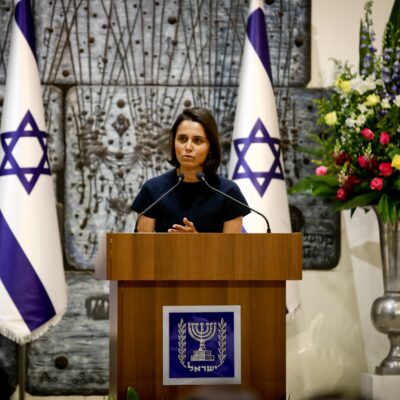
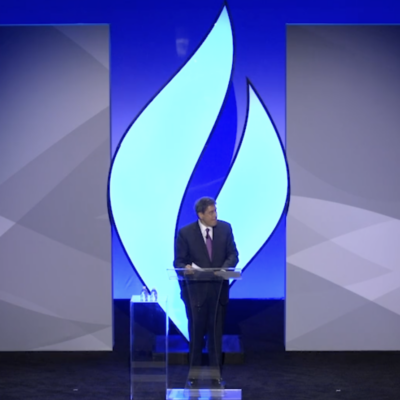
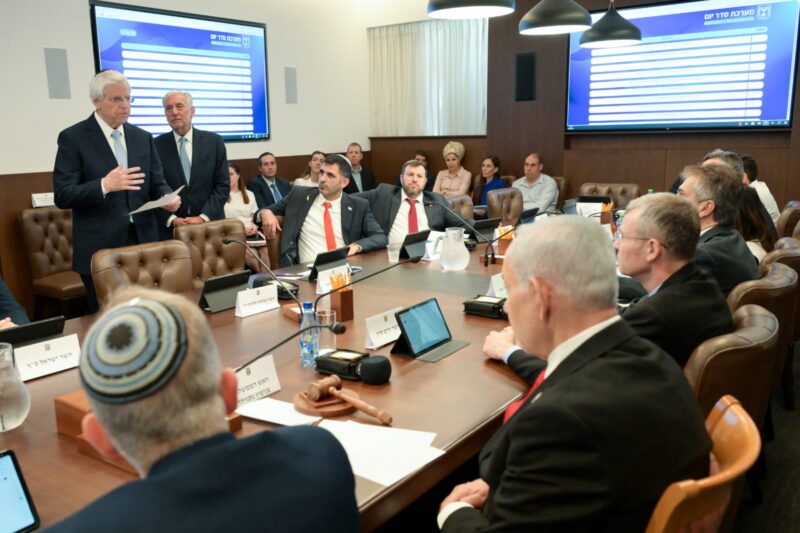
Gary Torgow (left) and Eric Fingerhut, the board chair and CEO of Jewish Federations of North America, address the Israeli Cabinet meeting in Jerusalem on June 28, 2026.




 Add EJP on Google
The Israeli government approved a NIS 100 million ($33.4 million) budget, which will be matched by philanthropic donations, to support Jewish day school education in the United States and Canada through the Jewish Federations of North America, whose leaders told eJewishPhilanthropy that this represents both substantive support and a symbolic gesture encouraging others to do the same.
Eric Fingerhut, president and CEO of JFNA, told eJP today that the government resolution was not a mere “statement of good intention,” but signified the official allocation of funds that had already been budgeted. “But that’s not to take away from the symbolic importance [of the resolution],” he added.
In recent years, formal Jewish education has become a growing focus for JFNA, which sees Jewish day schools as a top method of instilling strong Jewish identity in the next generation.
“Jewish identity and Jewish education are key to the future of the Jewish people and combating antisemitism,” Gary Torgow, JFNA board chair, told eJP. “[This partnership with the Israeli government] is the opportunity for us to enlarge the scope to Jewish connectivity for the next generation.”
Torgow, who long supported Jewish education initiatives in his native Detroit, said the Oct. 7 attacks and rise in global antisemitism “awakened something in the Jewish community” about the importance of Jewish education.
In addition to prioritizing it within the federation system, JFNA has also been a strong advocate of a new federal tax credit that would offer $1,700 for donations to scholarship-granting organizations (SGOs), offsetting the costs for tuition by the same amount. While until now, the efforts to create those SGOs have been undertaken by local communities, Torgow said that JFNA was launching a national SGO to raise awareness and make it easier for families to take advantage of the tax credit.
Both Fingerhut and Torgow attended yesterday’s Israeli government meeting where the measure was approved.
“Since its founding, the State of Israel has served as an anchor for the security of the Jewish people,” Israeli Prime Minister Benjamin Netanyahu said at the meeting. “Today, we are also strengthening one of the most important pillars of our future — Jewish education. This is a major investment in the next generation of the Jewish People, in its identity, its values and its deep connection to the State of Israel.”
The government resolution referred to support for Jewish education in the Diaspora as a “strategic national priority of the highest importance, particularly in light of the challenges facing world Jewry and the rise in antisemitic incidents since the Oct. 7 terrorist attack.” The NIS 100 million allocation for Jewish education abroad (incorrectly reported as NIS 200 million in government funds in many news outlets) was met with skepticism in Israel, as the Israeli education system has increasingly been found to be failing.
In December 2024, Israel’s Diaspora Affairs Ministry launched Project Aleph Bet, a pilot program to fund Jewish education initiatives in North America. Initially planned to offer $40 million, the program was scaled back to $4 million due to budget cuts in the wake of the Oct. 7 terror attacks and ensuing war against Hamas in Gaza. Now, nearly two years later, Project Aleph Bet is approaching its original budget.
The matching funds from the federation system will come “from multiple funds and individuals,” Torgow said.
Fingerhut said that the goal of the project — and the metrics used to gauge its success — will be an increase in enrollment in Jewish day schools, not making it easier for the families that were already sending children to them.
While a recent study by the Jewish day school umbrella group Prizmah found that enrollment was ticking up, formal Jewish education remains a relative rarity among the vast majority of non-Orthodox Jewish families. This is primarily credited to three main factors: the high cost of tuition; a shortage of schools; and a perception that Jewish day schools are not as academically excellent as other options.
In a statement, the Israeli Prime Minister’s Office said that the funding would go toward addressing those areas, as well as improving services for students with learning disabilities.
“In addition, new and innovative frameworks and solutions — including digital tools — will be developed to expand access to Jewish education for broader audiences,” the PMO said.
Fingerhut acknowledged that the Israeli government’s NIS 100 million allocation on its own would not make a significant dent in addressing those areas, but said that it represents a meaningful step toward doing so.
“We know that it will take billions of dollars of investment… to double the number of students in Jewish education,” he said.
“You never begin a project at the full scale,” Fingerhut added, noting that even Birthright Israel, which has received hundreds of millions of dollars of support from the Israeli government since launching in 1999, “started with one plane.”
“That is why the partnership with the government of Israel and JFNA and all of the communities that will participate is critical. It takes something as large and influential as a government and large institutions like JFNA to move something at that scale,” Fingerhut said.
He also highlighted the fact that the initiative was backed by the Prime Minister’s Office.
“When something has been a priority of the Prime Minister’s Office in the past — Birthright, Masa — what you see is that it has a lasting impact beyond what it would have if it were just part of government or parts of the [American Jewish] community,” Fingerhut said. “It is our objective — and we believe a mutual objective with the government of Israel — that this will be the beginning of a longer-term, and we hope even more robust, process.”
Both Fingerhut and Torgow also acknowledged that this resolution was passed in the final months of the current Israeli government’s term, just before national elections that could bring in a new coalition, but said that they hoped it would continue regardless of who formed the next Israeli government.
“We believe future governments will also appreciate [this effort],” Torgow said.
Fingerhut noted a number of major donations that have been made in recent years for Jewish day schools — a $90 million grant by the Mandel family in Cleveland that was matched by the local federation last year; the Koum Family Foundation’s recent $36 million donation to Los Angeles’ Milken Community School; Kaelen Sherman’s $17.6 million gift to Toronto’s TanenbaumCHAT.
“There is clearly a moment today that there is recognition that lifting up and getting more of our children in Jewish education is critical since the events of Oct. 7[, 2023,]” he said. “We know that there are sparks out there, so how do we turn this into a flame?”