Opinion
BEST PRACTICES
Strengthening synagogue security: The case for cultural fluency




 Add EJP on Google
In Short
Cultural fluency does not replace tactical security, but it does strengthen it.
It’s Friday night, and there are two security guards posted at the front door of the synagogue. It’s getting dark outside, and although Shabbat services are well underway, latecomers continue to arrive.
A middle-aged man approaches the synagogue and quickly walks in. He looks flushed and out of breath. He is not wearing the customary kippah and is tightly clutching a bag with both hands. One of the guards is immediately concerned. He sees someone who is acting differently from the others at the synagogue. The man seems nervous and rushes through the front door while avoiding eye contact.
Sydney Schunk Photography
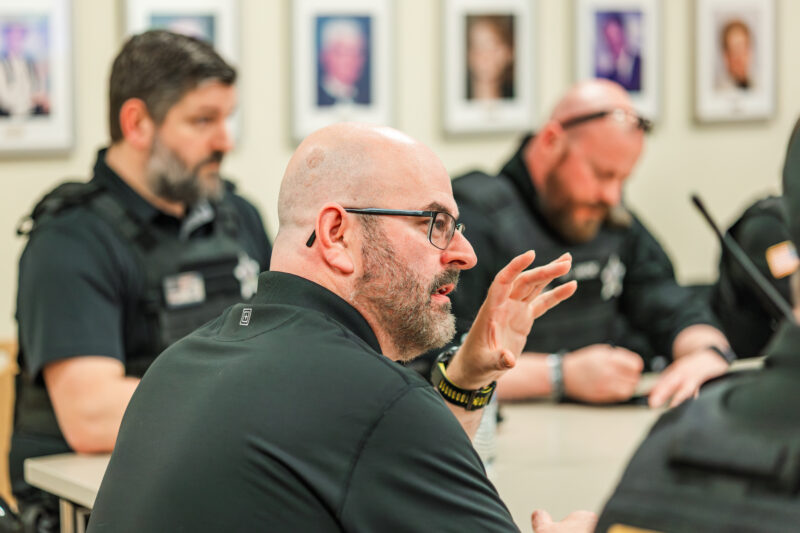
Members of a security firm that serves the Jewish community in the Chicago area listen during a training session led by Larry Glickman (not pictured).
The second guard recognizes the small, embroidered velvet bag as a tallis bag. He sees someone who likely hurried from work and is eager to find his family in the sanctuary. He knows that it is not unusual for people to arrive late for worship.
Both responses come from highly trained security professionals. The difference is not in the training they’ve had, but in the cultural fluency they have learned. As threats facing the Jewish community continue to evolve, that fluency is exactly what Jewish organizations should be expecting from the people who protect them.
As the threat landscape against the Jewish community has significantly expanded over the last several years, security resources, support and expertise have also expanded.
Jewish organizations are more prepared than ever to deal with emergencies, and the security firms who protect them know their buildings and leadership well.
With this strong foundation in place, the next layer isn’t more security tactics, but rather enhancing the cultural fluency of the guards protecting our Jewish institutions. We are not talking about inclusion or sensitivity training, but rather a foundational understanding of the distinct culture, faith and tradition characteristics of the community being protected.
For instance, it’s important to understand the Jewish community itself: the interconnected relationship between the synagogue and the JCC next door, the local Jewish day school, the community kitchen feeding the hungry, the kosher grocery down the street and the neighborhoods where people live.
It’s also important to understand the age, gender and racial diversity of the people entering Jewish spaces, and the differences between Jewish denominations as well. In more observant communities, many people do not carry phones on Shabbat or other Jewish holidays, and emergency communication plans that depend on phone trees, group texts or messaging apps may deliver important information in real time. (Pikuach nefesh, the Jewish principle that preservation of human life overrides nearly any other commandment, permits phone use in a genuine emergency, but of course the phone has to be available and accessible for that to matter.) A culturally fluent security leader works with synagogue and community leaders to build protocols that respects observance practices and rituals, and to set realistic expectations before an incident rather than during one.
It’s important to understand the synagogue itself, not just the building. Synagogues are busy, complex institutions hosting religious school, lifecycle events and community programming alongside regular worship services. Knowing who to work with on security matters and understanding how decisions get made helps security professionals build the right relationships.
A security professional who understands the meaning and importance of ritual objects throughout the synagogue building will be a much more effective partner than one who does not. The sacred importance of the Torah; the spiritual significance of the mezuzah; the reason that furniture like tallis racks or bookshelves are in the sanctuary — combined with knowledge of the sanctuary’s distinct architectural characteristics, these all inform security procedures and emergency plans, and understanding them helps guards respond appropriately during an incident.
It’s important to understand the Jewish calendar, and how holidays shape the rhythm of Jewish institutional life. Shabbat begins every Friday at sundown and ends Saturday at sundown, and for many Jewish communities, it is the busiest and most spiritually significant time of the week. The two guards at the door on Friday night are not just standing post — they are part of the Shabbat experience for every person who walks through that door.
Every Jewish holiday brings its own practices, customs and security considerations. Yom Kippur, the holiest day of the Jewish year, is a fasting holiday during which people do not eat for 24 hours. Medical emergencies are not uncommon, and some synagogues have EMTs on standby. On Passover, families gather for Seders that can draw large numbers of people to private homes as well as synagogues and JCCs. On Hanukkah, public menorah lightings draw crowds in open, exposed locations. Each holiday is an opportunity for connection and celebration. and each one requires security professionals to understand what is happening, why and what that means for the people they are protecting.
Understanding the Jewish calendar also means understanding threat elevation. Antisemitic incidents have historically spiked around Jewish holidays and significant events in Israel. A security professional who knows when Purim begins, or when a major geopolitical event has raised community anxiety, is far better positioned to anticipate and respond.
A culturally fluent security professional also tracks current events and understands what is on the minds of people walking through the door. The March 2026 attack on Temple Israel in West Bloomfield, Mich. The 2022 hostage situation in Colleyville, Texas. The 2018 Tree of Life shooting in Pittsburgh. These are not abstract historical events for the Jewish community. This is what we live with. This is what we persevere through. The security team that follows these events is better positioned to plan, to brief and to support both the institution and the people.
We began with a story of a man who rushed into synagogue. The first guard noticed a very nervous person in a hurry carrying a small velvet bag, while the second guard recognized a common Shabbat occurrence. The second guard was not a better professional, but he was a more culturally fluent professional, and it is that cultural fluency that can provide a safer, more welcoming space for everyone.
The security firms already standing post at synagogues across the country have built deep knowledge of their buildings, their leadership and the rhythms of the institutions they protect. Cultural fluency strengthens what they already do well; it does not replace it. The conversation can start simply: a pre-High-Holidays cultural briefing for the team standing post, a walkthrough with clergy and lay leadership, a few scenarios designed around Jewish institutional life. It should happen before the next crisis, not during one.
Larry Glickman is the founder and CEO of JCAT Partners.