
Opinion
A HIGHER STANDARD
A tale of two Haredi communities




 Add EJP on Google
In Short
Why do American Jews demand civic responsibility in Israel but hesitate to ask for it at home?
That same American Jewish community that speaks passionately about civic responsibility in Israel is often remarkably quiet when similar questions arise in our own backyard. Here in New York, thousands of children are denied the education they need to become economically independent and civically engaged adults. The addresses may be in Brooklyn, Kiryas Joel, Monsey or New Square rather than B’nei Brak or Jerusalem, but the underlying questions are strikingly familiar — and the parallels are uncomfortable.
Masha Zolotukhina/Getty Images
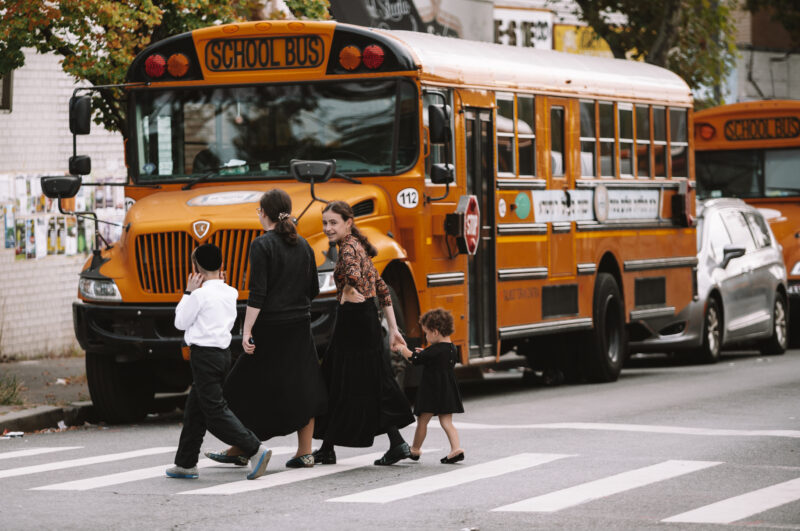
Hasidic children cross the street in the South Williamsburg neighborhood of Brooklyn in New York City on Sept. 27, 2020.
In Israel, we criticize an educational system that limits workforce participation for many men because of the lack of secular education for many Haredi boys, and increasingly relies on exemptions from military service that shift the burden of national defense onto others.
In New York, thousands of children complete Hasidic and Haredi schools without receiving the education required under state law. Many leave school without basic proficiency in English, mathematics, science, or civics. Some struggle to find meaningful employment. Many were never given the educational foundation necessary to participate fully in American civic life.
These are not identical problems. Israel’s obligations are not America’s. Military service is not the equivalent of a secular education. But both raise the same fundamental question: What does a community owe its children, and what does it owe the society in which it lives?
Israel answers that question, in part, through military or national service. America answers it differently. Here, civic participation depends upon education. A democracy assumes that its citizens can read a ballot, understand a contract, earn a living, serve on a jury, engage with the government and support themselves and their families. And there is growing recognition that these capacities cannot be taken for granted. A recent Progressive Policy Institute report warned of a nationwide crisis in civics education, noting that nearly four in five American eighth graders lack proficiency in civics and arguing that a healthy democracy requires schools to do far more to prepare young people for citizenship. Those opportunities begin in the classroom.
Yet American Jews often frame these issues in entirely different moral terms. When the conversation is about Israel, we speak confidently about equality, shared burden and democratic responsibility.
When the conversation shifts to New York, we become far more hesitant. Some invoke religious liberty and worry about appearing anti-Orthodox — understandable concerns given the history of religious minorities being misunderstood and unfairly targeted. But religious freedom does not require accepting educational neglect or denying children the tools they need to function as adults.
I have seen the consequences of this system firsthand. I have spoken with young adults who struggle to complete a job application, read an English-language lease or employment contract, or understand basic civics — and who wish they had been given greater educational opportunities. I have met parents who quietly worry about their children’s futures but feel powerless to challenge communal expectations. These are not abstract policy debates. They are real people whose opportunities were narrowed long before they reached adulthood.
This is not an attack on Haredi Judaism. It is, in many ways, an affirmation of what Judaism values: giving every child the tools to flourish. Many parents within these communities want their children to thrive both religiously and economically. Many mothers worry privately about how their sons will support families and their lifestyles. Others are concerned that even the secular education available to girls is beginning to erode, despite the expectation that women will often become their families’ primary wage earners. These conversations deserve partners, not silence.
We recognize the costs when young Haredi men in Israel are discouraged from acquiring the skills necessary to participate fully in society. The principle of shared responsibility should not end at Ben Gurion Airport.
Neither an 18-year-old Israeli facing military service nor a 13-year-old Hasidic boy sitting in a classroom without meaningful secular instruction chose the system into which he was born — it is something they inherited. Both of them deserve adults willing to ask difficult questions on their behalf.
Children should never have to choose between their faith and their future. They deserve both. It is time for the broader American Jewish community to apply at home the same principle it so passionately defends abroad.
Adina Mermelstein Konikoff is the executive director of YAFFED (Young Advocates for Fair Education), a nonprofit organization advocating for educational equity in Hasidic and Haredi yeshivas.