APP ATTACK
At WJC Dublin antisemitism forum, envoys press social media firms to crack down on Jew hatred
'Engagement with [social media companies] is how you actually have a proper conversation,” WJC's Yfat Barak-Cheney tells eJP. 'It doesn’t mean that you’re not criticizing them.'
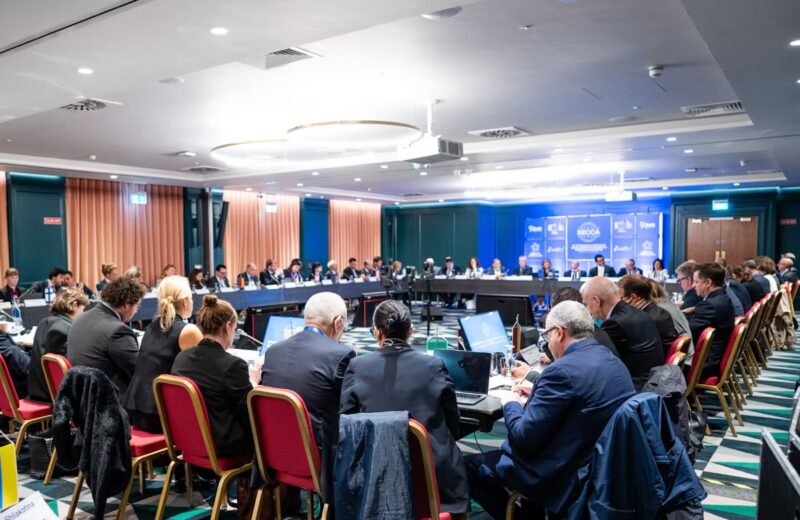
Phelia Barouh/WJC
International antisemitism envoys meet in Dublin in October 2026.


 Add EJP on Google
The Republic of Ireland is not necessarily the natural place to hold a gathering of the world’s top government officials and nonprofit professionals dedicated to combating antisemitism.
The country has long been one of Europe’s staunchest and fiercest critics of Israel, which has often led to antisemitism directed against its small Jewish community. Earlier this month, Irish Jews were forced to hold a memorial event for the victims of the Oct. 7 terror attacks in secret for fear of having the ceremony targeted by anti-Israel activists.
And indeed, when the organizers of the Special Envoys and Coordinators Combating Antisemitism (SECCA) Forum attempted to book a block of 70 rooms at Dublin’s Herbert Park Hotel, they were asked whether the Israel Defense Forces would be involved in the event. According to Maurice Cohen, head of the Jewish Representative Council of Ireland, the booking was then rejected.
“There is an uncomfortable irony in organising an international conference to discuss antisemitism and finding that, before the conference has even begun, you have already encountered something that forces you to ask exactly the questions the conference was created to address,” Cohen said in his opening remarks, later shared to X.
Before concluding on Wednesday, the SECCA forum brought dozens of Jewish community representatives and 39 government delegates from 28 countries to the Irish capital to discuss antisemitism and strategies to stem its tide, particularly on social media.
The World Jewish Congress founded the forum in 2019, when only two or three countries had antisemitism envoys. It now meets twice a year, said Yfat Barak-Cheney, executive director of the WJC’s Technology and Human Rights Institute and its representative to the United Nations. The 15th forum was held in Ireland as the country takes its turn leading the Council of the EU. It was organized by WJC with funding from the European Commission and help from Ireland’s Jewish community council.
“It’s really important to actually bring these discussions where it’s most difficult,” Barak-Cheney told eJewishPhilanthropy this week. “The point is not to go where it’s easy. The point is to go where we need to support the local community.”
Antisemitism in tech was a core focus of the conference, Barak-Cheney told eJP. This was the other reason why the gathering was held in Dublin. Home to the European headquarters of many major tech companies, Ireland’s media regulator plays a major role in enforcing EU rules, she said. Delegates met the regulator and visited TikTok, where staff showed how content moderation works, followed by a visit to Meta.
Barak-Cheney said the WJC pressed platforms to correctly define antisemitism and enforce their policies.
Major platforms, including Meta and X, have lowered enforcement on hate speech since January 2025, Barak-Cheney told eJP.
She was particularly critical of community notes, a crowdsourced fact-checking feature used by major platforms. Specifically, she said, the feature opens the door to antisemitism and disinformation, which Jewish groups don’t have the bandwidth to counter, describing the feature as “very, very problematic.” WJC raised with platforms how to keep notes from favoring extremists or majority groups, and how to make sure accurate notes appear on false content about Jews and Israel, said Barak-Cheney.
She added that WJC wants platforms to promote Jewish life online, including Jewish creators and small communities’ projects, and emphasized the importance of engaging with social media companies, despite disagreements. “Engagement with them is how you actually have a proper conversation,” she said. “It doesn’t mean that you’re not criticizing them.”
Organizers were well received by the Irish president’s office and Foreign Ministry, she said, and did not avoid difficult topics. “We didn’t come here to make everything look rosy,” Barak-Cheney said. Participants discussed with officials how anti-Israel sentiment can “very easily” cross “the line into overt antisemitism.”
Even colored by strained Ireland-Israel relations, the conference featured several firsts.
According to a statement, October’s SECCA forum was attended for the first time by a representative from the United Arab Emirates. Also announced at the forum by U.S. antisemitism envoy Yehuda Kaploun, Armenia will soon join the International Holocaust Remembrance Alliance, with another three countries expected to follow.
Related News

MAJOR GIFTS
Center for Jewish History celebrates 25 years with a $25M matching grant
CLOSING WORDS
In AZM address, Cosgrove links communal ‘orthodoxy’ on Israel to rising anti-Zionism among young Jews
PRESIDENTIAL REBUKE
Israel’s Herzog: Mamdani ‘makes no effort’ to hide disdain for Israel, Jews must fight back

MAGICAL EXPERIENCE
Shefa launches psychedelics retreat for Jewish professionals suffering burnout
HIGHER EDUCATION
As Jewish donors reconsider academia, Jan Koum doubles down, endowing Israel studies at Stanford