Opinion
MEETING THIS MOMENT
Between panic and complacency


 Add EJP on Google
In Short
The Jewish condition is never simple. Today is no exception.
The number of American Jews who tell me they are seeking citizenship abroad is flabbergasting. Not long ago, such searches would have been unimaginable.
For generations, Jews regarded America as the Goldene Medina — the “Golden Land”—a place unprecedented for giving us security and a sense of belonging. It felt like a permanent home. That many are now contemplating a second passport says something profound about how we view our status here. But why?
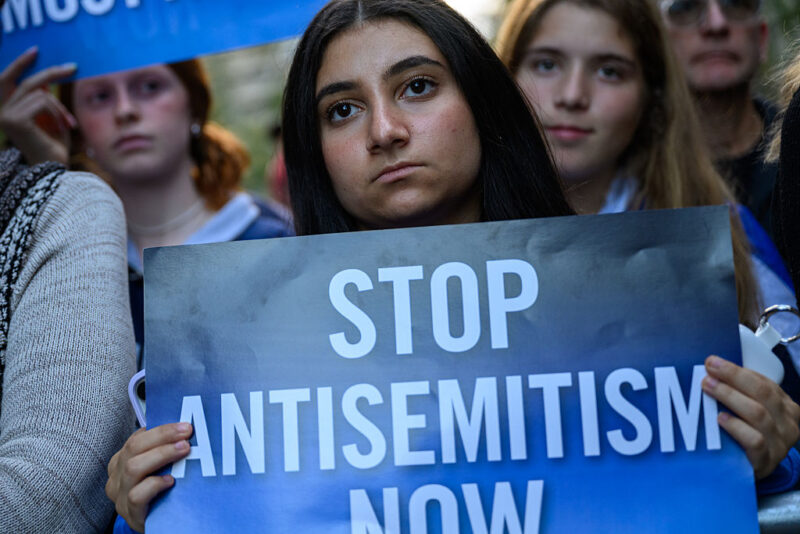
Alexi J. Rosenfeld/Getty Images
A girl holds a "Stop Antisemitism now" sign during in the "No More Excuses Rally Against Antisemitism" held outside of the 81st session of the U.N. General Assembly at U.N. Headquarters on Sept. 23, 2026 in New York City.
First, there is ever-rising antisemitism. Shockingly, an AJC survey recently found that 93% of American Jews view antisemitism to be a problem. Simultaneously, we are losing the right to define antisemitism for ourselves, with an unrepresentative Jewish minority providing cover for views — including anti-Zionism — that polls show most of us find indefensible.
Second, we are seeing community consensus thin. Once universal positions are now merely majoritarian. Significantly, dissent clusters among younger Jews, who are less affiliated and less Jewishly educated — a subsector, yet one overrepresented in fields shaping public conversation.
And then there is Israel. It once provided near-universal pride and offered security. It now faces multiple existential threats. It degraded its enemies after October 7, but military victories do not guarantee peace. Meanwhile, it remains deeply divided and increasingly isolated, lacking answers to critical questions.
So, what now?
To start, we must confront antisemitism directly, including where extreme ideas are drifting toward the mainstream. At minimum, that means demanding the courtesy extended to other American communities: that our own definitions of prejudice against us be respected, fringe dissenters notwithstanding. If overwhelming majorities of Jews feel calls for Israel’s destruction are antisemitic, outsiders cannot override that by pointing to unrepresentative contrarians. No other community accepts this. Neither should we.
We must also contest falsehoods gaining currency: that we are interlopers in our ancestral homeland; that Israel is uniquely illegitimate among nations born as colonialism retreated; that we are powerful oppressors rather than among history’s most persecuted peoples. These claims provide the intellectual scaffolding for much contemporary antisemitism and must be rebutted clearly and relentlessly.
Doing so requires recognizing that we are fighting a 21st-century battle with a 20th-century playbook. Much of today’s struggle takes place online, where nuance is punished and emotional clarity outperforms careful argument. Too often, our communications persuade us rather than those we need to reach. We must identify what moves opinion and abandon what does not. We must also label people candidly. When public figures make statements that overwhelming majorities of Jews regard as antisemitic, know it and continue to do it anyway, we should not hesitate to call them bigots.
We also must remember we are not only in a battle of ideas but a contest of power. Those targeting us readily disrupt events, apply public pressure and exact professional consequences. Why do we so rarely respond in kind? We should mobilize, support those aligned with us and seek consequences for those who are not, using the legitimate tools of civic engagement employed by every other group in American life.
And all of this must be done alongside allies. Jews are too few to fight alone. That said, our alliances must be reciprocal, with allies who show up for us as we do for them. Many allies failed that test after Oct. 7, 2023. That should be acknowledged. Yet alliances are not a luxury; without them, we lose.
Next, we must relearn some “lessons of the ghetto.”
The Jewish playbook for survival was forged over millennia, focused not on the hatred directed at us but on the joy and depth of our inheritance, buttressed by strong institutions, commitment to education and dense communal networks. Synagogues, schools and cultural and community centers were not amenities; they were the infrastructure of continuity. They must become that again.
Jewish education cannot be an afterthought. Day schools and camps are among our most effective tools for building Jewish identity and must become more affordable and available — a no-brainer for Jewish families. And after-school Jewish education cannot remain a running joke when its consequences are so serious; there is no better explanation for the detachment of some of our most accomplished young people than the thinness of the Jewish education they received in these programs.
Then there is another key lesson: When professional doors close, we must fight for our legal rights, but it is also worth remembering that parallel institutions were once a hallmark of Jewish resilience, from individual firms to whole industries founded by Jews. Building spaces that welcome us without requiring a renunciation of our identities is not retreat; it is insurance.
All of this takes money. After the Oct. 7 attacks, many Jewish philanthropists I approached about supporting 92NY, the Jewish institution I run, told me they were redirecting giving to Israel. I understand why. But a strong American Jewish community is not a distraction from Israel’s security — it is a precondition for it.
This brings us to Israel itself.
When it comes to Israel, we must first correct the record. Israel is not the sum of its wars. It is a miracle, with extraordinary achievements in life-saving technology, environmental science, artificial intelligence and art. It protects women and LGBTQ+ communities in ways unmatched among its neighbors. Notwithstanding the “apartheid” libel, more than 2.1 million Arab citizens of Israel hold full rights. They comprise nearly 20% of Israeli university students and a quarter of its doctors and nurses, and they have sat in every parliament since Israel’s founding, served on its Supreme Court and served as senior diplomats.
Much of what is said about Israel today, therefore, is false. But not everything.
Successive Israeli governments have aligned ever more tightly with one American political party, a stunningly reckless choice for which Israel is paying dearly. Within Israel, ethno-nationalists once considered fringe even on the right run key ministries, ignoring inexcusable settler violence against Palestinians in the West Bank. And while Hamas embedded itself among civilians to increase deaths and could have spared thousands by releasing hostages earlier — or not initiating the conflict — it is fair to ask whether Israel could have defanged Hamas with fewer civilian deaths.
Finally, there is the Palestinian question. Here, we should be clear: among those most responsible for the Palestinians’ plight are their supposed allies — in Arab capitals, the U.N. and global campuses. These “friends” pushed Palestinians to reject a state in 1948, and repeatedly thereafter propped up corrupt leadership and cheered whenever Palestinians embraced violence (with disastrous consequences for Palestinians). Most egregiously, while consistently bemoaning the Palestinian condition, “friendly” Arab leaders have, for seven decades, denied citizenship to Palestinians settled in their countries, forcing them to remain multigenerational “refugees” rather than integrating them as Israel did with the Jews expelled from Muslim lands, and as India and Pakistan did for populations displaced under similar circumstances. As Abba Eban said, “The Arabs never miss an opportunity to miss an opportunity.”
But blame does not change the arithmetic. Israel has roughly 7.8 million Jewish citizens, 2.1 million non-Jewish citizens and another 5.5 million non-citizens in the West Bank, East Jerusalem and Gaza. To remain both Jewish and democratic, only three paths exist: Palestinian expulsion; permanent Palestinian statelessness; or two states. The first two would validate Israel’s harshest critics and seal its pariah status. Only separation would allow Israel to fulfill its founding ideals and remain aligned with an American Diaspora that, per recent polling, overwhelmingly supports a two-state solution. Failing to work towards this — or actively foreclosing it, as Israel’s government is doing — turns a short-term tactic into a strategy with no endgame, further straining crucial ties.
American Jews must stop treating Israel’s flaws as someone else’s problem. We do not pay Israeli taxes or serve in the IDF, but our philanthropy and political support sustain Israel’s institutions and alliances. The aftermath of Oct. 7 has proved that Israeli actions reverberate here. That gives us both the right and obligation to speak.
Some fear that honest criticism hands ammunition to anti-Zionists. This has it backward. Anti-Zionists will attack Israel regardless. Our silence does not stop them; it hands them a heckler’s veto and risks allowing Israel to become, over time, the caricature they falsely portray it as today.
Speaking up offers another benefit. By confronting our own shortcomings, we earn the moral standing to ask the same of others. Why, we can ask, are Muslim communities not answering for misogyny, homophobia and sectarian violence; Hindu communities for caste discrimination and India’s exclusionary nationalism; or Europeans for rising anti-immigrant and anti-minority parties? Finding our voice would make us more persuasive, allowing us to defend a fundamental principle: that universal human rights are universal only when applied universally.
So, let us abandon our defensive crouch and stand up.
Stand up unambiguously in support of America’s historic diplomatic, cultural, commercial and, yes, military ties with Israel, recognizing that undermining Israel’s security is tantamount to death in its hostile neighborhood. But let us also stand up when Israel misplays American politics, deviates from its founding principles or refuses to resolve the Palestinian question in a way that preserves its democratic and Jewish character. Silence does not protect Israel. It leaves its future to be shaped by others.
The Jewish condition is never simple. Today is no exception.
In response, we must reject both panic and complacency and meet the moment. Now is the time not to give up, but to stay and fight. With strength and determination, let us define our future together.
Seth Pinsky is the CEO of The 92NY in New York City.