DIVINE INSPIRATION
Artist, philanthropist Barbara Hines, who discovered Jewish roots late in life, opens first Israeli show
With ethereal paintings of Jerusalem, ‘imbued’ with the city’s own soil, Hines showcases her bonds to the capital
Courtesy/Annie Leibovitz
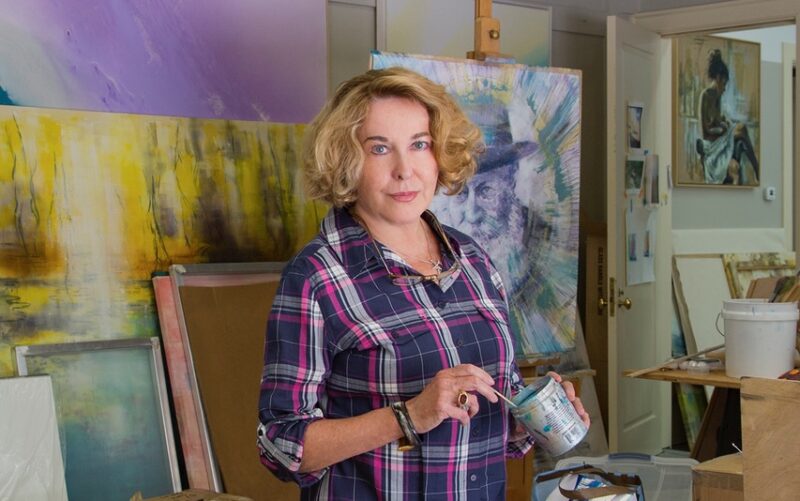
Barbara Hines in her studio.


 Add EJP on Google
Raised in a typical, secular Australian Christian home, artist and philanthropist Barbara Hines attended Sunday school at a local Methodist church and celebrated Christmas and Easter just like all her friends and neighbors in suburban Sydney. She knew she had been born in Germany, and that her parents had immigrated to Australia shortly after World War II.
But what she didn’t know was that her parents, assimilated German Jews, were also Holocaust survivors and that 86 extended family members had been murdered by the Nazis. Her parents had chosen to keep the family’s Jewish roots hidden from Hines and her sister out of fear and to keep them safe. She knew her father had been imprisoned by the Nazis, and his mother forced to wear a yellow star, but as a child who knew nothing about the Holocaust, she did not realize their significance. She didn’t know her mother was Jewish at all.
On Thursday, Hines, an internationally exhibited painter and philanthropist whose journey in discovering her Jewish roots began in midlife when her then-teenaged son began exploring Judaism, inaugurated her first solo exhibition in Israel, “Jerusalem in My Soul,” at the Moshe Castel Museum of Art in the Israeli settlement of Ma’aleh Adumim. The exhibition features 30 ethereal paintings of Jerusalem, painted over the last decade, which she said aim to convey the ambiance and bond she feels for Jerusalem. Hines told eJewishPhilanthropy that she plays with light, shadow and shape to bring together mystical elements, architecture and history, and her deep connection to her rediscovered Jewish heritage.
“Going to University of Sydney, I didn’t know what a Jew was. And then having suddenly been surrounded by a group of friends who all were Jewish…I thought, ‘Why am I with these people? What is it here [that is attracting me to them]?’” said Hines, who studied psychology and education before moving to Germany, to meet relatives and work as a teacher.
It was then that she made her first trip to Israel and felt an inexplicably strong connection to the country.
Later, when she and her first husband, commercial real estate mogul and philanthropist Gerald Hines, were raising their two children in London, and her son, Trevor, began his own journey into Judaism during his studies at Westminster School, she began to connect with her Jewish roots. In a phone conversation from Australia, Hines’ mother revealed that she was Jewish, as were her mother and grandmother, and therefore, according to halacha, so were Hines and her two children. They all three started observing Orthodox Judaism, and though her husband maintained his agnostic Christianity, he was supportive of their decision, Hines said.
As a young woman in her early 20s, she had explored various religions, moving from yoga to Hinduism, Sufism and becoming a practicing Buddhist for over 20 years, even traveling with the Dalai Lama and serving on one of his boards, Hines said this week, sitting in her light-filled Jerusalem apartment that she shares with her second husband, Rabbi Natan Ophir, whom she married in May, following Hines’ death in 2020 at 95.
It was during her first date with Ophir last year at the Moshe Castel Museum of Art that Hines was invited by its director, Hagai Sasson, to exhibit her work at the museum.
Though she saw the common denominator of trying to connect with the divine and make people strive to be better and take care of one another in all the religions, after much reading and studying and reaching out mainly to Chabad rabbis and teachers, she realized her strong connection with Judaism.
“It was a slow realization that this was my heritage, this is where I belong, and these are my people. It had been denied to me because of Adolf Hitler and the war. And I wasn’t going to let Adolf Hitler decide my future,” she said.
She recalled how she never felt settled anywhere when she and Gerald Hines traveled and lived around the world with their children, including Texas, Aspen, Colo., Paris and London. Her art accompanied her throughout their travels.
She now tries to imbue in her paintings of Jerusalem her deep connection to the city by mixing soil from Jerusalem — from her Jerusalem garden and soil friends sent her when she was in the U.S. — into the pigments she uses in her creations, she said.
“My paintings are very ethereal and light and transparent. I paint in layers using a wonderful Swiss pigment called Lascaux, like the caves. Then I would add the soil into the darker parts [pigments]. I felt that was like imbuing the actual painting with Jerusalem,” she said.
Though the results are markedly different, she finds in this process a similarity to the technique used by Moshe Castel, who mixed ground basalt rocks with glue, sand and natural pigments.
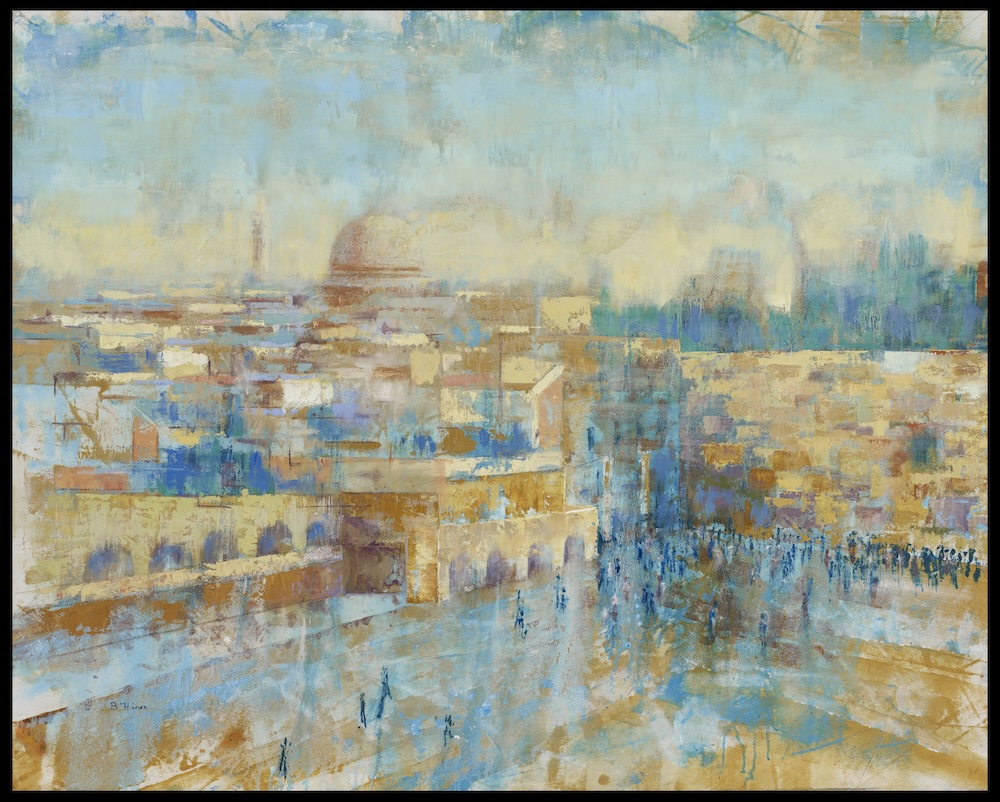
“Everybody sees something else in [my paintings.] They are often things I don’t even intend to put in there. And they see it, and I think that’s great because it strikes a chord in everybody,” she said. “We’re all at different places in our spiritual evolution. I hope it touches them and moves them in some way to seeing the great potential and as well as history, the past together with the future. I feel very blessed to be here in the present. It’s our gift to be here, and it’s part of the Aliyah process. Some people have a real calling to be here. Many people I’ve spoken to feel like me. They’re just drawn here and they come for a visit, and they’re still here 20 years later.”
Another of her exhibitions, “A Celebration of Survival,” which was commissioned by Houston’s Holocaust Museum, is now a permanent exhibit at the Dallas Museum of Biblical Art.
Continuing her husband’s tradition of philanthropic endeavors, which includes the Gerald D. Hines College of Architecture and Design and the Chabad Jewish Community Center in Aspen, Hines donates all proceeds from the sales of her paintings to Jewish educational institutions, including yeshivot and ulpanot, with a main focus on advancing Jewish education for girls and women. Following her own battle with breast cancer, Hines also supported the creation of the Barbara Hines Building at Aishel House at Texas Medical Center, a hospitality service offered by Houston Chabad for out-of-town hospital patients and their relatives. Much of the art in her new exhibit was flown in from the Aishel House, with Hines replacing the pieces with laser-copied and repainted duplicates.
The “Jerusalem in My Soul” exhibit runs through Dec. 31.
“This city is divinely inspired and blessed and protected. It’s been destroyed many times. The First, then the Second Temple, and then all of the wars,” Hines said. “When people ask me about [current] politics, I say, this is a storm in a teacup. I feel we’ve gone on for thousands of years, and we will continue because I think we’re here on a mission and we’re inspired and protected by the divine.”
Related News

MAJOR GIFTS
Center for Jewish History celebrates 25 years with a $25M matching grant
HIGHER EDUCATION
As Jewish donors reconsider academia, Jan Koum doubles down, endowing Israel studies at Stanford
MAGICAL EXPERIENCE
Shefa launches psychedelics retreat for Jewish professionals suffering burnout

EXIT INTERVIEW
Elizabeth Sokolsky, longtime EVP of Birthright Israel, to retire next year
ADVANCING A VISION
N.Y. federation donates $1M toward building shared-society center named for peace activist killed on 10/7