Tons of Tikkun
Repair the World marks 1 million acts of Jewish service
The organization met the goal four years early, amid rapid growth; ‘The next million starts with the next one,’ CEO says
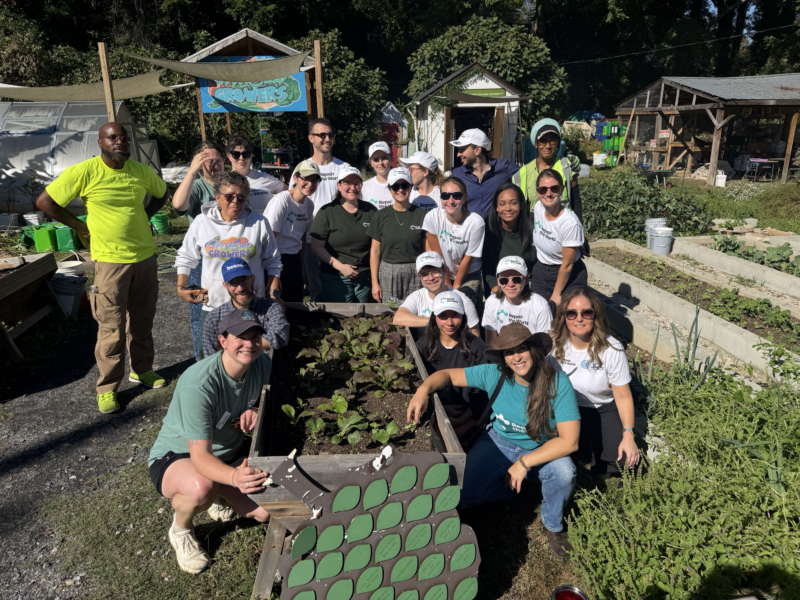
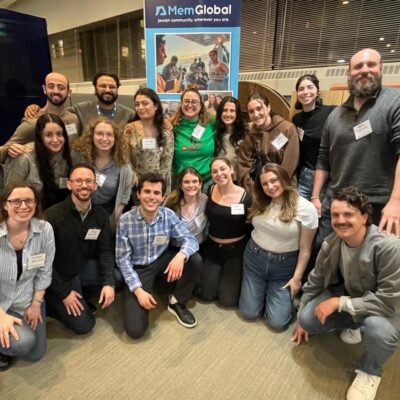
Courtesy/Repair the World
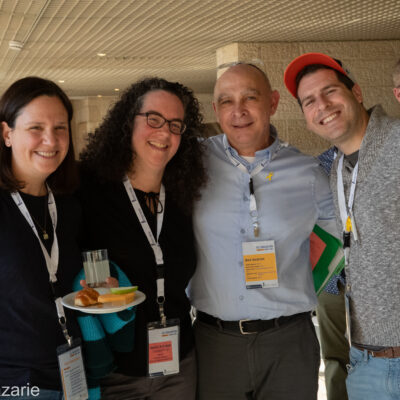
Repair the World staff yesterday at Historic Westside Gardens in Atlanta


 Add EJP on Google
The acts of service piled up slowly, one at a time, starting in 2019 — cleaning up a park or helping kids after school, and tying the hands-on work to a Jewish text. It was tikkun olam in action.
And by the time stakeholders of the nonprofit Repair the World gathered on Tuesday night in Atlanta, the tens of thousands of volunteers that fuel the organization had completed a staggering 1 million acts of service and learning. The goal, set six years ago, was expected to take 10 years. Repair achieved it four years early.
Cindy Greenberg announced the campaign after becoming CEO at Repair — she wanted to do something bold. At the time, it seemed unattainable.
“I remember sitting in that room with my board members and my senior staff, being like, ‘Yes, this is what we want to do. This is our vision for what the world needs and what the Jewish community needs, and being a little terrified at how we would get there,’” Greenberg told eJewishPhilanthropy.
Over the next six years, Repair met the goal one act of service at a time, she said, with over 700,000 volunteers caring for their communities, leading vaccine efforts during the COVID-19 pandemic, distributing essential supplies to displaced families after the Los Angeles wildfires and cleaning beaches to celebrate the 250th anniversary of America. The goal was bolstered by not just a surge of participants, but a flood post-Oct. 7, with volunteers jumping to help in soup kitchens, food pantries and after-school programs.
“There was no magic bullet,” Greenberg said. “That million acts of service and learning is made up of 10 volunteers here, 20 volunteers there, a cohort of volunteers in our service corps.”
But prompting those single acts of service takes organization, leadership, strategy and investment. Under Greenberg’s leadership, the organization has doubled its budget and revenue, widened its reach through national partnerships and by embedding employees in local organizations.
In the past six years, Repair grew drastically. In 2019, the organization had 35 full-time staff; today it has 59. The budget increased from $6.2 million in 2020 to $15.5 million in 2027, and its revenue nearly doubled from $6.6 million to $12.5 million. It recently added six new partners to its Jewish Service Alliance, a network of over 60 Jewish organizations, which now includes Union for Reform Judaism, Orthodox Union Relief Missions, Adamah, Young Judaea, Jewish Community of Greater Pittsburgh and JFNA Changemakers.
Since 2020, major donors have also jumped aboard, with Repair receiving transformational funding from MacKenzie Scott, who alongside her ex-husband Dan Jewett gave an unrestricted grant of $7 million in 2021, the Jewish Communal Response and Impact Fund, which provided a $5.8 million as part of its COVID-response, and a seven-organization philanthropic collaborative that gave an $13 million investment towards Repair’s expansion in 2025.
Currently, Repair has staff in 11 communities with three embedded employees who work out of local nonprofits, deeply entwined in the larger organizations’ work. The embedded workers roles began in August, serving in Orange County, Calif., at the Orange County Hillel, Bergen County, N.J., at the Kaplen JCC on the Palisades and Houston at the Evelyn Rubinstein JCC Houston. Within five years, Repair plans to bring staff into seven more communities.
“We now have solid partnerships with the largest Jewish engagement organizations, especially those focused on young people, but also beyond that,” Greenberg said. “They all include a strategy around how do we make sure that service is a defining part of what that organization is offering to their constituents.”
Locations chosen for embedded employees are decided based on funder appetite, the readiness of organizations to increase service work and the potential audience in each location. Often embedded partners start out by participating in national campaigns, such as the recent National Days of Jewish Service, which ran from Sept. 10 to Oct. 10. Funding for the new embedded employees was provided by the Samuels Family Foundation, the Russell Berrie Foundation and the Samueli Foundation.
Sue Gelsey, CEO of Kaplen JCC on the Palisades, had worked for 3 ½ years building partnerships with community and religious-based organizations with the goal of “strengthen[ing] the relationships between and among groups, disrupt[ing] tensions and creat[ing] change,” she told eJP.
Gelsey regularly met with other leaders and the JCC held community-wide programs with other organizations. “It’s really been focused on being with one another, meeting one another, and now we can advance that into acts of service and hopefully creating real change,” she said.
Before taking on the role of CEO, Gelsey worked for the JCC Association, and she remembers when Greenberg set the goal of 1 million acts of service.
“It was so exciting and seemed so lofty,” she said. Today, people are looking for new ways to do Jewish, she said. “A lot of what we might have grown up with isn’t necessarily resonating with everyone, and service is accessible to everyone and [Repair does] it always with [Jewish] learning. So it’s cleaning a park and also learning a little bit of text. [Repair] realize[d] that this is a different accessible way to engage Jewishly, and the fact that they’ve gotten to [the goal of 1 million acts of service and learning] years ahead of schedule means that they were right.”
Using service as a way to bond with others across boundaries is critical to combating antisemitism, Gelsey said, especially post-Oct. 7, and doing so is more impactful than sitting down with people and trying to teach them about Jew hatred.
“When you get to know people on a personal level, you realize that we have so much more in common, and that hate is misplaced,” Gelsey said. “The more that we’re able to mobilize the Jewish community to do anything with all different faith-based communities, the better we’re all going to be. And to do it with Repair the World through acts of service is such an easy and accessible way to do it.”
The way to combat antisemitism, Gelsey said, similar to the way Repair achieved 1 million acts of service, is “One person at a time.”
Repair the World checks numerous boxes for the Houston-based Samuels Family Foundation, which began investing in the organization four years ago. “One of my father’s passions was community service and volunteering,” Ben Samuels, director of the foundation, told eJP. “This was [at the] intersection of both volunteering and our Jewish investing,”
Once Repair began planning to embed a staff in the Evelyn Rubinstein JCC Houston in August, the SFF “quintupled down” on their investment, Samuels said. Houston may not have as big of a Jewish community as New York or California, he said, but Houston Jews are “dynamic.”
His father, Vic Samuels, was a seventh-generation Jewish Texan who launched numerous businesses in the state. The family foundation focuses most of its investments in local initiatives, with some national and Israel-based investments. “This [investment] now has leapt from a national program to [a] Houston [program], where we do bigger investments, where we can have a bigger impact.”
Repair reaching the 1 million acts of service mark four years early is tantamount to “a Northern California growth stock,” where investors jump onto a stock that is already doing well, allowing it to grow and make a bigger impact.
“We’re not slowing down,” Greenberg said. “The next million starts with the next one.”
Related News
ADVANCING A VISION
N.Y. federation donates $1M toward building shared-society center named for peace activist killed on 10/7
EXIT INTERVIEW
Elizabeth Sokolsky, longtime EVP of Birthright Israel, to retire next year

MAGICAL EXPERIENCE
Shefa launches psychedelics retreat for Jewish professionals suffering burnout
EXCLUSIVE
Detroit-based philanthropists Nancy, James Grosfeld donate $8M to renovate JDC’s Israel campus
PRESIDENTIAL REBUKE
Israel’s Herzog: Mamdani ‘makes no effort’ to hide disdain for Israel, Jews must fight back