Opinion
ICYMI
The work of noticing




 Add EJP on Google
In Short
SRE Network's roadmap for the future of gender equity in Jewish communal life.
The following is an abridged version of the author’s opening remarks at the 2026 SRE Network Convening on June 15 at the Museum of Jewish Heritage in New York City.
Max W. Orenstein
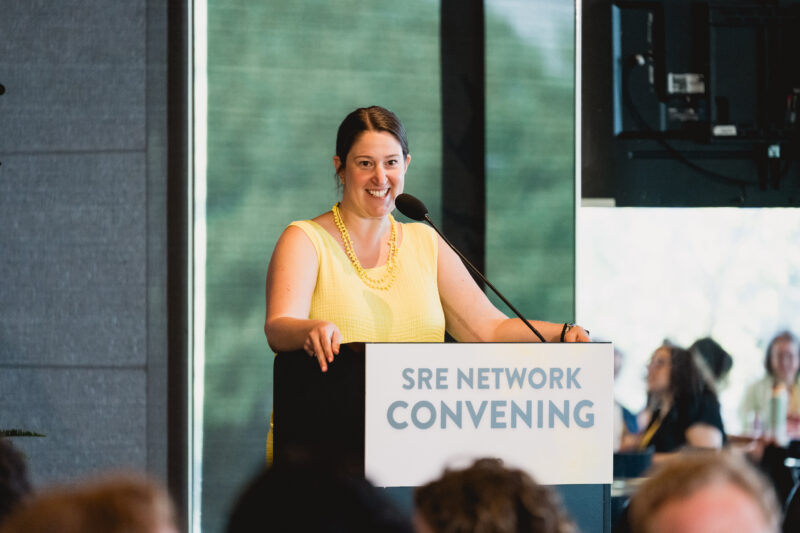
Rachel Gildiner, executive director of SRE Network, addresses the 2026 SRE Network Convening at the Museum of Jewish Heritage in New York City on June 15, 2026.
Growing up in the 1980s and ’90s, I watched a lot of television with my family. What I remember most vividly wasn’t the shows themselves — it was the commentary.
My parents, both lifelong feminist advocates and champions of reproductive rights, couldn’t let a sexist commercial or stereotypical scene pass without saying something. And in the ’80s and ’90s, that was most commercials and many scenes.
“Why is it always women doing the cleaning?”
“Why do they need to sexualize women to sell gum?”
“Remember, girls, in this house, it’s your father who does the laundry and sewing.”
Years later, when I was reading my son’s favorite book, Goodnight, Goodnight Construction Site for what felt like the 2,000th time, I found myself frustrated that every truck was a boy. Construction trucks can be girls, too. So I grabbed a pen and started changing the pronouns.
In that moment, it all came full circle.
My parents weren’t interrupting family television for fun, just as I wouldn’t describe line editing a children’s book with a Bic pen as fun. They were teaching me to notice.
To notice what gets normalized when nobody questions it.
To notice whose voices are missing, whose leadership is assumed and whose experiences are treated as secondary.
That is what SRE Network is committed to doing. We work with leaders who refuse to look away and who know we can do better. Leaders who notice when the implications of gender shape people’s ability to fully show up, to lead, to belong and to be safe.
We know that all of us come to this work from different experiences and perspectives. Not everyone grew up with parents who yelled at the television. Not everyone committed to this work identifies as a woman. At SRE, we understand gender as diverse. And you don’t have to call yourself a feminist or lead an organization dedicated explicitly to gender equity.
If you believe that building workplaces rooted in safety, respect and equity is both good for our organizations and deeply grounded in our Jewish communal values — this work is for you, too.
It is impossible to ignore the moment we are living in. Antisemitism is real and rising. Democratic norms that protect and keep people safe are under strain. The rights of many are being challenged and our organizations are stretched thin.
In moments like these, there can be a temptation to treat equity and belonging as secondary — to return to them when things settle down.
SRE believes the opposite to be true. Moments of overwhelm reveal who we are. They test whether our values are as deeply embedded as we think they are, or want them to be.
Equity, dignity and fairness cannot be treated as luxuries for easier times. The stakes for our sector and for Jewish life are simply too high.
SRE began in 2018, in the wake of the #MeToo movement, when it became clear that gender-based harm was happening across Jewish communal life and that most organizations lacked the tools and support to adequately respond.
Gender-equity advocate and supporter of this work, Barbara Dobkin, described SRE then as a nascent coalition that:
“promises to engage major Jewish community funders, service providers, and subject-matter experts to discuss how to change the way our community deals with issues of harassment, pay inequity and the dearth of women leading our communal organizations.”
We can say confidently that we, as a sector, have accomplished far more than just discussing.
In the years since our founding, we have invested more than $7.4 million in over 150 projects. We have convened thousands of organizational and foundation leaders. Hundreds of organizations have strengthened policies, built ethics protocols and developed more equitable workplaces. We have catalyzed research, curricula, assessment tools, facilitation guides, podcasts and resources now used across the field.
We have moved conversations about gender equity from the margins into the spotlight. And yet, the need remains great.
Progress too often depends on individual champions or isolated efforts. It lives in silos rather than systems. To meet this moment, we need change that is integrated into our leadership, our policies, our culture and our funding, because gender equity is not a stand-alone issue. It shapes who contributes. Who is heard. Who leads. Who is protected. Who stays — and who leaves.
Those realities affect the strength of every organization in our sector.
After years of listening, learning, convening and investing in the field, SRE has sharpened its understanding of where change is most needed and can have the greatest impact. We are focusing our efforts on four interconnected areas:
Strengthening systems of harm prevention and response
This work has been at the heart of SRE since our founding, and it remains foundational.
While harassment remains a serious concern, harm in our workplaces extends beyond sexual misconduct. It also includes discrimination, bias, exclusion and the everyday experiences that undermine dignity and belonging.
Too many organizations still struggle to respond consistently and accountably when harm occurs. Policies alone are not enough. Preventing harm requires attention to both individual behavior and institutional culture.
SRE is working to build expert support networks, expand access to affordable anti-harassment and anti-bias training and equip organizations to move beyond compliance toward cultures where safety, respect and accountability are truly lived values.
Advancing diverse women’s+ leadership
The leadership gap remains real and persistent. Women make up the majority of the Jewish nonprofit workforce yet remain underrepresented in leadership, and barriers are compounded for those with intersecting marginalized identities. And when we speak about women’s-plus leadership, we do so with an understanding of gender as expansive, inclusive of anyone who identifies as a woman, as well as nonbinary individuals for whom this work resonates.
SRE is investing in research to better understand where barriers exist and how they can be dismantled. We are also committed to expanding access to the supports we know make a difference: coaching, mentorship, sponsorship, leadership development and equitable compensation.
Leadership at every level should reflect the diversity of the communities we serve.
Mobilizing men as partners
Lasting gender equity is not possible without men. Men continue to hold significant institutional power across much of our sector, and their engagement is essential to creating meaningful change.
At the same time, many men are themselves navigating isolation, loneliness and expectations that limit their ability to seek support and show up authentically. Gender equity is not a zero-sum game. The same norms that constrain women often constrain men as well.
Supporting women, men, trans, nonbinary and gender-diverse individuals are not competing priorities. We need one another. SRE is committed to creating opportunities for men to learn, reflect and build the skills needed to become genuine partners in this work.
Engaging funders for lasting change
Organizations cannot advance culture change without the resources to sustain it, yet gender equity remains underfunded despite its impact on organizational health, leadership and effectiveness.
SRE believes safety, respect and equity are not optional enhancements. They are essential infrastructure. We are committed to partnering with funders to increase investment in this work and build the sustainable support our sector needs to thrive.
We envision a Jewish communal landscape where safety, respect and equity are woven into the fabric of our organizations.
Where workplaces actively prevent harassment, discrimination and abuse — and when harm does occur, organizations respond with clarity, compassion, accountability and meaningful pathways to repair.
Where leadership reflects the diversity of our communities, and people are compensated equitably for their contributions.
Where power is shared, and all genders take collective responsibility for one another’s success.
Where organizations can access the resources they need because this work is recognized as essential and sustainably supported — and where no one is doing this work alone.
SRE’s role is not simply to imagine this future. It is to help ensure we are all walking toward it together.
Because noticing is only the beginning. The real work is what comes next.
Rachel Glidiner is the executive director of SRE Network.