EXTRA! EXTRA!
Local Jewish leaders, journalists team up to launch Seattle area’s only Jewish publication
The news outlet, The Jewish Sound, is being launched as a nonprofit; grassroots organizers say donors won’t have editorial control

GETTY IMAGES
Freshly printed newspapers come out of a rotary press at a printing facility in Zurich, Switzerland.




 Add EJP on Google
The Puget Sound region of Washington state, the area around and including the booming tech hub of Seattle, has long been home to a sizable, wealthy and active Jewish community. Yet for the past six years, it has had no local Jewish newspaper to inform the region’s estimated 75,000 Jewish residents. A group of philanthropists, local leaders and editors — led by a relative newcomer to the area — is looking to change that.
Early next year, these organizers plan to launch The Jewish Sound, a digital-first publication that will operate as a 501(c)(3) nonprofit.
For nearly a century, the area had a local Jewish newspaper, The JTNews, formerly known as The Jewish Transcript, which was owned by the Jewish Federation of Greater Seattle and served Washington state from 1924 to 2015. It then transitioned into a bimonthly glossy magazine, Jewish in Seattle, which shuttered in 2020 after the COVID-19 pandemic hit.
The new publication will be run by several former editors of The JTNews, including the final editor, Joel Magalnick, who will serve as the founding executive director of The Jewish Sound. He will be joined by Donna Blankinship, a former editor at The Jewish Transcript, who will serve as the founding executive editor. Along with regular online content, the publication plans to print three issues yearly, based around Jewish holidays and an annual Guide to Jewish Washington.
Coverage will be hyperlocal, Karen Kalish, chair of The Jewish Sound’s board of trustees, told eJewishPhilanthropy, including on issues related to Israel, which the publication won’t cover unless it’s tied to the Puget Sound region.
“Everyone can go elsewhere for all that, even The Seattle Times, Wall Street Journal, mainstream publications, they are and should be covering Israel,” she said.
Instead, the publication will focus on community news, lifecycle announcements, a comprehensive calendar and opinion pieces from residents across the political spectrum. While the publication will set a limit around what views are permitted related to Zionism, its red line is going to be “pretty far to the left,” Blankinship told eJP, though she added: “We’re not going to [platform] people who say Israel shouldn’t exist.”
Blankinship said she hopes to encourage a lively, robust conversation about Jewish communal issues, something she hopes will attract younger readers. Being able to allow all viewpoints on contentious issues is one of the reasons the paper decided not to financially partner with their local federation, which would want editorial input.
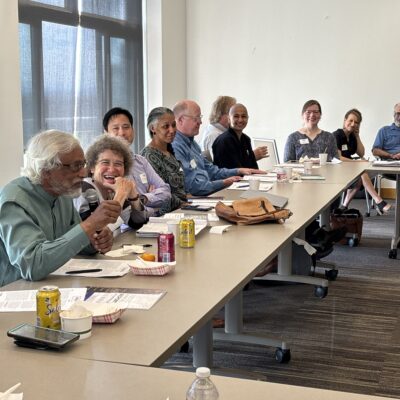
Kalish came up with the idea for the publication soon after moving to the region four years ago. She was disconcerted to find the community had no publication to help her connect to other Jews, to find events or to read about births and deaths within the community. She contacted the federation, which told her that it didn’t have the capacity to run a paper.
But after Kalish and a group of 20 other locals, including the former JTNews editors, began weekly planning meetings, the federation became interested.
“We want to do this, but we would have to have the last word,” she remembers a representative telling her, to which she replied, “Thank you very much, todah rabah” — and passed on the partnership.
Organizers are being clear to donors — they are starting a journalistic organization. “We will let our large donors know, and we are going to have this in our transparency statement, that your money does not give you access to the editorial team,” Magalnick told eJP.
Organizers also decided not to use a fiscal sponsor to launch the outlet because the sponsor would charge a percentage of donations. “I just didn’t want that donated money to go anywhere but us,” Kalish said.
Young Jews have flooded into the region recently for tech jobs, forming their own Jewish employee resource groups at Amazon, Microsoft and smaller local startups, celebrating holidays together at local pubs.
“They want to meet other Jewish young people,” Blankinship said. “Judaism isn’t their whole life, but it’s an important part. … So they want a lot of information about how to get involved, how to find activities that interest them.”
This demographic is one of many disparate Jewish communities in the region that are thriving but disconnected, with massive waterways slicing through Jewish communities physically. The area is also home to the third-largest Sephardi community in the United States.
Blankinship, a veteran writer and editor with a digital background, hopes to expand the publication across platforms, including social media and podcasts, to connect with different audiences.
Even though the organizers who are launching the publication skew older, “they know that the publication can’t just market to them,” Blankinship said. “You can’t just appeal to the 80-somethings and 70-somethings with your publication and expect it to live beyond 10 years from now.” Her goal is to help launch the publication, but prepare to transition the editorial side to a professional with “younger ideas and more modern experience,” she said.
Blankinship leads a community task force, made up of professional Jews across the spectrum, young, old, Sephardi, Ashkenazi, setting the paper’s policies and calendar. Her daughter, who is 31, has been begging her to have a matchmaker column in the new publication, Blankinship said. The board, which currently has four people on it, also aims to represent the larger community, Kalish said. “We’re really thinking about the young singles and the young with families.”
When searching for talent to write for the publication, Blankinship is “more interested in talent than I am in pedigree,” she said. Writers need not be Jewish, but they need to know how to write well.
Last month, The Jewish Sound was approved by the IRS for its 501(c)(3) status, and it set a projected launch date for early 2027, but first it needs to raise $600,000, enough for a nest egg, with the goal of eventually creating an endowment for long-term sustainability.
The publication has already raised over $100,000, with a projected yearly budget of $400,000, organizers said.
Although the articles will be accessible for free, there will be memberships, similar to those used by public radio, Kalish said, where members can get perks and merchandise, such as a coffee mug.
“My saying in my life is, you see a problem, you grab an ally or two or three, roll up your sleeves and get to work,” Kalish said. She identifies as a “serial social entrepreneur” and has launched three nonprofits in the past based around literacy, connecting Black and Jewish students and closing the opportunity and achievement gaps in low-performing schools.
As a newcomer to the region, Kalish said that she is “the worst person to do this in Seattle, because I have no history here.” But she said that she is also “the best person to do it here, because I had no history, so I’m talking to all kinds of fundraisers.”
Kalish said she unabashedly evangelizes about the publication everywhere — in the pews of local synagogues and in line at the local Jewish film festival. “I want to spread the word. I want to plant the seeds. I want members. I want money. You need friends before you get funds.”
There is a lot of money in the Puget Sound region, she said. “And a lot of Jewish money. I’m gonna tap it.”
Related News
EXIT INTERVIEW
Elizabeth Sokolsky, longtime EVP of Birthright Israel, to retire next year
CLOSING WORDS
In AZM address, Cosgrove links communal ‘orthodoxy’ on Israel to rising anti-Zionism among young Jews

MAJOR GIFTS
Center for Jewish History celebrates 25 years with a $25M matching grant

EXCLUSIVE
Detroit-based philanthropists Nancy, James Grosfeld donate $8M to renovate JDC’s Israel campus
HIGHER EDUCATION
As Jewish donors reconsider academia, Jan Koum doubles down, endowing Israel studies at Stanford