Opinion
GLOBAL JEWRY
The geography of Jewish worth




 Add EJP on Google
In Short
Global Jewry is more than a donor map.
I recently spent time in two European cities that had never sat especially high on my personal bucket list, which is to say they were not exactly competing with “eat pasta in Rome” or “pretend I understand contemporary art in Paris.” Yet both Budapest and Bucharest proved far more compelling than my limited imagination had allowed.
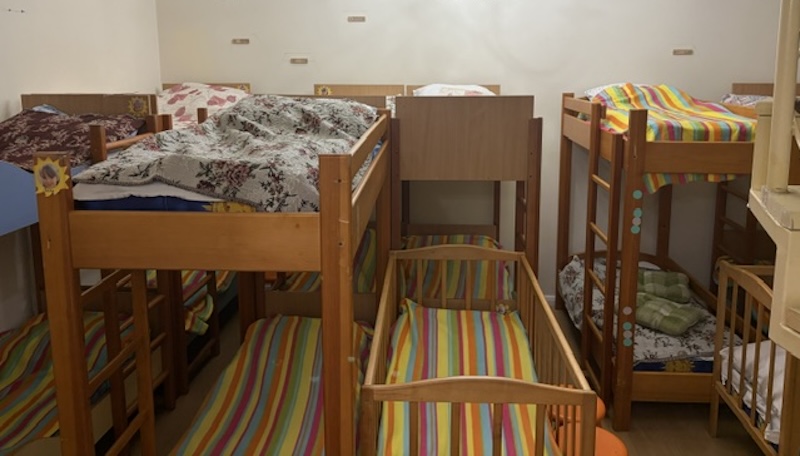
Budapest was a beautiful and complicated experience, one I shared with members of the Natan Fund on one of their annual trips. Our guide was a remarkable woman; deeply knowledgeable, she was passionate about the city of her birth and candid about her decision to live elsewhere while Hungary flirted with authoritarian nationalism. Luckily for her, and for the rest of us who prefer our politics with fewer armbands, that particular government eventually ended, but this is not to say history has lost its taste for reruns. My visit to Bucharest included a stop at Tikva Children’s Home, an orphanage, school and vocational training network for Ukrainian Jewish children who were forced to flee Odesa after Russia’s full-scale invasion of Ukraine.
Courtesy/Rachel Lithgow
A bedroom at Tikvah Children's Home, which relocated its charges from Odesa to Bucharest to ensure their safety after the Russian invasion of Ukraine.
In both cities, I heard the same cluster of questions, always delivered with the grave sincerity of people who believe they have discovered geopolitics between the appetizer and the main course: What is the future for Jews living here? Shouldn’t they leave? Wouldn’t the U.S. or Israel be better? Why support them here when we’d feel more comfortable supporting them there?
I am not arguing that these questions are inherently malicious. Philanthropists and volunteers routinely ask where money will do the most good, whether a community is sustainable and what obligations follow from need. Those are legitimate questions of strategy. But there is a difference between strategic analysis and asking vulnerable strangers to justify the geography of their existence.
I cannot think of another community for whom this interrogation is treated as ordinary small talk. Why can’t Palestinians live in any of the 57 Muslim-majority nations? Why can’t Sudanese people facing genocide just, I don’t know, leave, and then I’ll care more? Shouldn’t Ukrainians just give in to the stronger power and end this damn war already? Why can’t Iranians rise up and overthrow the fundamentalists who’ve been crushing them for decades?
When these questions are asked about other ethnic, religious, cultural or national groups, the questioner is quickly labeled insensitive, inappropriate or privileged. They are dismissed as people for whom reality has become an elective course they keep auditing but never pass.
So why does the question become acceptable when Why don’t you simply pack up and leave? is directed at Jewish widows, orphans, refugees and the elderly? And why are Jews themselves so often the ones most eager to ask other Jews to prove that their address deserves communal concern?
Whether or not you believe that the future of Judaism does not lie in the old Jewish Quarter of Budapest — now home to several gentlemen’s clubs and one excellent kosher restaurant, because history apparently has a flair for zoning irony — should not determine whether the poorest Jews who live there deserve bread, dignity and a roof over their heads. They are there, now: corporally, inconveniently and not waiting for a strategic planning retreat. Where does communal responsibility begin for the Jews of Bucharest or the Jews who remain in Odessa and Sophia; the many small and aging Jewish communities whose members stayed because they could not leave, would not abandon parents, lacked the legal or financial means to move or simply made a choice that outsiders do not get to overrule?
The demographic reality makes this question more serious, not less. The Institute for Jewish Policy Research’s country data, drawing on Sergio DellaPergola’s 2024 world Jewish population estimates, underscores how varied and fragile these communities are. Jews constitute roughly two-tenths of one percent of the world’s population, and yet Jewish life remains dispersed across dozens of countries, including small, aging communities in places whose names rarely appear in American Jewish fundraising brochures unless the theme is “Before They All Disappear.”
In Bucharest, I met a 13-year-old boy who was living temporarily in the local orphanage. Originally from Ukraine, he was found in a trash can when he was a week old, yet he grew into an active, bright and thriving child. Do his needs matter less because he is not living in a children’s home in Israel? As wards of the Ukrainian government, children like him cannot simply be spirited across a border because Jewish funders would prefer the moral geometry of the story to be cleaner. The children and the staff — psychologists, teachers, therapists, security personnel and others who support them — are not necessarily where funders would hope they’d be. But humanitarian ethics begins with people as they are situated, not as we wish they were arranged on a donor map.
The larger Ukrainian context matters here. According to United Nations High Commissioner for Refugees, millions of refugees from Ukraine have been recorded across Europe since February 2022, and UNICEF reported that by the end of 2024 more than 6.78 million refugees had fled Ukraine while more than 3.6 million people were internally displaced. UNICEF also reported that 90 percent of Ukrainian refugees in Europe were women and children. Those numbers do not become less urgent when the displaced child is Jewish, nor do they become simpler when the best temporary refuge happens to be Romania rather than Jerusalem, New York, or any other place that makes the donor feel tidier.
This is not to say that immigration or aliyah should be dismissed. For a meaningful portion of the Bucharest group, and much less so for the Jews I met in Budapest, it may eventually become the right path, and it should be. They are being prepared with options. The children I met speak Ukrainian and Russian, but several also speak excellent Hebrew, which they studied in school, and they are now learning English as well. What these children have experienced, both within the damaged family structures they come from and in the war-torn region they call home, is extraordinary. Yet to see happy, thriving children speaking two to four languages, some beginning entrepreneurial endeavors is not merely charming (one remarkable boy receives 20 lei for every cat he catches wandering the compound, and let me tell you, this kid is a venture capitalist with a butterfly net). It is evidence that stability, care and Jewish continuity can exist outside the places we instinctively imagine as safest. Wherever these children end up, they will be contributing members of not only the larger world, but the Jewish world, where they will live by the “Children live what they learn” adage according to not only a decent and moral path, but through the Torah Judaism they continue to learn about repairing the world, and being supportive and of service in their own community.
Jewish philanthropic priorities shift with time and circumstance, as they should. The first Jews who arrived in what became New York from Recife, Brazil, fleeing the Inquisition, were instructed by the Dutch West India Company not to become a “burden” on the colony, despite Peter Stuyvesant’s strenuous objections to their presence. They began by meeting the basic needs of their own tiny community, and soon their generosity expanded to include new refugees seeking respite from their own geopolitical catastrophes.
The world may have forgotten how central Jews have been to the development of modern philanthropy and to movements that aided non-Jews as well as Jews, but we should not forget the principle beneath that history: people deserve agency, and communities deserve support where they actually live, even temporarily. If Jewish peoplehood means anything, it cannot mean caring only for Jews whose zip codes flatter our ideology. It must also mean bread, schools, safety, language classes, trauma care, and dignity for Jews who remain in Budapest, Bucharest, Odesa, Sofia and every other place where Jewish life persists. They need our support more urgently than they ever have, and they deserve and should expect it from us.
Start by looking at organizations like Tikva Children’s Home. Host a salon in your house to educate your circles on one of these communities. There is much work to be done, and it’s up to the larger Jewish world to do it.
Rachel Lithgow spent 25 years running large legacy Jewish historical and cultural institutions until 2021, when she pivoted to writing; her first book, My Year of Really Bad Dates, was published in November 2025. She is also the founder and CEO of the Noga Agency.