RADICAL EDUCATION
Why do so many leaders study in Pardes’ Beit Midrash?
As the institute rebrands, graduates share their experiences with Jerusalem’s pluralistic yeshiva
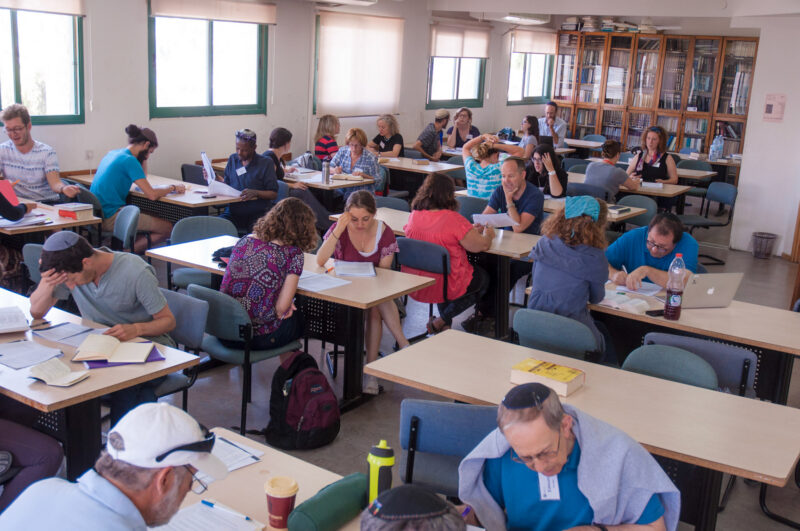
Courtesy: Pardes
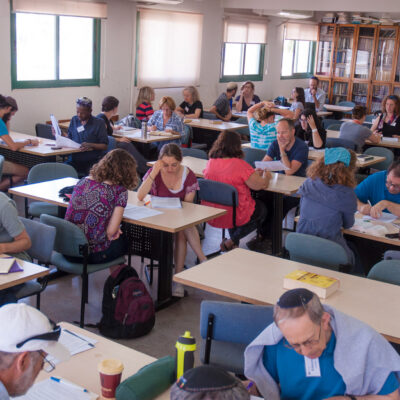
Students studying at the Pardes Beit Midrash during the institutes summer program


 Add EJP on Google
One former student of the Pardes Institute of Jewish Studies in Jerusalem helped put the issue of environmentalism on the Jewish communal agenda. Another now leads the largest Reform temple in Canada. And a third, Rachel Goldberg-Polin, whose tireless work on behalf of the hostages held captive in Gaza earned her great praise throughout the Jewish world, credits her five years of study at the institute’s beit midrash as influencing everything in her life since.
Today, more than 50 years after Pardes opened its doors in 1972, under the direction of Rabbi Michael Swirsky, it’s hard to imagine an area of Jewish life that its students haven’t touched. The pluralistic yeshiva continues to serve as an incubator for leaders, and its impact ripples across denominational lines and around the Jewish world. And this week, the school launched a new website as part of a rebranding of its visual identity, including an updated version of its pomegranate logo and a new tagline, “The Art of Jewish Learning,” reflecting its emphasis on building skills, exploring diverse perspectives and engaging deeply with Jewish texts. (The old tagline was “Your Torah. Your Journey.”)
When Meesh Hammer-Kossoy first strolled through the institute’s doors in 1987, the Jerusalem beit midrash looked markedly different than it does today, where LGBTQ+ advocates study across from Jews of color, and women in tank tops partner with those with their hair wrapped in tichels. Today, Hammer-Kossoy, who began teaching at the institute in 1999, is herself the director of Pardes’ year program and is rosh beit midrash — yet another student who has made good.
“The core mission, which is letting Jews define their own Jewish journey and really hav[ing] access to the Torah, is still 100% the core mission of the institution,” she said. “And in some ways the learning is very similar to how it was” when she first enrolled, Hammer-Kossoy told eJewishPhilanthropy.
Ordained at the Jewish Theological Seminary and a leader in the Havurah movement, Swirsky envisioned a Jerusalem-based yeshiva with deep respect for Torah intertwined with the intellectual openness and progressive thinking of an American university. When the school opened in the fall of 1972, it catered to post-college young adults primarily from North America — today, students of all ages trek from around the globe to study together.
In her recent book, When We See You Again, Rachel Goldberg-Polin describes the institute as “where inquisitive young postgraduates could go to hydrate their thirst for learning.” She enrolled in a six-week summer program in 1995, but didn’t leave for five years. In this regard, hers is a story that mirrors many others who came for one program and stayed for more. In September 2023, she was hired as the Student Support Coordinator, a position she would hold for a month before tragedy struck and her son, Hersh, was kidnapped by terrorists during the Oct. 7 terror attacks in southern Israel and executed nearly a year later.
A summer 2026 alumni impact study found that 53% of Pardes alumni serve as Jewish professionals — they are rabbis, educators and leaders. Twenty-three percent have founded or co-founded Jewish institutions, initiatives or communities such as Jewish-environmental nonprofit Adamah, Jewish meditation and spirituality organization Or HaLev and the Hadar Institute, which modeled its learning on Pardes.
Born in Chicago, Swirsky made aliyah in 1971, at 26, entering a country still buzzing with excitement after its definitive Six-Day War victory and before the national shock of the 1973 Yom Kippur War surprise attack.
At the time, the country’s existence felt miraculous, and that heady sense of euphoria encouraged the settler and baal teshuva movements, with spirituality-seeking hippies turning towards Torah. It also led Swirsky to partner with the World Zionist Organization to offer American Jews a pluralistic setting to debate Torah.
A lot has changed since Pardes’ inception. The school split from the WZO in 1987. It launched programs to train Jewish educators and started offering summer programs, immersive seminars, a second-year fellow program, community education programming and an expanded curriculum to North America.
“Many of the people at Pardes are not getting a degree from being there,” Nigel Savage, who founded Adamah, previously known as Hazon, in 2000, told eJP. “Most of the time, we’re on professional tracks and getting undergrad degrees and graduate degrees, and Pardes, almost since its beginnings, but up through ‘till today, has attracted bright, talented, questioning, idealistic students.”
Pardes is in an infinity loop, Savage said; students and faculty bring out the best in one another. “The caliber of those students influences each other and inspires the faculty, and having great faculty inspires the students. So that’s a potent mix in a really lovely way.”
In 1994, Savage served as a lay leader in London’s Jewish community while working on the English version of Wall Street when he packed his bags to study at Pardes. After wrapping up his year of studies, Savage thought to himself, “Why would I want to commute to the city of London in a pinstripe suit?” so he stayed in Israel without a plan. Then a friend from Pardes invited him on a hike from the Mediterranean Sea to the Sea of Galilee. “I’d never basically set foot outdoors,” he recalled, “and I was incredibly scared.”
Clad in ill-suited shoes and lugging a gargantuan backpack, Savage journeyed into the unknown, slogging through rainstorms and sweltering heat, but he fell in love with nature. The wilderness “was a great way to bring people together across difference,” he said. Soon, he founded Hazan and today Savage serves as the founding CEO of the Jewish Climate Trust.
None of this would have happened without Pardes, Savage said. His time at the school gave him the footing to move forward in the world steeped in Jewish tradition, and the school taught him something that later would become the tagline for Hazan: “The Torah is a commentary on the world, and the world is a commentary on the Torah.”
Rabbi Samuel Kaye, too, was searching when he strolled through Pardes’ doors in 2012. He was a 26-year-old bartender living in Chicago who discovered the institute after returning home from a Birthright Israel trip. “When everyone else was hooking up with each other, I fell in love with Israel,” he told eJP. Browsing through a Masa Israel Journey catalog, a Pardes promotion “just spoke to me,” he said. “I didn’t know anyone who had gone, I didn’t know anyone who was there, but it was listed as this egalitarian study-based program. I didn’t think it was gonna try to turn me into a black hat.”
Before Pardes, “I would not have identified myself as a religious person,” Kaye said. “I would have identified as a Jewish person, and when I finished at Pardes, I was both Jewish and religious.”
During his time in the year program, Kaye participated in the school’s student-led egalitarian minyan, but grew frustrated that staff wouldn’t intervene in intragroup conflicts, especially over who was counted for prayers. “Now I appreciate that they wouldn’t get involved in that,” he said, “and that they let people discuss it and resolve it for themselves every single year… because it shows you how Jewish community has to function to answer questions inside of itself as opposed to having authority come and tell you what to do.”
Today, Kaye serves as lead rabbi at Canada’s largest Reform congregation, Holy Blossom Temple in Toronto. “I credit Pardes with a lot of my success,” he said. “My love of text, my ability to work with more traditional conservative Orthodox colleagues, the fact that I find a lot of joy in being in intra-Jewish spaces, and my continued study habits.”
Rabbi Maya Zinkow was studying creative writing at Barnard College when her Hillel rabbi told her about Pardes. Zinkow grew up in a Reform household with rabbis as parents. After two weeks studying Gemara at Pardes, she had an epiphany: “I can’t believe I’ve been Jewish my whole life, and I’ve been really Jewish my whole life, and I’ve never, like, done this, and this is new, and this is different,” she thought to herself.
She loved that Pardes allowed students to find their own path. “No matter who you are — queer, straight, woman, man, trans, cis, Zionist, anti-Zionist, whoever you are as a Jew — Pardes is a place that really embraces the idea of coming to the text as you are,” Zinkow told eJP. “For thousands of years, only a certain kind of person, at least on the surface or as we understood them, was coming to the text as who they were. All of the laws of niddah, all of sacred sexuality as relates to menstruation, were developed by a certain kind of person who didn’t actually have that experience. What happens when you open up the doors to the beit midrash and actually have different people with different bodies and different identities coming to the text?”
The beit midrash at Pardes “is like a little bit more rad, a little bit more queer every day, every year,” Zinkow said. “There’s no other place where you can go and learn Torah in a very traditional yeshivish kind of way, but be a Jew of any and all kind.”
At Pardes, Zinkow experienced educators who were “brilliant minds who know the entire Torah and are also incredibly emotionally intelligent, care about you as a human. I was like, ‘Whoa! If that’s what a rabbi is, can I be a rabbi?’”
The school allowed her to find herself “as Rav Maya, the feminist, Rav Maya, the queer person, Rav Maya, wanting to heal the world of its brokenness in whatever ways, that allows me to authentically learn and teach Torah in the same way that it’s been happening for centuries, but in my voice, which has not been happening for centuries.”
In October, Zinkow — formerly campus rabbi at Berkeley Hillel from 2021 to 2026 — joined the Pardes North America faculty, teaching a monthly class with varying topics in Berkeley, Calif., with the first session titled, “Why Pray for Rain? (Or Anything at All).”
There will be a time in every Pardes student’s life when they will be looked up to as if they were the most educated Jew in the world, David Bernstein, the dean emeritus of Pardes, tells students at the beginning and closing of every year. They need to be prepared, he says. According to Pardes’ recent report, they are; 96% of alumni report serving as a trusted source of Jewish wisdom in their communities.
The study surveyed 760 alumni and found that the participants reached 513,000 people through teaching, mentorship, leadership, institutions and community life. Magnified across the more than 10,000 alumni who have studied at the institution over its 54 years, alumni are estimated to have impacted 6.7 million people.
Having taught at Pardes since 1999, Hammer-Kossoy has watched alumni establish their own Jewish schools and organizations across the globe, but often the school’s impact is more intimate. She’s watched students fall in love. Watched them smooch under a chuppah, surrounded by Pardes peers who shower the couple with Sunkist Fruit Gems. She’s watched Pardes’ graduates start families together, and she kvelled at their children’s bar and bat mitzvahs.
“At the core” of the Pardes student body “is a group of Jews with a really strong, robust and vibrant Jewish identity,” Hammer-Kossoy said. Today’s students often identify as postdenominational, she said. “In a lot of ways Pardes has always kind of transcended those labels.” They are individuals, coming from all backgrounds, finding themselves. “We give them confidence to back up that identity, and from that identity they want to be leaders; they naturally become leaders.”
Related News
CLOSING WORDS
In AZM address, Cosgrove links communal ‘orthodoxy’ on Israel to rising anti-Zionism among young Jews
HIGHER EDUCATION
As Jewish donors reconsider academia, Jan Koum doubles down, endowing Israel studies at Stanford
ADVANCING A VISION
N.Y. federation donates $1M toward building shared-society center named for peace activist killed on 10/7

MAJOR GIFTS
Center for Jewish History celebrates 25 years with a $25M matching grant
MAGICAL EXPERIENCE
Shefa launches psychedelics retreat for Jewish professionals suffering burnout