Opinion
THINK GLOBALLY
Sustaining Jewish life beyond America and Israel


 Add EJP on Google
Jewish philanthropy has long and rightly concentrated on the United States and Israel: those centers face urgent challenges and command the largest donor bases and institutional capacity. Yet while that focus remains necessary, it is also incomplete. Jewish communities, many of them small, exist across dozens of other countries, and they are working to sustain Jewish life under constraints that larger centers do not face. They are simultaneously engaged in communal responses to the worst upsurge of antisemitism since the 1930s while also continuing the practical work of continuity — education, youth engagement, communal programming and institutional viability — even as resources stretch thin.
In conversations with B’nai B’rith leaders on the ground in Latin America, Europe, Australia and elsewhere, the limitations are consistent. These communities often lack a substantial local donor base, and fixed costs that larger communities absorb become disproportionately heavy. Security requirements in particular consume a larger relative share of limited budgets, leaving less for education, cultural programming and engaging the next generation.
Courtesy
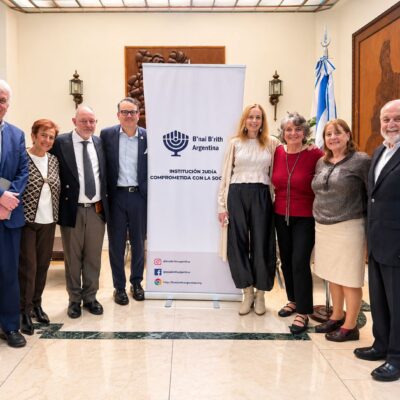
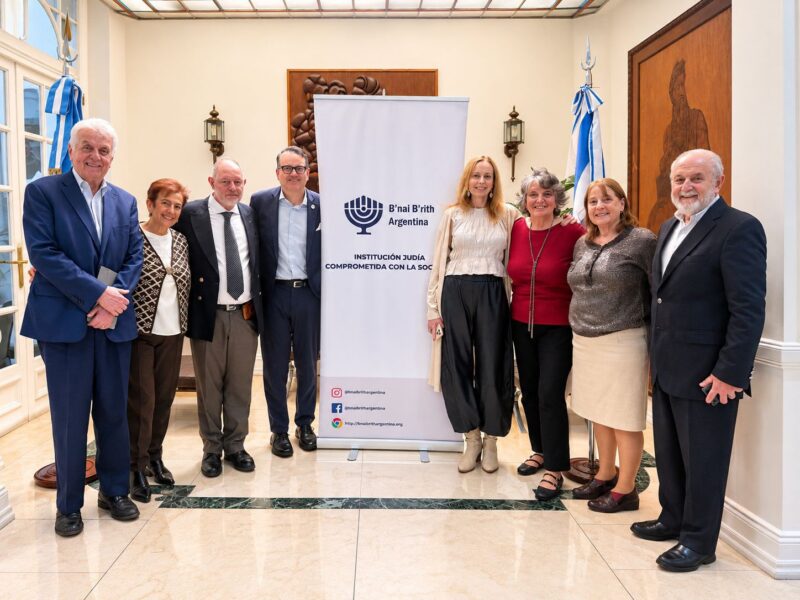
B'nai B'rith International CEO Evan R. Bernstein (4th from left) in October with senior leadership of B'nai B'rith Argentina, who advocate in their local communities and volunteer on health and human service and other programs and projects that impact the Jewish and non-Jewish communities.
Consider Venezuela, where the Jewish population has fallen from roughly 25,000 in the 1990s to between 4,000 and 6,000 today amid prolonged political and economic crisis. Those who remain form a tightly knit community that continues to operate synagogues, schools and mutual aid, yet faces an inverted demographic pyramid dominated by older members and strained resources for youth programming and institutional upkeep. In the Czech Republic, a historic community rebuilding after decades of communist suppression, now confronts both demographic shrinkage and a sharp rise in antisemitic incidents — record levels in 2024, including vandalism and physical attacks linked to the post-Oct. 7 climate — while young leaders work to maintain a visible Jewish presence in Prague and beyond with limited local capacity.
In smaller communities across Central and Eastern Europe and in Australia, similar patterns hold. Post-Oct. 7 antisemitism and violent attacks on the Jewish community and its institutions have driven up security costs, which weigh more heavily where the donor pool is modest. Volunteer leaders must balance basic protection with the materials, training and youth activities needed to keep Jewish life continuous.
The needs are concrete: curriculum materials and training that help volunteers run educational programs, support for youth activities that keep teenagers connected and resources that allow local institutions to remain open. These communities cannot generate the philanthropic support available to American or Israeli institutions. Yet they remain viable. Small does not mean destined for decline. Many have multigenerational roots and committed local leadership that keep Jewish life present even as resources stay thin.
This is the work at the heart of B’nai B’rith’s mission and the strategic pivot we are making. B’nai B’rith International strengthens Jewish communities by connecting, equipping and mobilizing the people at their heart: local members, volunteers, leaders and supporters who know their neighborhoods, understand their communities’ needs and have the relationships to turn shared purpose into meaningful action. Our network across more than 40 countries is the source of our strength and impact. As we move forward, a core goal is to foster meaningful connections among our volunteers globally so they can share best practices — particularly so that smaller communities do not feel isolated. Our opportunity is to connect international expertise, trusted relationships and philanthropic investment with local leadership so that volunteers who already sustain Jewish life on the ground can give their efforts greater reach.
By providing training, materials and practical resources, we amplify what local leaders are already doing. Capacity building at this level determines whether Jewish continuity is maintained or gradually eroded.
Treating philanthropy as a choice between American and Israeli needs on one side and everyone else on the other underestimates their shared reality. Smaller communities face the same requirements for viable Jewish life; they simply do so with smaller donor bases more easily strained by mandatory costs. Strengthening them does not require reducing support for larger centers. It requires recognizing that sustainability outside the United States and Israel depends on external resources reaching local volunteers and institutions. A trained volunteer or modest investment in a small European or Latin American community can sustain programs that reach dozens of families for years, preserving a Jewish presence that would otherwise diminish.
Local communities are working to preserve Jewish education, engagement and institutional presence with limited local philanthropy. Supporting them through training and resources that equip volunteers and local leaders is part of ensuring that Jewish continuity is not confined to the places with the largest donor bases. Domestic and Israeli priorities remain essential. So does the work of making Jewish life viable in the many smaller communities that share the same aspirations and pressures. B’nai B’rith’s pivot is to make that work more systematic with our network of communities globally: connecting resources and volunteers to one another so that no community volunteer group, however small, has to sustain Jewish life in isolation.
Evan R. Bernstein is the CEO of B’nai B’rith International.