SACKS CONVERSATION
‘Clowns to the left of me, jokers to the right’: At Bar-Ilan, Lipstadt takes aim at antisemitism on all sides
Receiving award in memory of former British Chief Rabbi Jonathan Sacks, the former U.S. special envoy accuses JD Vance of making Jewish life ‘toxic,’ laments State Dept. officials who pushed Biden to scale back support for Israel post-Oct. 7
Bruno Sharvit
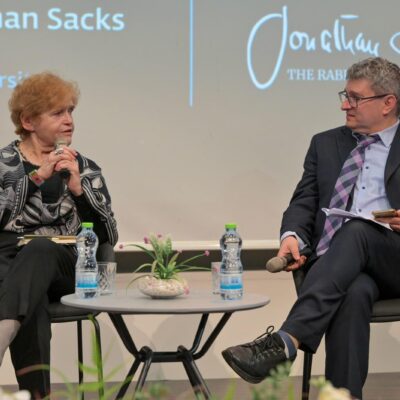
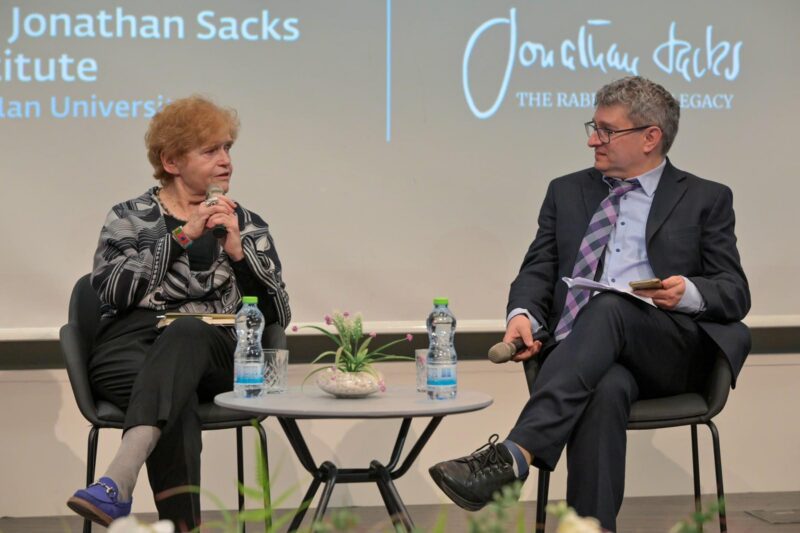
Ambassador Deborah Lipstadt, former special envoy for monitoring and combating antisemitism, speaks with professor Jonathan Rynhold, academic director of the Sacks Institute, at Bar-Ilan University outside Tel Aviv on Nov. 9, 2026.


 Add EJP on Google
RAMAT GAN — Ambassador Deborah Lipstadt, a former U.S. antisemitism envoy, offered a new geometry for thinking about the rise of Jew hatred around the world in recent years. Instead of the the “horseshoe theory” that she once espoused — of the far left and far right almost meeting over shared antisemitism — she now prefers a Venn diagram, connecting the three main groups that both hate Jews and desire to overthrow their respective societies: the far left, the far right and radical Islamists.
Speaking at Bar-Ilan University outside Tel Aviv on Monday night, she was presented the Jonathan Sacks Institute Prize for Outstanding Achievement as a Public Intellectual in Memory of Samuel Gewurz, Lipstadt said she moved away from the “horseshoe theory” because a horse-riding friend noted that “the two ends of the horseshoe don’t meet, and here we’re talking about something that does.” She also realized that radical Islamists, who do not easily sit in either the far-left or far-right camps, were not part of that theory.
“So now I talk about a Venn diagram, where [there] is overlap in the middle for leftist antisemitism, right-wing nationalist antisemitism, and of course Islamist antisemitism,” she said. “The place where they overlap — antisemitism — is the ideological glue. There’s also a structural element or a functional element in that overlap, and that’s regime change. All three of these sources want to overthrow existing regimes, particularly existing democratic regimes.”
Lipstadt said that this latter aspect also helps make it clear why countering antisemitism should be a priority not only for Jews but for society at large, pointing to the unrest in France, which has long struggled to constrain antisemitism, as an example of how things develop. “Antisemitism is the harbinger, the point of the spear, telling you that more bad stuff is coming,” she said.
Though she held the official title of “special envoy for monitoring and combating antisemitism,” Lipstadt also said that she has personally shed the notion of “combating antisemitism,” as this indicates that you can beat it, when she believes that it can only be “countered” or mitigated. The goal, she said, is not to criminalize antisemitism, but to “create a public attitude, a widespread public attitude that it is unacceptable.”
How to go about accomplishing this is much less clear. “If I had the easy answer to that, I would spread it around, happily share it, and we could go on to other things,” she said. “But I think it’s something that must be fought and must be exposed as this massive lie.”
In her more than hour-long onstage interview with Israeli political scientist Jonathan Rynhold, director of the Sacks Institute, as part of the annual Sacks Conversation, Lipstadt said she was an “equal-opportunity” opponent of antisemitism, comfortable calling out people on the left and the right — including Vice President JD Vance, whom she accused of being part of a broader effort to “make Jewish life toxic.”
Discussing the recent antisemitic bicycle ride in Philadelphia targeting Jewish-owned businesses, Lipstadt noted that while the antisemitic protest was an immediate failure in the sense that it ended up bringing more businesses to the restaurants that were targeted as the local Jewish community and area politicians rallied behind them, it may ultimately prove successful.
“Governor Josh Shapiro called it out, and the mayor of Philadelphia called it out, the attorney general called it out. And what happened was thousands of people descended on these restaurants. One of the restaurants had to stop doing takeout — it just couldn’t handle the orders. They were getting takeout orders from Australia. I don’t know how well mac and cheese travels, but I don’t think it would be very good by the time it got to Australia. So in that sense it was a victory,” she said.
“But I’ll tell you, next week when a family is saying, ‘Let’s go have dinner, maybe at one of these restaurants.’ [The parents may instead think,] “‘We’re taking the kids. You know what? We’ll get takeout [instead],’” she said.
“And this toxification of Jewish life… it’s because of a very small group of people but very farbrente [fiery] on the progressive left and not only on the progressive left: Tucker Carlson, Candace Owens,” she said, thinking for a moment before adding, “the vice president of the United States and others who are leaning in that direction too. I call it the toxification of Jewish life, making Jewish life toxic, making you think twice.”
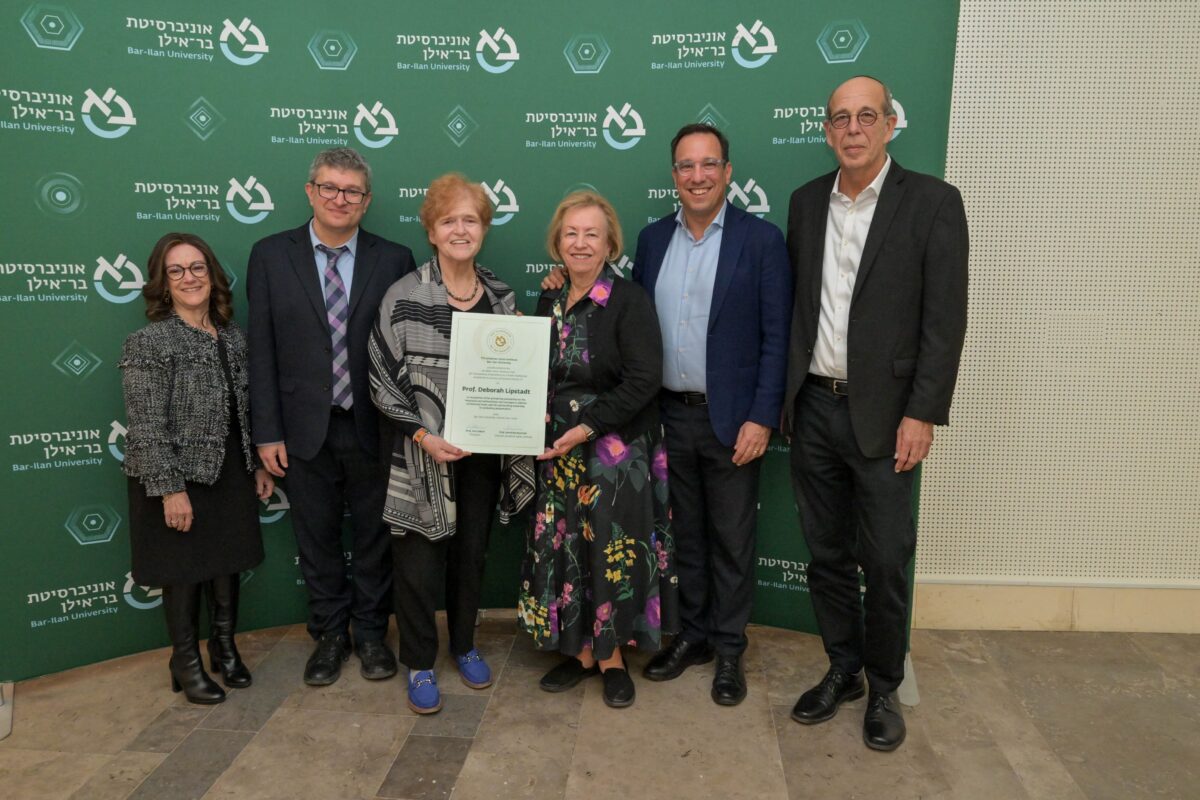
Speaking to an audience made up primarily of older, English-speaking, well-educated religious Jews, Lipstadt was firmly in her element, peppering her extemporaneous remarks with Yiddish phrases and American-accented Hebrew. The Sacks Institute Prize, named for the former British chief rabbi, was presented to Lipstadt in recognition of her years of work countering Holocaust denial and antisemitism, both as an academic and as a diplomat, according to the award’s funders, Brenda and Zev Gewurz, respectively the widow and son of Sam Gewurz.
The event also highlighted the connection between the former chief rabbi and the university, which presented honorary degrees to both Lipstadt and Sacks, who also served on its board of trustees, Bar-Ilan University President Arie Zaban told eJewishPhilanthropy on the sidelines of the event, calling it “organic.”
To highlight her concerns about both sides of the political aisle, Lipstadt’s regular refrain throughout the evening was the chorus of the Stealers Wheel hit, “Stuck in the middle with you”: “Clowns to the left of me. Jokers to the right.”
Lipstadt also spared no criticism for Israeli far-right politicians, whom she accused of not causing antisemitism but of providing a “gift” to antisemites by failing to prevent and unequivocally condemn violence by Israeli extremists against Palestinians in the West Bank.
“Antisemitism is irrational. It is a prejudice. … So I don’t want to say [their rhetoric and policies] cause it. But it is a gift to the antisemites of unbelievable proportions. If they had wanted to create someone who would prove they were right in their hatred of Jews and the Jewish faith, they couldn’t have asked for better,” she said.
Lipstadt said that it should be enough for Israel to intervene as these kinds of attacks are “antithetical to our Jewish moral soul,” but she added that they are also causing immense harm to the country internationally.
“The stain it has put on Israel’s reputation is immense because it is such a useful tool to the haters. And you know, it’s one thing to be attacked, but [it’s another] to give your enemy the ammunition to attack you and to bring you down in your status and your reputation,” she said, adding wryly: “But I don’t feel strongly about it.”
Lipstadt said that she was in the final stages of a book about her time in the Biden administration. “No one will like me when the book comes out. So if you’re inclined, I’ll need every friend I can get,” she said, drawing laughs from the crowd.
Reflecting on her time in office in the wake of the Oct. 7 terror attack, Lipstadt said that President Joe Biden was initially so clear and passionate about standing by Israel in its time of need, but that over time, as the war against Hamas in Gaza slogged on, other voices in the administration began pushing a different tone.
“Presidents do not fly into war zones. He flew into a war zone, and he was unequivocal,” Lipstadt said. “But then certain that happened in Gaza, and there were people in the administration who were pulling in the other direction. … There were people in the State Department, foreign service officers, career people and political [appointees] who were very much opposed, very much opposed [to supporting Israel in the same way].”
She stressed that this was seen predominantly in public statements, not in government action, but the effect within the State Department was troubling for Jewish staffers, particularly low-level ones, who wanted to see more robust support for Israel.
“It wasn’t a pleasant place. For me it was OK because I sort of flew above this kind of thing, but I would be in the elevator, and somebody would just get in, and when they got off, they turned to me, and they’d say, ‘Thank you. You know, I’m Jewish,’” she said.
Lipstadt shared that when she was first approached by Biden for the role, she initially considered turning it down, uncomfortable with the idea that her remarks would need to be vetted by State Department officials who were not experts on antisemitism. “In academia, you want to be right,” she said. “But as a diplomat, you want to be effective.”
Her friend Sarah Bloomfield, the director of the United States Holocaust Memorial Museum, convinced her to pursue the position, arguing that Lipstadt would be able to play a foundational role in addressing antisemitism in Muslim-majority countries because of the Abraham Accords, which had only recently been signed. “She said, ‘Because it’s a chance to do something affirmative. To change the narrative. It’s not going to change overnight,’” Lipstadt recalled. “Because the Gulf states had been so pivotal in sending out imams and in their media, spreading and ginning up antisemitism. And I thought about it, and now that was really appealing to me because I didn’t want to go into a job just to put out fires.”
She said she developed relationships with countries in the Gulf, including Saudi Arabia and the United Arab Emirates. Lipstadt noted that her first foreign visit in office was to Saudi Arabia and that she had ambitious plans to deepen ties with the country, moving from the high-level meetings that she had already had to those closer to the street, as part of a broader effort to advance relations between Israel and the kingdom. But this was all derailed by the Oct. 7 attacks.
“We were really planning. I was working with Princess Reema, the Saudi ambassador to Washington, thinking about how we can move from the level of minister, deputy minister down the levels to media, etc. I was supposed to go back to Saudi [Arabia]. We had a very ambitious program planned for me for Saudi Arabia for November 2023,” she said.
Though she occasionally alluded to the influence of Qatar on rising antisemitism, Lipstadt was hesitant to discuss it deeply.
Specifically asked by Rynhold if the “injection of tens of billions of dollars into higher education in America by Qatar” had prevented other donors from being able to rein in antisemitism, Lipstadt acknowledged that it was an issue but would not comment further.
“I can’t answer that directly,” she said. “But I believe it has had its impact. And it’s something that’s been going on for a long time — quietly building, building certain departments, departments of Middle East studies and things like that. I think eventually it will come back to an equilibrium, but I don’t know if I’ll be around to see it, and I intend to live a long.”
Discussing contemporary antisemitism, Lipstadt said that while she did not believe that the issue was as not yet as bad in the United States as it was in Europe, it has changed in the past few years.
When she was visiting London a few weeks ago with family friends, she took their 14-year-0ld daughter to Harry Potter Studios. And before they left, Lipstadt said that she took off the Star of David necklace that she always wears, worried that it may attract antisemitic remarks — something that she would handle if she were on her own but not when traveling with someone else’s child.
Today, she said, such considerations are becoming the norm. “There’s no grandparents who — as Hanukkah approaches — would like to buy their grandchild a Magen David who would do it without having a conversation with the parents, ‘Is it okay?’” she said.
Lipstadt recalled a British Jewish friend, Adam Boxer, who is a teacher in a non-Jewish school and was telling his students about how British Jews need a volunteer security service to protect synagogues and Jewish day schools from antisemitic attacks. When his nine-year-old daughter, who studies at a Jewish school, heard that, she was confused, not realizing that other schools don’t have security volunteers stationed outside.
“We are raising a generation which thinks this is the normal,” she said. “I live in a fairly suburban area of Atlanta. When parents line up to do carpool, they will have a number and the guard checks them as they go in. If there’s a Jewish event, even away from a synagogue or away from a Jewish institution, you have some form of security. Kids think that it is the new normal And it’s not how anyone should live. So you we’ve got to remind them that it’s not the new normal.”
Related News

EXCLUSIVE
Detroit-based philanthropists Nancy, James Grosfeld donate $8M to renovate JDC’s Israel campus

MAJOR GIFTS
Center for Jewish History celebrates 25 years with a $25M matching grant
ADVANCING A VISION
N.Y. federation donates $1M toward building shared-society center named for peace activist killed on 10/7

MAGICAL EXPERIENCE
Shefa launches psychedelics retreat for Jewish professionals suffering burnout
PRESIDENTIAL REBUKE
Israel’s Herzog: Mamdani ‘makes no effort’ to hide disdain for Israel, Jews must fight back