Phoenix Rises
JFNA General Assembly grapples with antisemitism, 88 years post-Kristallnacht
Antisemitism is not simply an issue for Jews, but a threat to Western society, speakers say
Courtesy/JFNA
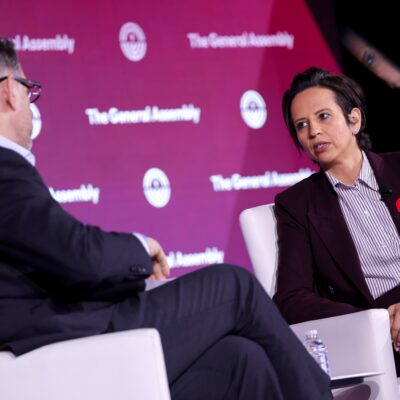
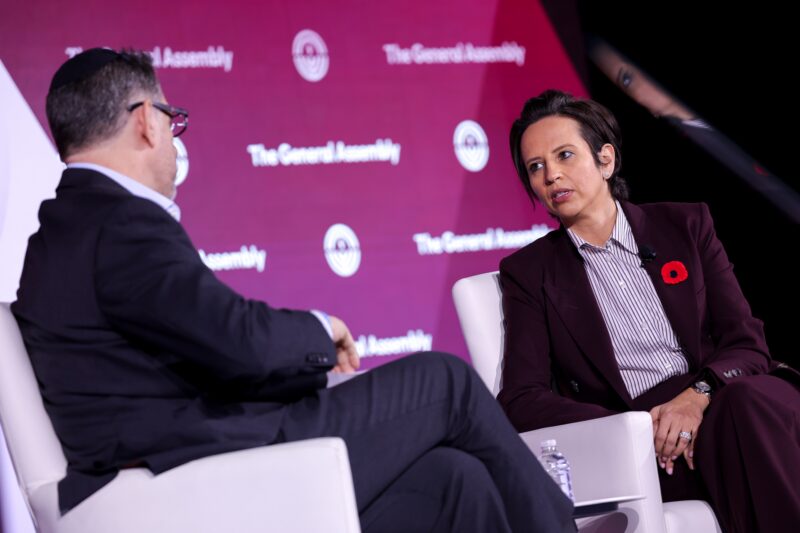
Conservative member of Canadian parliament Melissa Lantsman speaks with Rabbi David Ingber during a plenary session at the JFNA General Assembly in Washington on Nov. 9, 2026.


 Add EJP on Google
WASHINGTON — The second day of this year’s Jewish Federations of North America annual General Assembly fell on the 88th anniversary of Kristallnacht, the Night of Broken Glass, when Nazis ransacked and set fire to thousands of Jewish businesses and synagogues, murdering 91 Jews and shipping 300,000 Jews to concentration camps. The topic of antisemitism was in the air.
“We have wrestled through the darkness; we have borne terrible wounds, and we have endured,” Rabbi David Ingber, the founding rabbi of Romemu in Manhattan and the GA’s scholar-in-residence, said at Monday’s plenary. “But we’ve also learned that there’s a time to sound the alarm, a time to wake the sleeping, a time to stand guard at the door. Friends, we can’t wait for the glass to break again. We can’t wait until danger becomes undeniable. We can’t wait for someone else to sound the alarm for us.”
Held in Washington midway through the three-day conference, the plenary featured Jewish Conservative Party member of the Canadian Parliament Melissa Lantsman and author Douglas Murray. They warned the nearly 2,500 attendees who came from across North America and Israel that today’s antisemitism is not just an issue for Jews, but a threat to all of Western society.
“I used to think that my job was to convince Canada to protect its Jews, and now I think the job is very different,” Lantsman, the member of parliament from Thornhill who serves as the deputy leader of the Conservative Party, said. “And you can insert any other country in the West here for Canada. I think it’s my job to convince Canada to protect itself.”
Lantsman’s family immigrated to Canada from the former Soviet Union. The country allowed her family to go “in one generation … from the front seat of a taxi to the front row of Parliament Hill,” she said. “That’s the beauty of Canada. It’s the beauty of Western democracy, and it cannot happen anywhere else.”
Antisemitism is a threat to the Western values that allowed her family to flourish, she said. It’s a threat to freedom of speech, freedom of religion and freedom of conscience. To combat this hatred, she said, regular people need to stand up and not discuss it as a Jewish issue, but as a “deep sickness in our society.”
“The Jews are just the scapegoat in this,” Lantsman said. “They are, if you will, the canary in the coal mine. But it’s not the canary that you should be paying attention to; it’s the miners who should be paying attention to their lungs. We’ve stopped fighting for Western values. It is our indifference that I think brought us here … the fight against antisemitism has been lost, but the fight for the West is still very much on the table.”
When attempting to debate others on antisemitic tropes, Murray, who isn’t Jewish and whose latest book is titled On Democracies and Death Cults: Israel and the Future of Civilization, said: “A lot of us make a mistake in thinking that we are going to come up with the perfect argument. There seems to me to be something very Jewish in that.”
But when debating someone, when combating claims that Israel committed genocide, Murray said, “Sometimes you also just have to say the very obvious, and the very obvious in front of us now is what is said least often.”
The obvious, he said, is asking people why the discussion is being held in the first place. When someone is campaigning in Michigan based around Gaza, “We have to ask why [has] part of the left become a kind of fetishistic movement about the Palestinian cause, and why [has] part of the right in America decided that everything must be put on the Jews again?”
The foundation of the West, its values and beliefs, Murray said, are rooted in Jewish tradition and the Jewish People, and today’s antisemitism is about destroying “a building at its foundation.”
Even as antisemitism has turned more violent post-Oct. 7, Murray warned, “Let’s not fall into the trap of thinking that history is an endless repeat of the 1930s… In a way, it’s useful for us to have these early warning systems, and we should also remember that it’s not always going to be like that if we play it right.”
Monday’s plenary also featured actor Selma Blair, who shared her feeling that she has been exiled from Hollywood because of antisemitism, after she was accused of making an Islamophobic comment on Instagram in February 2024.
But her onstage interview was also held under a cloud of questions — which she acknowledged — over whether she should have been given a platform at the GA, both due to her past controversy and after an incident last month where she allegedly assaulted flight attendants, a police officer and a nurse.
During her appearance, Blair thanked the audience for “showing up here today, even though you can add some chaos and headlines to my resume. It’s awkward. It’s terrible because, like any good yente, I want to tell you everything that happened from my perspective, but it is not my time to do that.”
Blair’s February 2024 comment — “Deport all these terrorist supporting goons” — was the actor’s response to U.S. Rep. Rashida Tlaib (D-MI) and former Rep. Cori Bush (D-MO) voting against a measure that would stop anyone involved in the Oct. 7 massacres from immigrating to the U.S. “Islam has destroyed Muslim countries and then they come here and destroy minds. They know they are liars. Twisted justifications. May they meet their fate,” Blair wrote.
Blair used the plenary to discuss the past post, which moderator Julie Platt, JFNA’s immediate past board chair, described as “a post that had to do with radical Islam.”
“I responded on an Iranian American friend’s page with some emotion against the extremism, against terrorism, and it was misconstrued,” Blair said. “I clarified later, but it was misconstrued, and I was canceled very heavily in my internal circle.”
In Monday’s plenary, Blair also made additional remarks about Islam in general, including that her son goes to school “where he hears Allahu Akbar [God is great] often… and I think it’s sad.”
Blair also shared about growing up in Detroit, where she attended Hillel Day School, which “was a safe environment for me growing up, safe environment to explore the trials of Jews and history’s reaction to it and also the love of having a home and a school and a safe place always for the holidays.”
She realized just how important her experience in Jewish elementary school was after she graduated and entered a private boarding school, which “was very WASPy and so really fulfilled all my Ralph Lauren dreams of the American landscape,” she said, even though she was often told at the school, “You don’t look like a Jew. You’re cute.”
Jewish day school, she said, was a respite for her. “It’s one-stop shopping” for Jewish families, she said, offering learning and community.
Blair ended the discussion by saying, “I know as a people we are not perfect, but I know as a people we do our best, and I’m more proud than ever to be a humble, humble Jewish woman and I pray we’re all here for each other.”
For Ingber, he wanted his teachings at the conference to grapple with the antisemitism of today, while recognizing Oct. 7, one of the darkest days in Jewish history. But he also wanted to celebrate the Jewish people’s history of resiliency, he told eJewishPhilanthropy.
His message to attendees: “You can’t build a Jewish future solely focusing on the reality of antisemitism and anti-Judaism and anti-Israelism. We have to do both, underscore at this moment the precarious quality in various communities of Jewish life, while also advocating for strengthening Jewish vitality. We have to focus on Jewish survival and focus on Jewish thriving… We need both.”
Ingber’s job during the weekend was not to debate government or nonprofit policy, he said. “My job is to actually read our texts and read our spiritual resources to meet this moment.” Jews know how to be resilient, he said, borrowing a quote from Rabbi David Wolpe: “The Jewish people are a phoenix amongst arsonists.”
He invoked the image of the shofar. “The quintessential Jewish instrument, and it’s, of course, a desiccated dead bone that we blow into and we breathe life into it. And in many ways, we are the world’s longest story, and we are the world’s most resilient civilization.”
Related News
CLOSING WORDS
In AZM address, Cosgrove links communal ‘orthodoxy’ on Israel to rising anti-Zionism among young Jews
EXCLUSIVE
Detroit-based philanthropists Nancy, James Grosfeld donate $8M to renovate JDC’s Israel campus

MAJOR GIFTS
Center for Jewish History celebrates 25 years with a $25M matching grant
ADVANCING A VISION
N.Y. federation donates $1M toward building shared-society center named for peace activist killed on 10/7
PRESIDENTIAL REBUKE
Israel’s Herzog: Mamdani ‘makes no effort’ to hide disdain for Israel, Jews must fight back