2 JEWS, 3 OPINIONS
Dueling commentators square off on midterms’ consequences for U.S. Jews, ties with Israel
David Axelrod, former senior advisor to Obama, and Eliana Johnson, editor-in-chief of the 'Washington Free Beacon,' open final morning plenary of JFNA General Assembly

Courtesy/JFNA
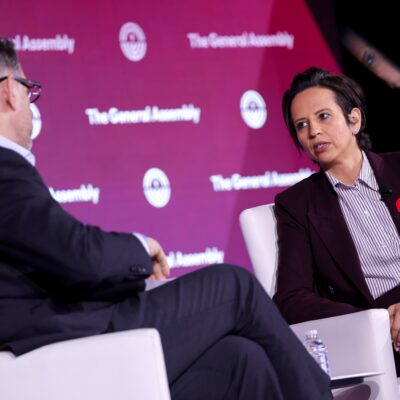
David Axelrod speaks alongside Eliana Johnson and Eric Fingerhut during Closing Plenary


 Add EJP on Google
With last week’s midterm elections still reverberating, Jewish Federations of North America pit two commentators with largely opposing political views against one another to discuss the impact that the Democrats’ victories across the country are liable to have on the Jewish community.
At Tuesday’s opening plenary, David Axelrod, chief political analyst at CNN and a former senior advisor to then-President Barack Obama, and Eliana Johnson, editor-in-chief of the right-leaning Washington Free Beacon, considered the election of several far-left candidates, the potential deterioration of the American-Israeli relationship and threat of antisemitism on both sides of the political aisle.
“This was such a rebuke, and a lot of it was around the economy,” Axelrod said at the event.
Acknowledging that although many in the room were worried about the many members of the Democratic Socialists of America who will take office in the next Congress, Axelrod said he’s anyway bullish about the future of the Democratic Party. “There’s a new generation of leadership that was thrust forward here that is exciting for the Democratic Party and the country,” he said, downplaying the DSA candidates antagonistic views on Israel and Zionism.
“Whatever their views on Israel, they did not run on those issues,” Axelrod said. “They ran on issues that were much closer to home, and in [New York City Mayor Zohran] Mamdani’s case, he was the first guy to start trumpeting the issue of affordability that became a dominant issue in this midterm cycle. So it would be wrong to say they ran on an anti-Israel platform, and that’s how they got elected. They ran around their views on Israel, and they got elected.”
Johnson suggested that Axelrod was playing down fears about the DSA. She countered that those concerns are well-founded.
“You’re right that Mamdani ran on affordability,” Johnson said.
“But then in office he turned around and he used his political power to help get elected these three new DSA members [from New York] in Congress — Brad Lander, Darializa Avila Chevalier and Claire Valdez,” she said. (Lander is not, in fact, a DSA member but is considered DSA-adjacent.)
“I would not say that they really ran on affordability… In fact, from my vantage point, which is obviously not as close as yours, the ticket to entry to the DSA and to left-wing progressive policy picks appears to be a loathing of the State of Israel,” Johnson said.
While Republicans have one representative who loathes Israel, Johnson said, apparently referring to Rep. Thomas Massie (R-KY), Democrats now had six or seven. “That’s too many, even if they’re not a majority.”
Most Democrats are not far left, Axelrod said. They believe in strong borders and police and enjoy celebrating Thanksgiving. “On economic issues, there is a sense that the system is rigged against working people and that on issues like healthcare there’s a real hunger for something better, something different, and I think that unifies Democrats across the country.”
America has an antisemitism problem, and it’s across both parties, Axelrod said, adding,“If you assume that it’s a Democratic Party problem, you’re kind of missing the scope of it, and the merging of anti-Zionism and anti-Semitism is deeply, deeply troubling to me.”
Johnson took note of some of the losses on the Republican side in the midterms. “There are several [pro-Israel] stalwarts who went down in this election,” she said. “I would point to Dan Sullivan, who looks like he’s going to lose in Alaska. It’s a shame that Mike Rogers lost in Michigan. There are people all over the map [who were defeated]. The House Republican Conference is basically liquidated, so there are lots and lots of people who were stalwarts of Jewish people and the State of Israel and the United States of America who went down in the election.”
During the exchange between Johnson and Axelrod, there seemed to be, perhaps expectedly, a partisan divide within the audience. Some members would clap for one speaker, while their neighbors sat watching with mouths agape.
After the midterms, Vice President JD Vance tweeted that the issues standing in the way of winning voters back to the Republican Party were the war with Iran, inflation, putting America first and changing America’s relationship to Israel.
“In the Republican Party, there’s always been a struggle between isolationists and internationalists, and the isolationist right has always been deeply suspicious of foreign entanglement and particularly of the deep U.S. relationship to Israel,” Johnson said.
Those isolationist arguments have been elevated by podcasters who intertwine their views with antisemitic conspiracy theories about Jews and Jewish influence, Johnson said. “The people who become president are generally the people who keep the most people under a single tent. Short term, my own guess is the Republican Party remains pro-Israel, but longer term, I do have real concerns.”
The big question people need to ask is, Johnson said, “Are these young people just young and stupid and they’re going to grow up and grow out of their views? Or is this really something new where the anti-Israel, anti-American views we see reflected among young people in both parties are going to stay with them through their lives, and in doing so, change the nature of the Republican Party?”
Axelrod believes that American leaders have a responsibility to grapple with Israel’s actions the past several years, including America’s role in them through military and diplomatic support. “What happened on Oct. 7 was one of the most disgusting, barbaric acts in history,” he said. “And Israel certainly had a right to defend itself. How it did it, I think, is a fair discussion to have.” If politicians are not willing to have these discussions, they may lose young voters.
“It’s worth making the practical case for Israel as opposed to the moral case,” Johnson said. “Which is that [if] we don’t want to go fight wars in the Middle East, put American soldiers in the Middle East, it makes sense to have close alliance with the leading military power, the leading technological power out there.”
Related News
CLOSING WORDS
In AZM address, Cosgrove links communal ‘orthodoxy’ on Israel to rising anti-Zionism among young Jews
HIGHER EDUCATION
As Jewish donors reconsider academia, Jan Koum doubles down, endowing Israel studies at Stanford

ADVANCING A VISION
N.Y. federation donates $1M toward building shared-society center named for peace activist killed on 10/7

EXIT INTERVIEW
Elizabeth Sokolsky, longtime EVP of Birthright Israel, to retire next year

MAJOR GIFTS
Center for Jewish History celebrates 25 years with a $25M matching grant